Introduction
Interviews today go far beyond checking qualifications or technical knowledge. Employers want to understand how candidates think when faced with uncertainty, pressure, or unfamiliar problems. They are interested in your reasoning process, not just your final answer. This is where problem-solving frameworks become extremely valuable. A framework gives structure to your thoughts and allows interviewers to see your approach clearly.
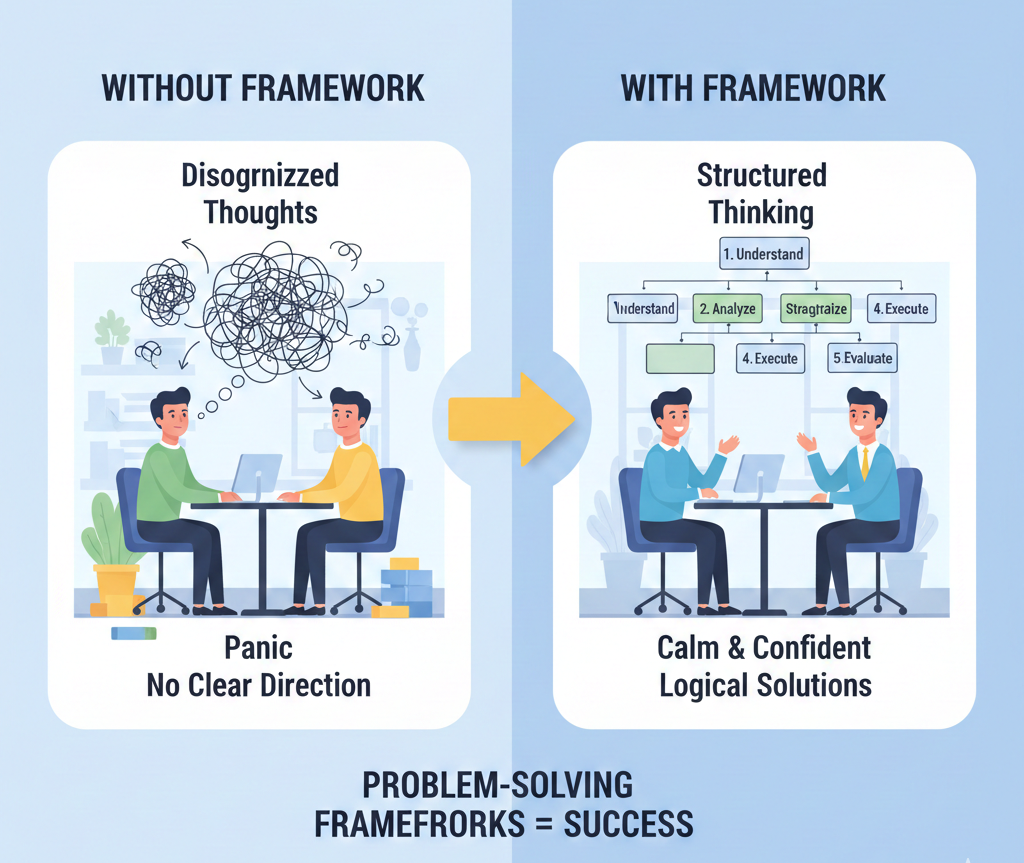
When candidates use problem-solving frameworks, they demonstrate calmness, clarity, and logical thinking. Instead of reacting impulsively, they break problems into manageable parts. This structured approach reassures interviewers that the candidate can handle real workplace challenges. In competitive interviews, this ability often becomes a deciding factor.
Interviews are designed to evaluate thinking ability
Many candidates prepare interviews by memorizing answers. However, interviewers are rarely impressed by rehearsed responses. They want to observe how you process information and make decisions. This is especially true for behavioral, situational, and case-based interviews.
Problem-solving frameworks help candidates organize their thoughts under pressure. Even when the question feels complex, a framework provides direction. You can pause, analyze the situation, and respond logically. This signals maturity and professionalism. Interviewers value candidates who can think clearly rather than rush to impress.
Structured answers create clarity and confidence
Unstructured answers often confuse interviewers. Candidates may jump between ideas, miss important points, or overexplain irrelevant details. As a result, even strong experience can appear weak. Problem-solving frameworks solve this issue by bringing order to responses.
When you follow a structured approach, your answers flow naturally. You introduce the problem, explain your approach, and conclude with outcomes or insights. This clarity builds interviewer confidence. They can easily follow your reasoning and assess your suitability for the role. Clear structure also reflects strong communication skills, which employers value highly.
Frameworks reduce interview stress and nervousness
Interview stress usually comes from uncertainty. Candidates fear not knowing what to say or how to start an answer. Problem-solving frameworks reduce this fear by giving you a mental roadmap. You always know the next step.
This sense of control lowers anxiety. Instead of panicking, you focus on applying the framework. As a result, your tone becomes calmer and more confident. Interviewers notice this composure. Calm candidates appear more capable, even when discussing challenging scenarios.
Interviewers trust logical decision-makers
Most job roles require daily decision-making. Employers want candidates who can evaluate options, consider risks, and justify choices logically. Problem-solving frameworks allow you to demonstrate exactly that.
When you explain your reasoning step by step, interviewers see transparency in your decision-making. They understand why you chose a particular solution. This builds trust. Employers prefer candidates whose decisions are thoughtful rather than impulsive. Framework-based answers mirror real workplace thinking, making you appear job-ready.
Behavioral questions become easier with frameworks
Behavioral interview questions often overwhelm candidates. Questions like “Tell me about a time you faced a challenge” can lead to long, unfocused stories. Without structure, candidates may forget key details or fail to highlight impact.
Problem-solving frameworks help organize these stories. They guide you to explain context, actions, and results clearly. This ensures your contribution stands out. Interviewers can quickly identify your role, skills, and achievements. Structured storytelling improves recall and leaves a strong impression.
Frameworks signal professionalism and preparedness
Using problem-solving frameworks shows that you understand professional expectations. It signals preparation and seriousness about the role. Interviewers associate structured thinking with high performers and future leaders.
Candidates who use frameworks appear self-aware and disciplined. They show that they can approach problems methodically rather than emotionally. This perception increases hiring confidence. Employers believe such candidates will require less supervision and adapt faster to workplace demands.
Frameworks strengthen both technical and non-technical interviews
Problem-solving frameworks are not limited to technical roles. They benefit candidates across all industries. In technical interviews, frameworks help explain logic, algorithms, or design decisions clearly. In non-technical interviews, they help prioritize ideas and explain reasoning.
This flexibility makes frameworks universally useful. Whether you are interviewing for marketing, operations, management, or technology roles, structured thinking improves answer quality. Interviewers appreciate candidates who communicate complex ideas simply and logically.
Poor structure weakens strong candidates
Many capable candidates fail interviews due to poor answer structure. They may have excellent experience but struggle to explain it effectively. Interviewers may feel confused or unconvinced.
Frameworks prevent this problem. They keep answers focused and purposeful. Instead of overwhelming the interviewer, you guide them through your thinking. This clarity allows your skills to shine. Structured answers protect strong candidates from being misunderstood.
Frameworks help you stand out in competitive interviews
When multiple candidates have similar qualifications, interview performance becomes critical. Problem-solving frameworks help differentiate you from others. They highlight how you think, not just what you know.
Interviewers remember candidates who explain problems clearly and logically. This memorability matters during final selection discussions. Framework-based answers leave a stronger, more professional impression than unstructured responses.
Consistent performance across interview rounds
Some candidates perform well in one round and poorly in another. This inconsistency often comes from lack of a repeatable approach. Problem-solving frameworks provide consistency.
With a framework, you approach every question methodically. This improves reliability across interview stages. Interviewers value consistency because it reflects dependable performance at work.
Long-term value beyond interviews
The benefits of problem-solving frameworks extend beyond interviews. Structured thinking improves workplace performance, communication, and leadership ability. Professionals who think systematically solve problems faster and earn trust.
Interviewers often hire with long-term potential in mind. When you demonstrate structured thinking, you signal future leadership capability. This makes frameworks valuable throughout your career, not just during interviews.
Conclusion
Problem-solving frameworks help in interviews because they reveal how you think under pressure. They bring clarity, reduce stress, and improve communication. Interviewers trust candidates who approach challenges logically and calmly.
By using frameworks, you show professionalism, preparedness, and job readiness. You stand out in competitive interviews and prepare yourself for real-world problem-solving. To apply these skills where they matter most, explore opportunities that value structured thinking using the best job tool.
Find Your Dream Job Today – Explore Endless Career Opportunities and Secure Your Next Role with Best Job Tool.




Leave a Reply