What Are Story-Based Answers?
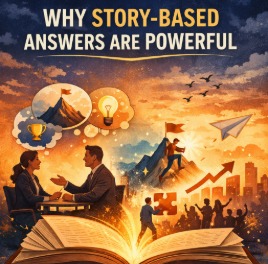
Storytelling means presenting your professional experience, achievements, and learnings in a narrative way, which can engage recruiters and make you memorable. A good story can change your resume or answers from a boring to a memorable and impactful.
In today’s competitive job market, only telling about skills and qualifications is not enough. Employers need candidates who can communicate their experience effectively and can present their journey in an interesting way. That is the reason why storytelling is important in applications.
Why Story-Based Answers Are Powerful?
1. Story-Based Answers are Easy to Remember
Most answers look the same, which makes them difficult for recruiters to remember. However, when your answer tells strong stories—highlighting a specific challenge, a unique solution, or an impactful result—it sets you apart from hundreds of candidates.
2. Story-Based Answers Create Emotional Connection
The role of a answer is not only to show logic; it should also create an emotional connection. Numbers, results, and metrics appeal to logic, while challenges, efforts, and growth engage emotions. Storytelling balances both. When you explain how you handled a problem, motivated a team, or performed under pressure, recruiters can feel your dedication and commitment.
3. Storytelling Showcases Skills in Context
It is difficult to prove soft skills like communication, teamwork, leadership, and adaptability directly on an application. Here, storytelling becomes very powerful. When you describe situations involving team collaboration, client handling, or conflict resolution, your soft skills reflect naturally. Recruiters do not have to guess what type of person you are—your story tells them everything.
4. Humans Remember Stories Better Than Facts
The human brain can remember stories more easily than facts. When answer contains only generic statements like “responsible for team management” or “worked on multiple projects,” these lines do not stay in the recruiter’s mind for long.
However, when you present your achievements in a short storytelling format—explaining the situation, the action you took, and the result you achieved—it creates a clear picture for the recruiter. Through storytelling, recruiters can imagine your work, which is why you ranswer becomes more memorable than others.
5. Story-Based Answers Show Growth and Learning
A storytelling not only tells where you worked; it also shows how you grew. When you present your roles in a flow—starting with challenges, moving to new responsibilities, and showing increasing impact—it becomes easy to understand your career journey. It works like a record of how you learned over time, how you adapted, and how you delivered better results. Stories of career progression give recruiters confidence that you can also grow in the future.
Tips for Crafting Your Stories
1. Use the STAR Method (Situation, Task, Action, Result)
The STAR method is one of the most effective frameworks for your answers storytelling. First, you describe the situation, explaining the context or problem you worked on. Then, you explain the task, which outlines your responsibility. After that comes the action, where you describe the steps you took to solve the problem. Finally, you present the result, showing the outcome or impact you created.
Through this method, you can easily present your achievements as stories in a way that recruiters can clearly understand what you faced, what you did, and what you achieved.
2. Quantify Impact: Numbers Make the Story Credible
A story becomes stronger when it includes numbers. Simply saying that you improved performance sounds weak, but when you write “improved performance by 30%,” the story instantly becomes more believable. Numbers give clear proof to recruiters that your work created measurable impact. When you quantify sales growth, engagement increase, or time and cost savings, your story looks professional and result-oriented.
4. Be Concise but Vivid
An answer is not a novel, which is why storytelling should be concise. Concise does not mean boring. You can still create a strong narrative with short lines if you choose the right words. With clear action verbs, specific examples, and impactful results, you can tell a complete story in just a few lines.
3. Show Transformation
Good storytelling is not limited to describing work; it also shows change. It is very important to highlight what the situation was before your contribution and what improved after your work. Whether a process was streamlined, productivity increased, or a new idea was implemented, this transformation shows recruiters that you create value. It presents you as a contributor and an innovator.
For more information about storytelling, you can read blog on “Why storytelling makes your resume powerful”.
Conclusion
Story-based answers are powerful because they go beyond simple words and facts. They create emotional connection, build trust, and help people understand your experiences in a meaningful way. Stories make your answers more memorable, authentic, and engaging, whether you are in an interview, writing content, or communicating professionally.
By sharing real situations, actions, and outcomes, you show not just what you know, but who you are. Developing the habit of giving story-based answers can improve your communication skills, boost confidence, and help you leave a strong and lasting impression.
You can read more such blogs here.




Leave a Reply