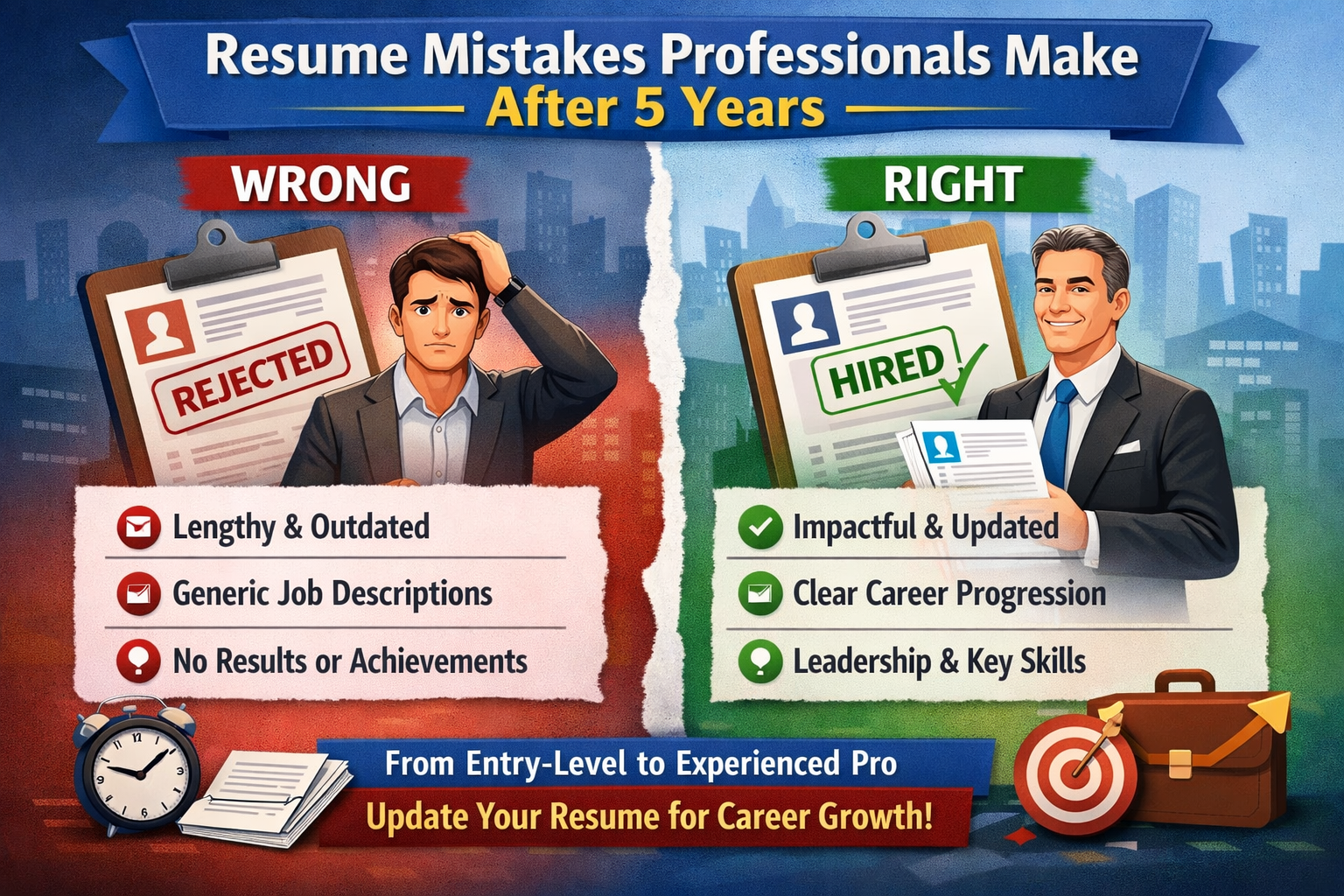
Introduction: Resume Mistakes Professionals Make After 5 Years
A resume is not just a document; it is our first step toward getting a job. A recruiter looks at our resume first, and we need to make it strong and impressive so that the recruiter can understand our personality and skills and feel motivated to hire us. But if our resume is not prepared properly, our very first step becomes wrong, and we get rejected at the initial stage, no matter how many skills we have. That is why we should focus the most on our resume and try to avoid all the mistakes.
In this article, we will discuss and understand the mistakes that should not be included in a resume, whether you are a fresher or a professional. Some tips are shared in this article, and by using them, you can build a better resume and avoid common resume mistakes.
Resume Mistakes Professionals Make After 5 Years
1. Treating the Resume Like an Entry-Level Resume
Many professionals continue using the same resume format they used for their first job. Using a generic resume for every job is a big mistake because every role has different requirements. If we send the same outdated resume to every job, the chances of rejection become very high. Recruiters feel that the candidate is not genuinely interested in the job or the company and is just looking for any job.
A generic or entry-level resume usually lists many responsibilities but does not show specific results or outcomes. It does not highlight leadership or ownership, and it fails to reflect career growth or professional maturity.
If you are a professional, you should customize your resume for each role. You should include your responsibilities along with measurable results and show qualities like leadership and ownership.
2. Listing Responsibilities Instead of Impact
If someone is a professional with five years of experience, recruiters expect results, not just a list of tasks. In five years, a professional learns many things, makes mistakes, and understands what brings profit or loss to a company. Recruiters want to know all of this.
If you share a resume that only lists tasks without outcomes, for example, “handled reports,” there is a high chance of rejection. But if you write something like “reduced reporting time by 30%,” your chances of getting hired increase.
That is why it is very important to include numbers, metrics, and business impact in your resume.
3. Not Showing Career Growth Clearly
Professionals often forget to show career progression. Many professionals repeat the same job title on their resume without any explanation and do not mention promotions, role expansion, or increased responsibilities.
This is a mistake because it reduces your chances of getting hired. If you want to avoid this mistake after five years of experience, explain each job title clearly and highlight your career growth, such as promotions, expanded roles, and increased scope of work.
4. Keeping the Resume Too Long (or Too Short)
Another mistake that many professionals make is creating a very long resume. Professionals have a lot of experience and many things to share with recruiters, but that does not mean you should turn your resume into long stories and make it messy and lengthy.
If your resume is 4–5 pages long or only one page, both are mistakes. A resume should be neither too long nor too short. Ideally, you should keep your resume around 1.5 to 2 pages and include all your valuable experience within those pages, so it looks balanced and professional.
5. Using Generic Job Titles and Descriptions
Using generic job titles and descriptions is another reason for getting rejected because generic titles reduce your chances in ATS and recruiter scans.
If your internal job titles are not aligned with market roles or important keywords are missing from your resume, there is very little chance that a recruiter will shortlist you.
To avoid this mistake, align your internal job titles with market-standard roles, clearly mention your specialization, and include relevant keywords. This helps your resume pass ATS filters and also makes it easier for recruiters to understand your profile.
If you want to learn more about ATS in detail, you can visit our blog about ATS here.
6. Ignoring Leadership and Decision-Making Skills
After five years of experience, leadership and decision-making skills matter a lot to recruiters. They want to hire candidates who can lead a team and make the right decisions, even in difficult situations.
Another common mistake professionals make after five years is not mentioning mentoring or team collaboration in their resume. They also fail to highlight qualities like decision-making, ownership, and initiative. This reduces the recruiter’s impression and lowers your chances of getting hired.
That’s why you should always mention skills such as decision-making, ownership, initiative, and team collaboration in your resume.
7. Poor Resume Structure and White Space Mistakes
Another mistake may seem small, but it is actually a major one: poor resume structure and lack of proper white space. Whether you are a junior or a senior professional, presentation is one of the easiest ways to impress a recruiter. If you are applying for senior-level roles, presentation becomes even more important.
If your resume has a weak structure, dense paragraphs, no clear sections, or a layout that is hard to scan, there is very little chance a recruiter will be impressed.
Conclusion
After five years of experience, recruiters expect everything—from your resume to your interview—to be professional and well prepared. Your resume represents your professional identity.
At this stage, recruiters want to see your impact, growth, and leadership mindset. But if your resume still looks entry-level or generic, recruiters may not be impressed and can reject your profile. In fact, they might be more impressed by a well-presented fresher’s resume than by a poorly presented experienced professional’s resume.
That’s why it is important to focus seriously on your resume, improve it carefully, and avoid the mistakes mentioned in this article. Experience matters only when you present it in the right way.
You can read more such blogs here.




Leave a Reply