Introduction
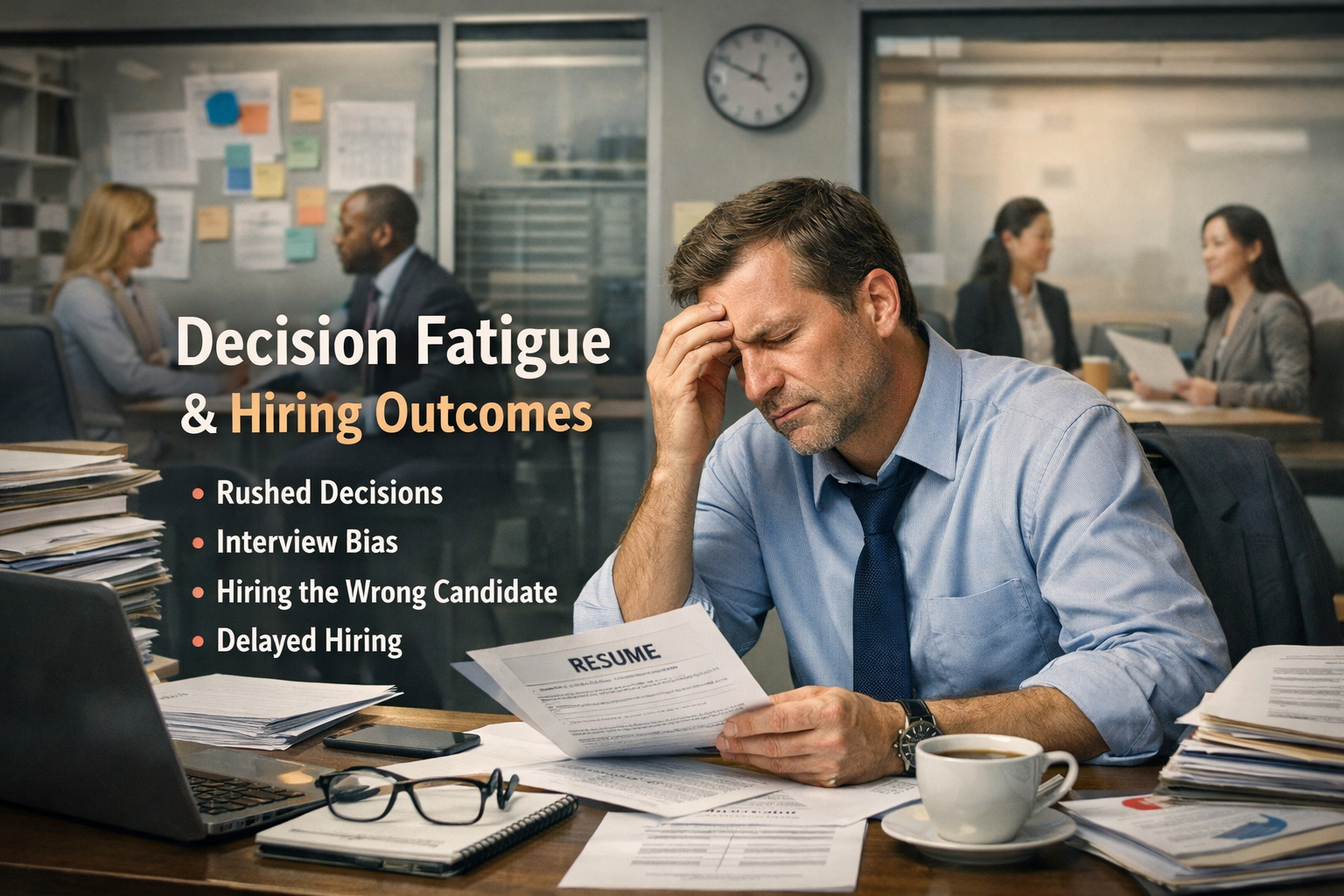
Hiring the right candidate is one of the most important responsibilities for any organization. A single hiring decision can impact team performance, company culture, productivity, and long-term growth. However, many hiring decisions are influenced by a hidden psychological factor called decision fatigue. Most recruiters and hiring managers are not even aware of how strongly it affects their judgment.
Decision fatigue happens when a person makes too many decisions in a short period of time. As the number of decisions increases, the quality of decisions decreases. In hiring, this can lead to unfair choices, rushed judgments, biased evaluations, and sometimes hiring the wrong candidate.
This article explains what decision fatigue is, how it affects hiring outcomes, common signs of decision fatigue in recruitment, real-world examples, and practical ways to reduce its impact.
What Is Decision Fatigue?
Decision fatigue is a mental state where a person’s ability to make good decisions becomes weaker after making many decisions continuously. The human brain has limited mental energy. When that energy is used again and again without rest, the brain looks for shortcuts.
Instead of carefully analyzing options, the brain starts choosing the easiest path. This can mean avoiding decisions, delaying them, or making quick choices without enough thought.
In hiring, recruiters often review dozens or even hundreds of resumes, conduct multiple interviews, compare candidates, and make judgments all day. Over time, their mental energy reduces, and decision fatigue sets in.
Why Hiring Is Especially Vulnerable to Decision Fatigue?
Hiring involves many small and big decisions, such as:
- Screening resumes
- Shortlisting candidates
- Asking interview questions
- Evaluating answers
- Comparing skills and experience
- Deciding cultural fit
- Negotiating salary
- Making the final offer
Each step requires focus and judgment. When done repeatedly, it drains mental energy. Unlike some tasks, hiring decisions directly involve people, which adds emotional pressure as well.
Recruiters often work under deadlines and performance targets. This pressure increases decision fatigue and makes the hiring process even more vulnerable.
How Decision Fatigue Impacts Resume Screening?
Resume screening is usually the first stage of hiring. Recruiters may review hundreds of resumes in a single day. At the beginning, they carefully read each resume. But as time passes, fatigue increases.
As a result:
- Good resumes may be rejected quickly
- Recruiters rely more on keywords than skills
- Candidates with non-traditional backgrounds are ignored
- Unconscious bias increases
Late in the day, a recruiter might reject a resume simply because it looks complex or different, not because the candidate lacks ability.
Interview Bias Caused by Decision Fatigue
Interviews require active listening, critical thinking, and emotional intelligence. When decision fatigue sets in, interview quality drops.
Some common effects include:
- Asking fewer follow-up questions
- Relying on first impressions
- Comparing candidates unfairly
- Giving more importance to minor mistakes
For example, a candidate interviewed in the morning may get more attention and patience than a candidate interviewed at the end of the day, even if both have similar skills.
This leads to unfair hiring outcomes.
Preference for “Safe” Candidates
When mentally tired, the brain prefers safe and familiar options. In hiring, this often means choosing candidates who look similar to previous hires or fit traditional profiles.
This reduces diversity and innovation. Companies may miss out on talented candidates who bring fresh ideas but do not match the usual pattern.
Decision fatigue pushes hiring managers to think, “This candidate looks okay, let’s just go with them,” instead of deeply evaluating long-term potential.
Increased Risk of Hiring the Wrong Candidate
Rushed decisions lead to mistakes. A tired recruiter may overlook red flags or fail to verify information properly.
This can result in:
- Poor job performance
- Cultural mismatch
- Higher employee turnover
- Increased training costs
Hiring the wrong candidate not only affects productivity but also impacts team morale and company reputation.
Delay in Hiring Decisions
Decision fatigue does not always cause fast decisions. Sometimes it leads to decision avoidance.
Hiring managers may:
- Delay final decisions
- Ask for unnecessary extra interviews
- Keep positions open for too long
This slows down business operations and may cause top candidates to accept offers from other companies.
Impact on Candidate Experience
Decision fatigue affects not just employers but also candidates.
Fatigued recruiters may:
- Respond slowly to emails
- Give unclear feedback
- Cancel or reschedule interviews
- Appear disinterested during interviews
This creates a negative candidate experience and damages the employer brand.
Real-World Example of Decision Fatigue in Hiring
Imagine a recruiter who interviews six candidates in one day.
- The first two candidates receive full attention.
- The next two receive average engagement.
- The last two face rushed questions and quick judgments.
Even if the last candidate is highly skilled, they may be rejected simply because the recruiter is mentally exhausted.
This is not intentional discrimination. It is a psychological effect of decision fatigue.
How Decision Fatigue Increases Bias?
Bias becomes stronger when mental energy is low. When tired, people rely on stereotypes and shortcuts.
In hiring, this may include:
- Gender bias
- Age bias
- Education bias
- Accent or language bias
Structured decision-making reduces bias, but decision fatigue weakens structure and consistency.
Long-Term Organizational Impact
Over time, poor hiring decisions affect the entire organization.
Some long-term consequences include:
- Reduced team performance
- Lack of diversity
- High attrition rates
- Increased recruitment costs
- Slower business growth
Decision fatigue may seem small, but its impact multiplies over time.
How Companies Can Reduce Decision Fatigue in Hiring?
The good news is that decision fatigue can be managed with the right strategies.
1. Structured Hiring Process
A structured hiring process reduces mental load.
This includes:
- Standardized interview questions
- Clear evaluation criteria
- Scoring systems for candidates
When decisions are based on structure, personal fatigue has less influence.
2. Limit Number of Daily Interviews
Companies should avoid scheduling too many interviews in one day.
Ideally:
- 3 to 4 interviews per day
- Breaks between interviews
- Important interviews scheduled earlier
This helps recruiters stay focused and fair.
3. Use Technology and Automation
Automation reduces repetitive decisions.
Examples include:
- Resume screening tools
- Applicant tracking systems
- AI-based shortlisting
Technology handles initial filtering, allowing recruiters to focus on meaningful evaluation.
4. Take Breaks Seriously
Short breaks improve decision quality.
Recruiters should:
- Take breaks between interviews
- Avoid back-to-back sessions
- Step away from screens
Even a 10-minute break can refresh the mind.
5. Rotate Hiring Responsibilities
Sharing hiring responsibilities reduces individual fatigue.
Different team members can:
- Conduct interviews
- Review resumes
- Participate in final decisions
This distributes mental effort and improves fairness.
6. Schedule Important Decisions Early
Critical hiring decisions should be made when mental energy is high.
Morning hours are usually best for:
- Final interviews
- Offer decisions
- Candidate comparisons
Avoid making final decisions late in the day.
7. Training Recruiters About Decision Fatigue
Awareness itself is powerful.
Recruiters and managers should be trained to:
- Recognize signs of decision fatigue
- Understand its impact
- Adjust their schedules accordingly
When people know the problem, they can manage it better.
Role of Leadership in Reducing Decision Fatigue
Leadership plays a key role in improving hiring outcomes.
Leaders should:
- Set realistic hiring targets
- Avoid rushing recruitment
- Support structured processes
- Encourage healthy work schedules
A supportive culture improves both hiring quality and recruiter well-being.
Decision Fatigue and Remote Hiring
Remote hiring has increased screen time and virtual interviews.
This adds new challenges such as:
- Video call exhaustion
- Reduced personal connection
- Increased cognitive load
Companies must be even more careful to manage decision fatigue in remote hiring environments.
Measuring the Impact of Better Hiring Decisions
Organizations can track improvement by monitoring:
- Employee retention rates
- Performance reviews of new hires
- Time-to-hire metrics
- Candidate satisfaction feedback
Better hiring decisions lead to measurable business benefits.
Conclusion
Decision fatigue is a silent but powerful factor that affects hiring outcomes. It influences resume screening, interviews, bias, and final decisions. When recruiters and hiring managers are mentally exhausted, the quality of their decisions decreases.
This does not mean they lack skill or intention. It means they are human.
By understanding decision fatigue and implementing structured processes, breaks, automation, and awareness, companies can improve hiring fairness, accuracy, and long-term success.
Hiring the right people is not just about talent availability. It is also about protecting the decision-making energy of those who choose that talent.
When decision fatigue is managed well, hiring outcomes become stronger, fairer, and more sustainable.
If you want to explore more such blogs, visit here.



Leave a Reply