Introduction
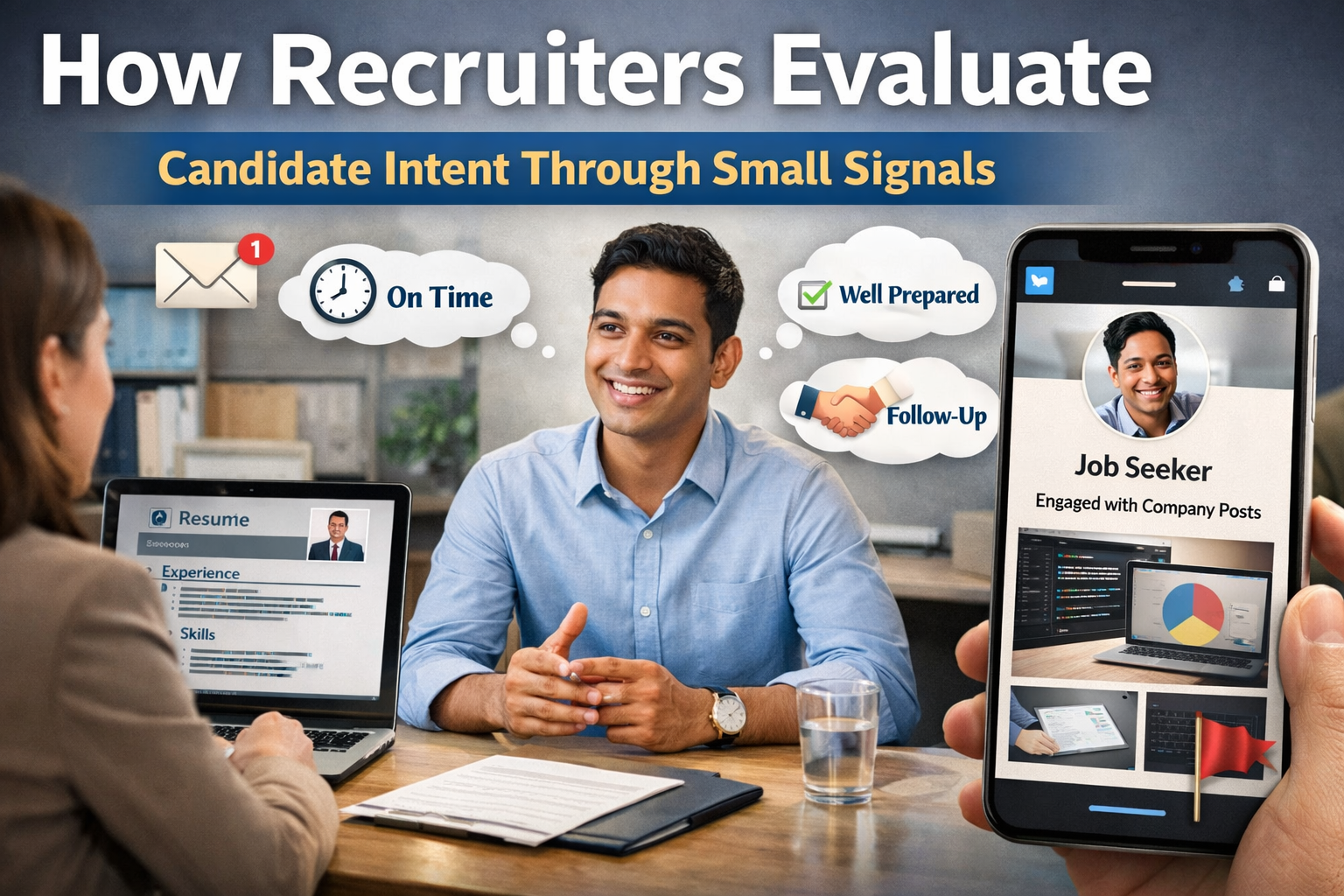
An interview is very important for every candidate because it gives them the opportunity to showcase their talent. However, passing an interview is not that easy because recruiters notice even the smallest details. Sometimes we ignore these things, thinking they don’t matter to the recruiter, but that’s not true. In an interview, recruiters evaluate a candidate’s intent through small signals, and based on these, they decide the candidate’s suitability.
That’s why we need to pay attention to even the tiniest details during an interview. In this article, we will discuss the small signals that recruiters observe and evaluate, so that we can be mindful of them.
How Recruiters Evaluate Intent Through Small Signals?
1. Recruiters Evaluate through Timely Responses
Recruiters evaluate a candidate’s suitability for a role through many small signals, and one of these is timely response. Many candidates, after hearing a question, either answer immediately or take too long to respond.
In both cases, you can create a negative impression on the recruiter. Giving an answer too quickly is not effective because the recruiter may feel you are just eager to respond without thinking or that you are giving a rushed answer. On the other hand, if you take too long to answer, the recruiter may think that you do not understand the question, lack knowledge about the topic, or are wasting time.
Therefore, during an interview, when a recruiter asks you a question, listen carefully, take a little time to think, and then answer. If you feel that you need more time to understand the question, you can explain your thinking process to the recruiter during that time. This shows the recruiter that you are serious and thoughtful about the job, which will leave a positive impression.
2. Interview Punctuality
Another small signal that recruiters use to evaluate you is interview punctuality. Time is very important for everyone, and especially for professionals like recruiters, whose time is extremely valuable because they have to conduct interviews with many candidates in a single day. If you do not arrive at the scheduled time or are late, the recruiter may feel that you are not serious about the job, which creates a negative impression and can reduce your chances of getting hired.
Therefore, always try to arrive before your scheduled interview time so that you don’t feel rushed. Use any extra time to review your preparation. This ensures that the recruiter does not get the impression that you are not serious about the job or that you lack punctuality.
3. Recruiters Evaluate through Preparation Level
Every candidate prepares for an interview, but a recruiter can easily gauge the quality of a candidate’s preparation through their answers. When a recruiter asks a question, the way the candidate responds, presents themselves, and explains their actions tells the recruiter how well and how thoroughly the candidate has prepared for the interview.
If the candidate has prepared well, they handle the interview smoothly and confidently, which impresses the recruiter. On the other hand, if the preparation is poor, the recruiter notices it immediately and may conclude that the candidate is not serious about the job, which reduces their chances of getting hired.
4. Thoughtful Questions
Have you ever answered only the recruiter’s questions in an interview and still got rejected? One reason for such a rejection could be that you only responded to the recruiter’s questions and didn’t ask any of your own. When a candidate only answers questions without asking anything, the recruiter may feel that the candidate is just interested in getting a job, rather than being genuinely interested in a specific role. This can lead to rejection.
Asking questions doesn’t mean you ask random questions. You need to ask thoughtful questions related to the company or the role. This shows the recruiter that you are not just looking for any job, but are serious about this specific role and the company. Thoughtful questions demonstrate your interest and preparation, which impresses the recruiter and improves your chances of being hired.

5. Well-Crafted Resume
As we all know, a resume is extremely important for getting a job because it is the first document we send to a recruiter. Through the resume, the recruiter understands what skills you have and whether you are suitable for the role.
However, if your resume is not well-prepared, you may fail to impress the recruiter. No matter how talented you are, a poor resume can lead to rejection because the recruiter doesn’t know you personally—they can only judge what you present in your resume.
That’s why it’s important to focus on your resume and prepare a good one. Avoid exaggerations, and don’t make it too plain either. Your resume should be real, honest, and easy to understand.
If you want to know how to create an impressive resume, you can read our another blog on resume writing.
6. Recruiters Evaluate through Professional Communication
Communication is another small signal through which recruiters evaluate you, because it shows how serious you are about the job.
If you communicate well with the recruiter, answer every question professionally, maintain good body language, keep eye contact, and present yourself professionally, it indicates to the recruiter that you are a strong candidate, serious about the job, and someone they would consider hiring.
Conclusion
Candidate intent is never solely judged by a single action or word. Recruiters carefully observe a combination of small signals—behavioral cues, communication patterns, preparedness, and even digital footprints—to gauge genuine interest and commitment. While these signals may seem subtle, they reveal a lot about a candidate’s motivation, reliability, and long-term fit.
To explore more such blogs, visit here.





Leave a Reply