
Introduction
An interview is not only about what you say. It is also about how you say it. Many candidates focus on preparing strong answers, impressive examples, and confident body language. But they forget one small yet powerful factor: pacing. Interview pacing means the speed and rhythm of your speech, the timing of your responses, and how smoothly the conversation flows between you and the interviewer.
Pacing affects how the interviewer sees you. It shapes their perception about your confidence, clarity, seriousness, and even your intelligence. Two candidates may have similar skills and experience, but the one who manages pacing well often leaves a stronger impression.
In this article, we will understand why interview pacing affects perception and how you can improve it.
What Is Interview Pacing?
Interview pacing includes:
- How fast or slow you speak
- How long you pause before answering
- How long your answers are
- How you handle interruptions
- How you move from one point to another
Pacing is like the rhythm of music. If the music is too fast, it feels stressful. If it is too slow, it feels boring. The same happens in interviews.
When your pacing is balanced, the conversation feels natural. When it is unbalanced, the interviewer may feel uncomfortable without knowing why.
Why Interview Pacing Affects Perception?
1. First Impressions Are Built in Seconds
Research shows that interviewers form first impressions very quickly. In the first few minutes, they start judging your confidence and communication skills.
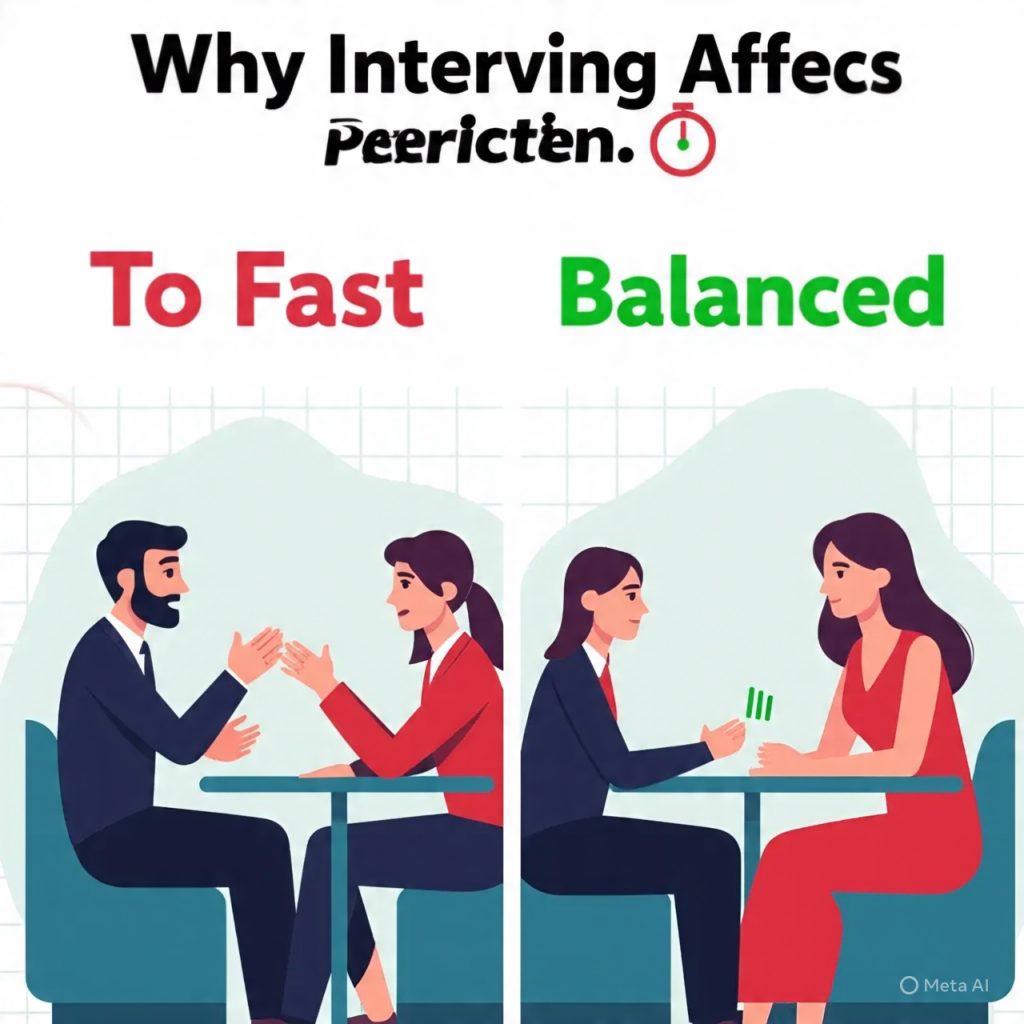
If you speak too fast, it may look like you are nervous or trying to impress too much. If you speak too slowly and take very long pauses, it may look like you are confused or unprepared.
Even before your full answer is finished, the interviewer is already forming an opinion about you. That opinion is strongly influenced by your pacing.
2. Fast Interview Pacing Can Look Like Anxiety
Many candidates speak very fast in interviews. They think that speaking fast shows confidence. But in reality, it often shows nervousness.
When you speak too fast:
- Your words may not be clear
- You may skip important details
- You may sound breathless
- You may not allow the interviewer to respond
Fast pacing can create pressure in the room. The interviewer may feel that you are trying to rush through answers. It can also make you look less thoughtful.
Speaking fast does not mean you are smart. Speaking clearly and calmly makes a better impact.
3. Slow Interview Pacing Can Look Like Lack of Preparation
On the other side, speaking too slowly or taking very long pauses can also affect perception.
If you pause too much before answering simple questions, the interviewer may think:
- You are not confident
- You are not prepared
- You do not understand the question
Silence is powerful when used correctly. A short pause before answering can show that you are thinking carefully. But long and awkward silence can make the interviewer uncomfortable.
Balanced pacing shows control. Extreme pacing creates doubt.
4. Pauses Show Thinking Ability
Not all pauses are negative. In fact, small pauses can improve perception.
When you take 2 to 3 seconds before answering a difficult question, it shows:
- You are thinking carefully
- You are not giving random answers
- You respect the question
This creates an image of maturity and self-control.
Interviewers appreciate candidates who think before they speak. Controlled pauses make your answers stronger and more structured.
5. Length of Answers Matters
Pacing is not only about speed. It is also about how long your answers are.
Some candidates give very short answers. For example:
“Tell me about yourself.”
“I am a content writer. I have 2 years of experience.”
This answer is too short. It does not give enough information.
Some candidates give very long answers. They keep talking without structure. The interviewer may lose interest.
Good pacing means giving complete but focused answers. Usually, 1 to 2 minutes per answer is a good balance, unless the question requires more detail.
When your answers are balanced, you look clear and organized.
6. Interview Pacing Reflects Confidence
Confidence is not only in your posture. It is also in your rhythm.
Confident candidates:
- Speak at a steady speed
- Do not rush
- Do not panic during silence
- Do not over-explain
When you control your pacing, you look calm. Calmness is often seen as confidence.
If your pacing is unstable, the interviewer may feel that you are unsure, even if your content is strong.
7. Pacing Influences Emotional Tone
Every conversation has an emotional tone. Fast speech can create tension. Slow and soft speech can create calmness.
If you speak too quickly when answering a serious question, it may look like you are not taking it seriously.
If you speak too slowly in an energetic discussion, you may look less enthusiastic.
Good pacing matches the tone of the question.
For example:
- When discussing achievements, your tone can be slightly energetic.
- When discussing challenges, your tone can be steady and serious.
Matching your pacing with the emotional context improves perception.
8. Interview Is a Two-Way Conversation
Many candidates treat interviews like a speech. They only focus on delivering their answers. But interviews are conversations.
Good pacing includes:
- Listening fully before answering
- Not interrupting the interviewer
- Allowing space for follow-up questions
If you interrupt frequently, you may look impatient. If you answer before the question is finished, you may look careless.
Balanced pacing shows respect for the conversation.
9. Interview Pacing Shows Professional Maturity
Professional communication is structured and clear. People in leadership roles usually speak with controlled pacing.
When your pacing is balanced:
- You look mature
- You look thoughtful
- You look professional
When your pacing is extreme, you may look inexperienced.
Interviewers often connect communication style with workplace behavior. If you speak calmly and clearly, they imagine you handling meetings and clients in a similar way.
10. Nervousness and Pacing Are Connected
Most pacing problems come from nervousness.
When you are nervous:
- Your heartbeat increases
- Your breathing becomes fast
- Your speech becomes rushed
To control pacing, you must control breathing.
Before the interview:
- Take deep breaths
- Speak slowly during practice
- Record yourself and listen
When your breathing is calm, your pacing improves naturally.
11. Online Interviews and Pacing
In online interviews, pacing becomes even more important.
Due to internet delay, speaking too fast can create confusion. If you do not pause properly, you may talk over the interviewer.
In virtual interviews:
- Wait one second before starting your answer
- Pause slightly after finishing
- Speak clearly and not too fast
Good pacing helps avoid technical confusion and improves clarity.
12. Cultural and Personality Differences
Some people naturally speak fast. Some speak slow. Personality also affects pacing.
Introverts may pause more before answering. Extroverts may speak quickly and passionately.
Neither is wrong. But in interviews, balance is important.
You do not need to change your personality. You just need to adjust your pacing to suit a professional setting.
Conclusion
Interview pacing may look like a small detail, but it has a big impact. It shapes how interviewers perceive your confidence, clarity, professionalism, and thinking ability.
Speaking too fast can make you look nervous. Speaking too slow can make you look unprepared. Balanced pacing creates trust and comfort.
An interview is not a race. It is not a speech competition. It is a professional conversation.
When you manage your pacing well, you show emotional control, respect for the conversation, and maturity. These qualities often matter as much as technical skills.
If you want to improve your interview performance, do not only prepare your answers. Prepare your rhythm. Control your breathing. Practice steady speech. Allow natural pauses.
Because sometimes, it is not only what you say that gets you selected. It is how calmly and clearly you say it.





Leave a Reply