Introduction
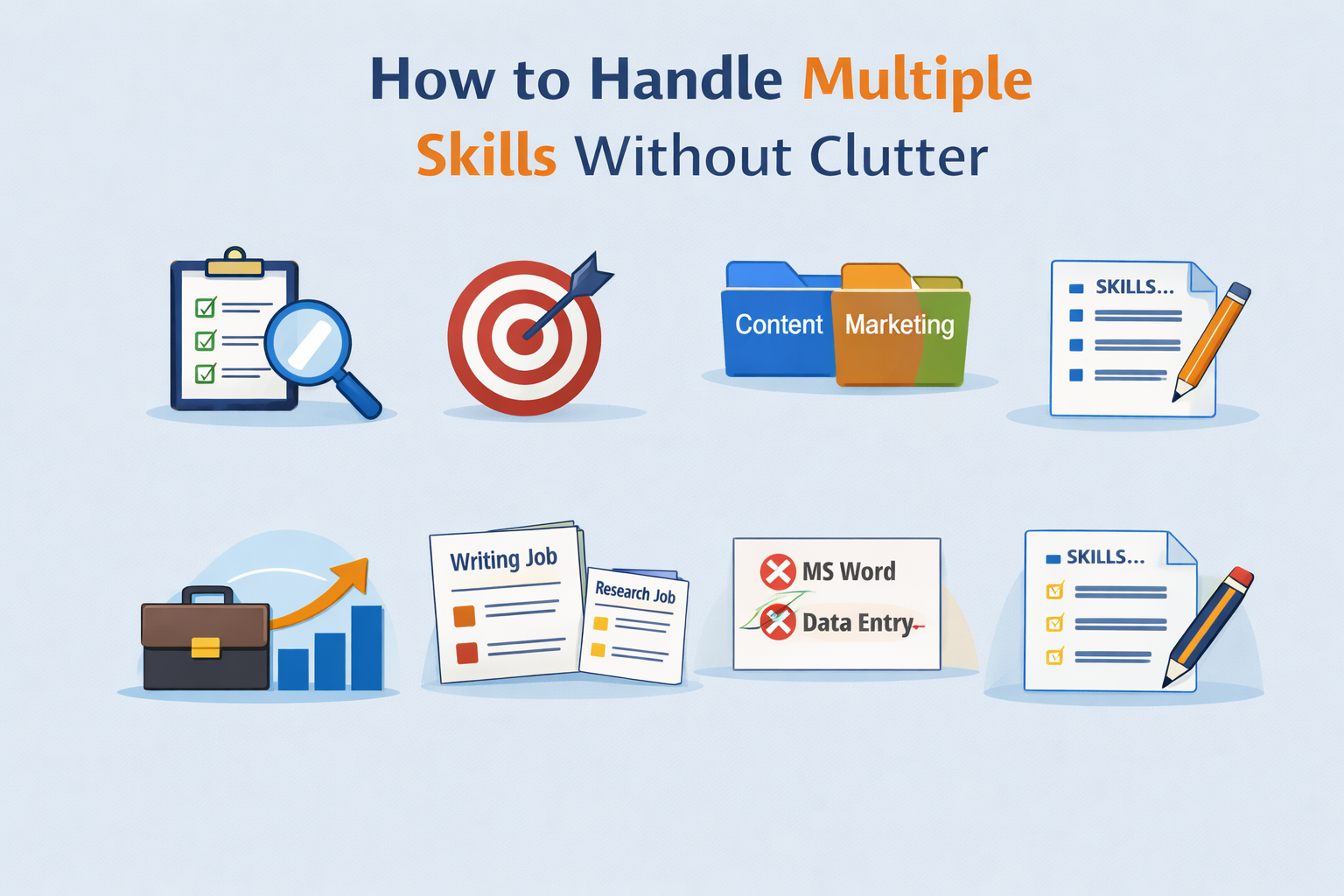
In this article, we will understand how to handle multiple skills without clutter. We will discuss practical and simple strategies that you can use in your resume, LinkedIn profile, and portfolio.
In today’s professional world, many people have multiple skills. You may know writing, editing, social media marketing, SEO, graphic design, research, or project management. Having many skills is a strength. But when you try to show all of them on your resume, LinkedIn profile, or portfolio, it can become cluttered.
Clutter makes your profile confusing. When recruiters or clients feel confused, they move on quickly. That is why it is very important to present multiple skills in a clean and clear way.
Understand the Difference Between “Having Skills” and “Showing Skills”
Many people think that if they know 15 skills, they must list all 15 skills everywhere. But this is not correct.
There is a difference between:
- Skills you have
- Skills that are relevant for a specific role
If you are applying for a content writing job, your focus should be:
- Blog writing
- SEO writing
- Research
- Editing
Not:
- Basic Canva design
- Event management
- Data entry
You may know these skills, but if they are not relevant, they create clutter.
Always remember:
Clarity is more important than quantity.
How to Handle Multiple Skills Without Clutter?
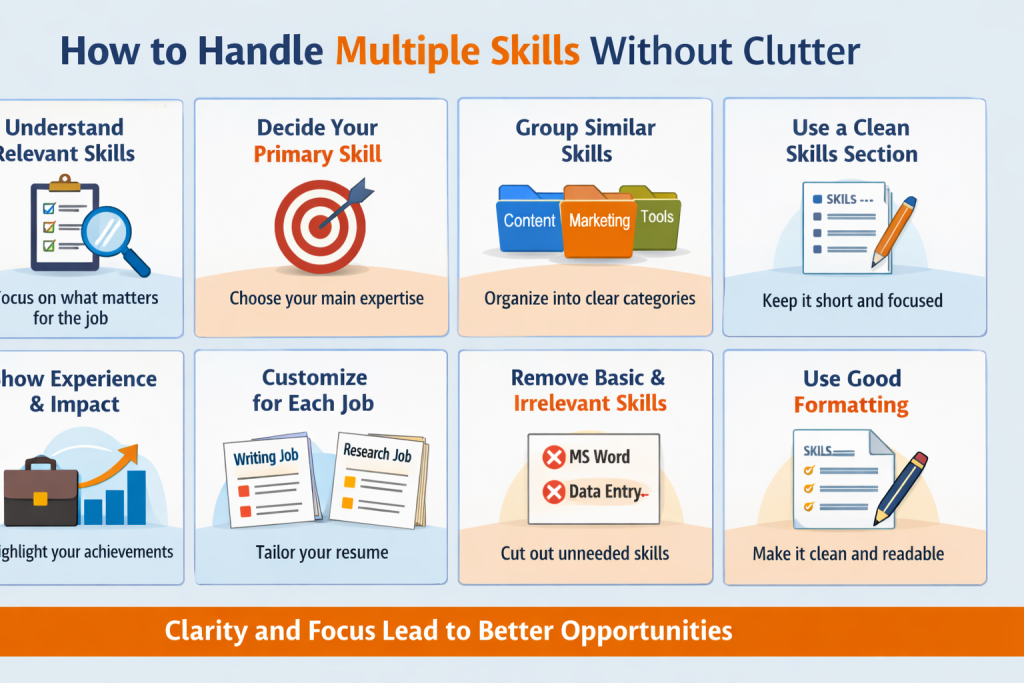
1. Decide Your Primary Skill
When you have multiple skills, confusion usually happens because you do not decide your main direction.
Ask yourself:
- What do I want to be known for?
- What role am I applying for?
- What service do I want to sell?
For example:
- If you want to become a freelance content writer, your primary skill is content writing.
- Other skills like SEO, social media, or editing should support your main skill.
Your primary skill should:
- Be visible in your headline
- Be mentioned clearly in your summary
- Be supported by your experience
Other skills should not overpower your main identity.
2. Group Similar Skills Together to Handle Multiple Skills
One common mistake is listing skills randomly.
For example:
❌ Wrong way:
- Writing
- Canva
- SEO
- Research
- WordPress
- Editing
- Social media
- Email writing
- Photoshop
This looks messy.
✔ Better way:
Content Skills
- Blog writing
- Article writing
- Email writing
- Editing
Marketing Skills
- SEO basics
- Social media content
- Keyword research
Tools
- WordPress
- Canva
- Google Docs
Grouping skills makes your profile:
- Organized
- Easy to read
- Professional
It also shows that you understand structure.
3. Use a Skills Section Properly to Handle Multiple Skills
In resumes, many people create a long paragraph of skills. That makes it difficult to read.
Instead, use:
- Bullet points
- Short phrases
- Categories
Keep your skills section short and focused. 8–12 relevant skills are usually enough.
Do not write:
“I know many skills like writing, editing, research, designing, management, communication, teamwork, leadership, and many more.”
This sentence is vague and cluttered.
Be specific and structured.
4. Avoid Repeating the Same Skill in Different Words
Sometimes people try to look impressive by repeating similar skills with different words.
For example:
- Content writing
- Article writing
- Blog writing
- Creative writing
- Copy writing
If you are not careful, this becomes repetitive.
Instead:
- Mention “Content Writing” as a main skill
- Explain in experience section what type of writing you did
This keeps your skills section clean and avoids clutter.
5. Use Experience Section to Show Depth of Multiple Skills
Your skills section should be short.
Your experience section should show depth.
Instead of listing too many skills, explain them through your work.
Example:
❌ Cluttered:
Skills:
- SEO
- Keyword research
- Blog writing
- Editing
- WordPress
✔ Clean:
Experience:
- Wrote SEO-optimized blog posts using keyword research.
- Edited and formatted content on WordPress.
- Increased blog engagement by 20%.
Now you are showing skills through action.
This is more powerful than listing everything.
6. Customize for Each Opportunity
One of the best ways to avoid clutter is customization.
If you apply for:
- A content writing job → highlight writing and SEO.
- A social media job → highlight content creation and strategy.
- A research role → highlight research and analysis.
Do not use the same resume for every job.
Remove skills that are not relevant for that specific role.
This makes your profile clean and targeted.
7. Use a Strong Headline to Handle Multiple Skills
Your headline should not try to include every skill.
❌ Wrong:
Content Writer | SEO Expert | Social Media Manager | Graphic Designer | Researcher | Editor
This looks confused.
✔ Better:
Content Writer Specializing in SEO and Research-Based Articles
This headline:
- Is clear
- Has direction
- Shows focus
You can explain other skills inside your profile, but your headline must be simple.
8. Create Separate Sections in Portfolio to Handle Multiple Skills
If you have multiple skills, your portfolio is the best place to show them clearly.
Instead of mixing everything together, create sections:
- Blog Writing Samples
- SEO Projects
- Social Media Posts
- Email Campaign Samples
This way:
- Clients can directly go to what they need.
- Your work looks organized.
- There is no clutter.
Structure reduces confusion.
9. Remove Beginner-Level or Irrelevant Skills
Sometimes we add skills because we feel insecure.
For example:
- MS Word
- Internet browsing
- Basic computer knowledge
These are basic skills. Most employers expect them already.
If you are applying for professional roles, remove very basic skills unless they are directly required.
Also remove:
- Skills you learned but never used.
- Skills you do not want to work on in future.
If you want to build a clear career direction, you must remove distractions.
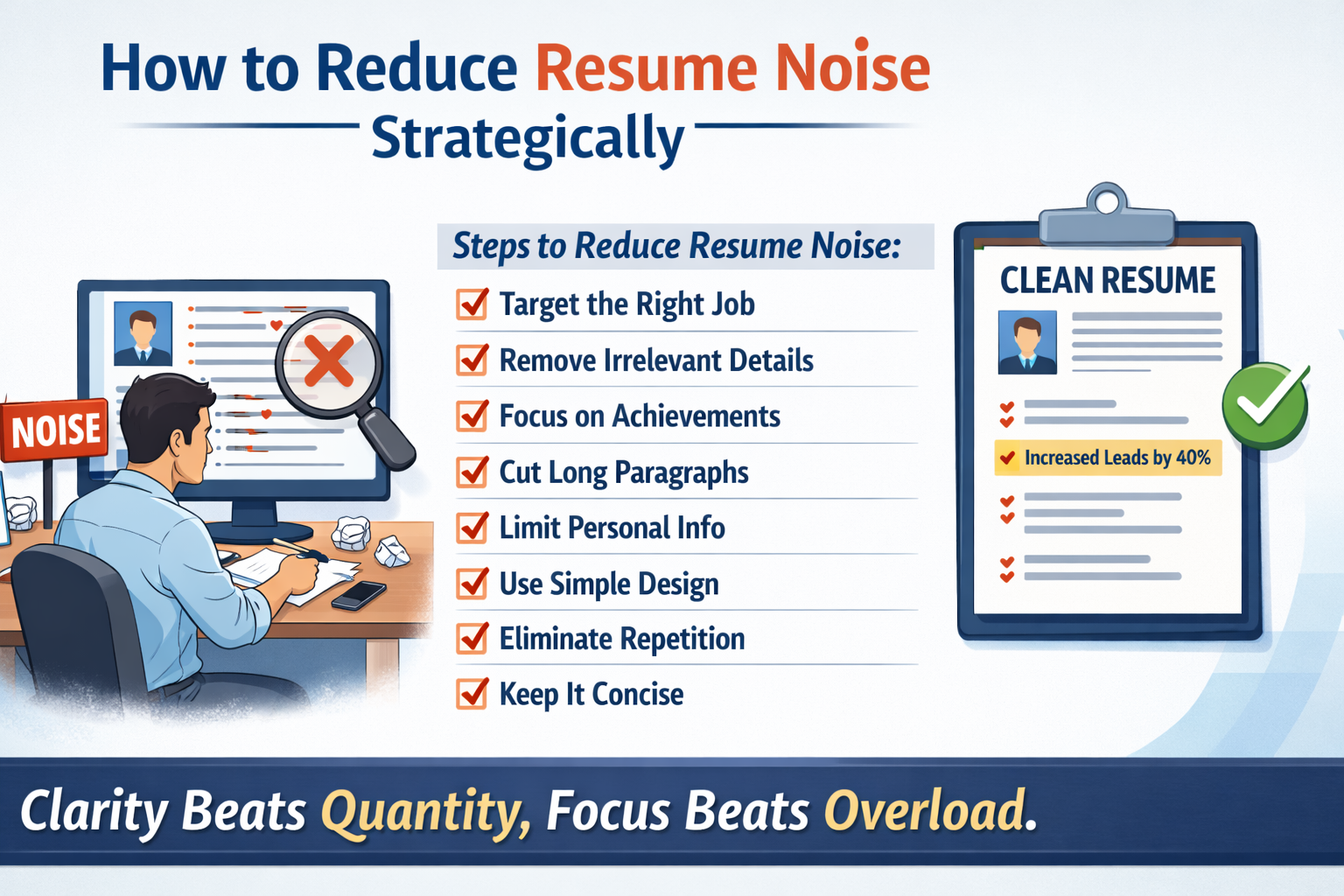
10. Use White Space and Formatting
Clutter is not only about skills. It is also about design.
To avoid clutter:
- Use spacing
- Use bullet points
- Keep margins clean
- Avoid long paragraphs
A resume with good white space looks:
- Professional
- Easy to read
- Clean
Remember:
Recruiters often scan resumes in 6–10 seconds.
If your profile looks crowded, they may not read it fully.
11. Focus on Impact, Not Just Skills
Instead of writing many skills, show impact.
For example:
Instead of:
- Social media marketing
- Content planning
- Analytics
Write:
- Created social media content calendar that increased engagement by 35%.
- Analyzed performance data to improve post reach.
Impact reduces clutter because you are replacing vague words with clear achievements.
12. Be Honest About Skill Level
Another reason for clutter is trying to look perfect.
You do not need to say:
- Expert in everything
Instead, understand your level:
- Beginner
- Intermediate
- Advanced
Focus on skills where you are confident.
It is better to show 5 strong skills than 15 weak ones.
Quality always beats quantity.
13. Use a Personal Brand Strategy to Handle Multiple Skills
If you have multiple interests, create a personal brand strategy.
Decide:
- Your main niche
- Your target audience
- Your main service
For example:
If your niche is youth and motivation, your writing, social posts, and articles should reflect that theme.
When you have a clear brand, your skills naturally align.
And clutter reduces automatically.
14. Keep Updating and Refining
Your career changes. Your skill grows.
Every few months:
- Review your resume
- Review your LinkedIn
- Remove outdated skills
- Add relevant new skills
This keeps your profile fresh and focused.
Do not treat your resume as a permanent document.
It is a living document.
Conclusion
Having multiple skills is a big advantage in today’s competitive world. It shows that you are adaptable and capable of learning new things. But showing all skills without structure creates confusion.
To handle multiple skills without clutter:
- Focus on your main direction
- Group related skills
- Use clean formatting
- Show results instead of listing everything
- Customize for each opportunity
- Remove irrelevant or basic skills
Always remember:
Clarity builds trust.
Structure builds professionalism.
Focus builds opportunity.
You do not need to show everything you can do.
You only need to show what matters most.
When you learn to present your skills in a clean and focused way, your resume, LinkedIn profile, and portfolio will look strong, confident, and professional.
To explore more such blogs, you can visit the Best Job Tool.

Leave a Reply