Introduction
In today’s competitive job market, your resume is not just a document. It is your first impression. Recruiters receive hundreds of resumes for one job. They do not read every word. They scan. If your resume has too much noise, they may miss your real value.
Resume noise means unnecessary information that hides your main strengths. It makes your resume long, confusing, and hard to understand. Many job seekers think adding more details makes their resume stronger. But the truth is simple: more is not always better. Clear and focused resumes work better.
In this article, we will understand what resume noise is, why it is harmful, and how you can reduce it strategically.
What Is Resume Noise?
Resume noise is any information that does not help you get the job you are applying for. It can be:
- Unrelated job experience
- Old skills that are no longer useful
- Long paragraphs
- Too many soft skills
- Personal details that are not required
- Repeated information
- Fancy design elements that distract
Noise hides clarity. And clarity is what recruiters want.
Why Resume Noise Is Dangerous?
Before we learn how to reduce noise, let us understand why it is harmful.
1. Recruiters Spend Very Little Time
Research shows that recruiters spend only a few seconds scanning a resume. If your important achievements are hidden inside long text, they may never see them.
2. It Makes You Look Unfocused
When you include everything you have ever done, it shows that you do not know what your core strength is. Employers want focused candidates.
3. It Confuses the ATS
Many companies use ATS (Applicant Tracking System). If your resume has too much unrelated information, it becomes harder for the system to identify your key skills.
4. It Reduces Impact
If everything looks important, then nothing feels important. Too much information reduces the power of your real achievements.
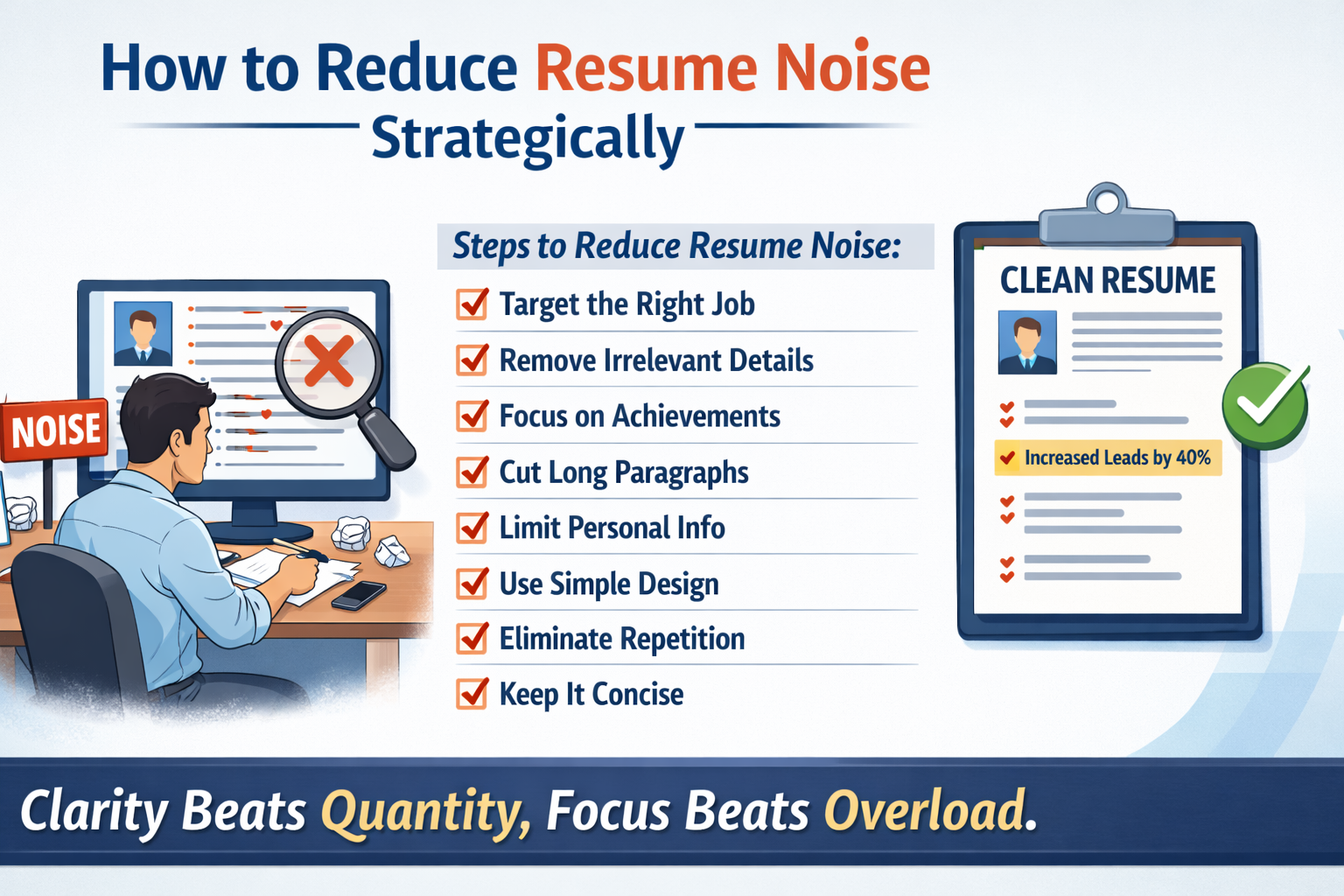
How to Reduce Resume Noise Strategically?
Step 1: Start With a Clear Target
You cannot reduce noise if you do not know your direction.
Before editing your resume, ask yourself:
- What job am I applying for?
- What skills does this job require?
- What experience matches this role?
Once you know your target role, remove anything that does not support it.
For example:
If you are applying for a content writing job, your resume should focus on:
- Writing experience
- Published articles
- SEO knowledge
- Content strategy
- Editing skills
You do not need to highlight your school debate competition from 10 years ago unless it directly supports your writing skill.
Step 2: Remove Irrelevant Experience to Reduce Resume Noise
Many people list every job they have ever done. This creates noise.
Instead, follow this rule:
Keep experience that supports your current goal. Minimize or remove the rest.
If you worked in retail but now applying for a marketing role, do not explain daily billing tasks in detail. Instead, highlight transferable skills like:
- Customer communication
- Sales targets
- Team coordination
If a job is completely unrelate and very old, you can remove it or mention it briefly.
Step 3: Cut Down Long Paragraphs
Large paragraphs are heavy and hard to read. Recruiters scan quickly.
Instead of this:
“I was responsible for managing social media accounts, creating content, designing posts, replying to comments, tracking engagement, and improving brand awareness across multiple platforms.”
Write this:
- Managed social media accounts
- Created content and designed posts
- Replied to audience comments
- Tracked engagement metrics
- Improved brand awareness
Bullet points reduce noise and improve clarity.
Step 4: Focus on Achievements, Not Duties
Listing job duties creates noise. Showing results creates impact.
Instead of:
- Responsible for writing blog posts
Write:
- Wrote 20+ blog posts per month
- Increased website traffic by 35%
- Improved average reading time by 2 minutes
Achievements are clear. Duties are common.
When you focus on measurable results, you automatically remove unnecessary words.
Step 5: Remove Weak and Repeated Soft Skills
Many resumes include a long list like:
- Hardworking
- Honest
- Punctual
- Team player
- Quick learner
- Positive attitude
This is noise.
These words are common. Every candidate writes them.
Instead of listing soft skills, show them through achievements.
For example:
- Led a team of 5 writers to complete project before deadline
This shows leadership and teamwork without saying it directly.
Step 6: Simplify the Summary Section to Reduce Resume Noise
Resume summaries often create noise when they are too long.
Bad example:
“I am a passionate, hardworking, dedicated individual with excellent communication skills and strong determination to achieve company goals while learning and growing in a dynamic environment.”
This says nothing specific.
Better example:
“Content writer with 3 years of experience in SEO blogs and web content. Published 50+ articles. Skilled in keyword research and audience engagement.”
Clear. Short. Focused.
If your summary does not add value, remove it completely.
Step 7: Limit Personal Information to Reduce Resume Noise
Do not include:
- Full home address
- Father’s name
- Religion
- Marital status
- Height and weight
- Hobbies that are not relevant
These details are not required in most modern resumes.
Keep only:
- Name
- Phone number
- Professional email
- LinkedIn profile
- Portfolio link
Anything more can create unnecessary distraction.
Step 8: Avoid Design Noise
Many job seekers use:
- Too many colors
- Different fonts
- Graphics and icons
- Complex layouts
Simple formatting is powerful.
Use:
- One professional font
- Clear section headings
- Proper spacing
- Consistent bullet points
Design should support content, not distract from it.
Step 9: Reduce Old or Outdated Skills
If you learned software 10 years ago and it is no longer relevant, remove it.
For example:
- Basic MS Paint
- Windows XP
- Old programming languages not used anymore
Focus on current, in-demand skills.
If you are in content writing, highlight:
- SEO
- Keyword research
- CMS tools
- Analytics
Do not list every small tool you ever tried.
Step 10: Remove Repetition to Reduce Resume Noise
Sometimes the same skill appears in different sections.
Example:
In summary: “Strong communication skills”
In skills section: “Excellent communication”
In job description: “Used communication skills”
This is repetition.
Mention it once clearly. Show it through results.
Step 11: Use Strong and Clear Language
Weak words create noise.
Avoid:
- Helped
- Assisted
- Tried
- Worked on
- Was part of
Use stronger words:
- Led
- Created
- Developed
- Improved
- Increased
- Designed
- Executed
Strong verbs reduce unnecessary explanation.
Step 12: Keep It Concise
For most professionals:
- 0–5 years experience → 1 page
- 6–10 years experience → 1–2 pages
- Senior roles → 2 pages maximum
If your resume is 3–4 pages without strong reason, it likely contains noise.
Ask yourself for every line:
“Does this help me get this job?”
If the answer is no, remove it.
Step 13: Customize for Every Job
One of the biggest mistakes is sending the same resume everywhere.
Each job description is different.
Read the job post carefully and:
- Add matching keywords
- Highlight relevant achievements
- Remove unrelated details
Customization reduces noise because you only keep what matters for that specific role.
Step 14: Use the 10-Second Test
After editing your resume, do this test:
- Look at it for 10 seconds
- Ask: Can I clearly see my main skills?
- Can I quickly understand what role this person fits in?
If the answer is no, there is still noise.
Step 15: Get Feedback
Sometimes we cannot see our own mistakes.
Ask:
- A mentor
- A recruiter
- A professional friend
Or read it again after two days with fresh eyes.
If a sentence feels long or confusing, simplify it.
Conclusion
Reducing resume noise is not about deleting randomly. It is about being strategic. It is about clarity, focus, and relevance.
A strong resume is not long. It is powerful.
When you remove unnecessary information, your real strengths shine. Recruiters understand you faster. Your value becomes clear. And your chances of getting shortlisted increase.
Remember this simple rule:
Clarity beats quantity. Focus beats overload. Strategy beats random detail.
Your resume should not say everything about you.
It should say the right things about you.
To explore more such blogs, you can visit the Best Job Tool.




Leave a Reply