Introduction
Interviews can be stressful. Sometimes, even when we prepare well, we fail. But failure is not the end. It is a chance to learn and improve. In this article, we will discuss how to use your past failures to prepare for interviews and increase your chances of success.
Understanding Failure in Interviews
Failure in an interview can happen for many reasons. Maybe you were nervous. Maybe you did not know the answer to a question. Or maybe you did not prepare enough. The first step in using failure to improve is to understand why it happened.
Think about your last interviews. Write down what went wrong. Did you stumble on technical questions? Were you not confident in your answers? Did you fail to make a good first impression? Understanding the reason behind failure is the first step in turning it into a lesson.
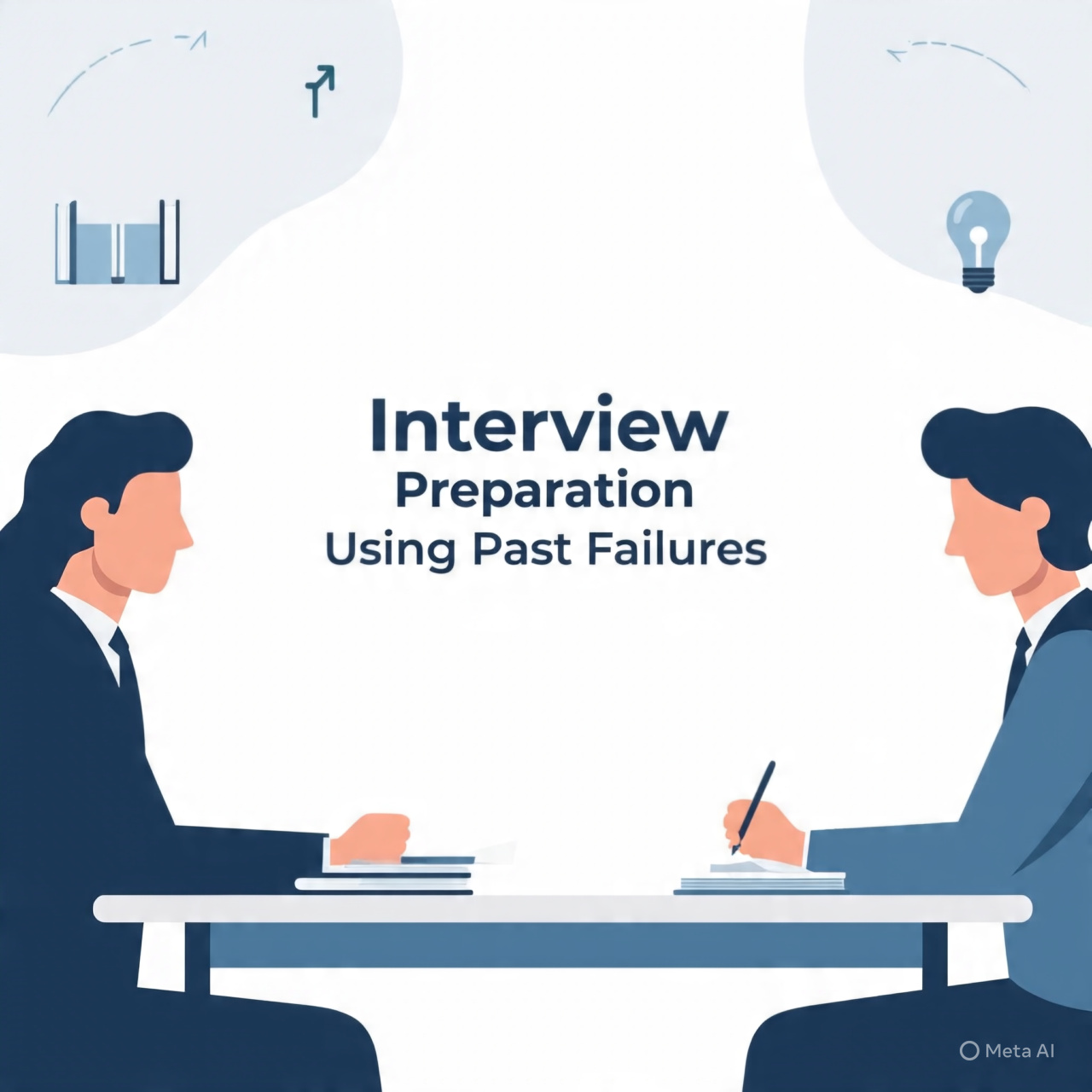
Interview Preparation Using Past Failures
1. Analyzing Your Past Failures
After every interview, take some time to analyze it. Ask yourself:
- Which questions were difficult for me?
- Did I answer all questions confidently?
- Did I manage my time well during the interview?
- Did I present myself professionally?
- Did I research the company before the interview?
Write down your answers. This analysis helps you find patterns. Maybe you always struggle with technical questions. Or maybe you get nervous when talking about your achievements. Identifying patterns will help you focus on the right areas for improvement.
2. Learning From Technical Failures
Many people fail interviews because they cannot answer technical questions. This is common, especially in fields like IT, engineering, or finance.
When you face a technical failure:
- Review the questions you could not answer.
- Study the topics you did not understand.
- Practice similar questions again and again.
- Use online resources, books, or courses to improve your skills.
Over time, repeated practice will make you confident. Technical failures are a signal, not a weakness. They show you exactly what to improve.
3. Learning From Communication Failures
Sometimes, you may know the answers, but still fail the interview. This can happen because of poor communication. For example, maybe you could not explain your ideas clearly, or your answers were too short or too long.
To improve communication:
- Practice speaking clearly and slowly.
- Record yourself answering questions.
- Ask friends or mentors to give feedback.
- Learn to structure your answers: start with the main point, give examples, and end with a conclusion.
Better communication can turn a failure into success in the next interview.
4. Learning From Behavioral Failures
Behavioral questions are meant to understand your personality and how you handle situations. Sometimes people fail these questions because they are not ready or do not have examples.
To improve:
- Use the STAR method (Situation, Task, Action, Result) to answer questions.
- Prepare 5–10 stories from your past experiences.
- Focus on challenges you faced, how you solved them, and what you learned.
When you answer behavioral questions well, interviewers see your problem-solving skills and maturity.
5. Learning From Nervousness
Many people fail interviews because they get nervous. Nervousness can make you forget answers or speak unclearly.
To reduce nervousness:
- Practice mock interviews with friends or mentors.
- Prepare answers for common questions.
- Take deep breaths before the interview.
- Visualize yourself performing well.
- Focus on the conversation, not on impressing the interviewer.
Confidence grows with preparation. Nervousness is normal, but it can be managed.
6. Turning Weaknesses Into Strengths
Failure shows weaknesses. The best way to prepare is to turn those weaknesses into strengths.
For example:
- Weak technical skills → Practice and learn more.
- Poor communication → Practice speaking and answering clearly.
- Nervousness → Build confidence through mock interviews.
- Lack of examples for behavioral questions → Prepare real-life stories.
Every weakness is an opportunity to grow.
7. Creating a Failure Improvement Plan
To use failures effectively, make a plan. Write down your weaknesses and the steps to improve. For example:
- Weak technical knowledge → Study 1 hour daily, practice problems weekly.
- Poor communication → Record answers twice a week, get feedback.
- Nervousness → Do 2 mock interviews weekly.
Having a clear plan helps you focus and track your progress. It also reduces anxiety before interviews.
8. Practicing Mock Interviews
Mock interviews are very useful. They simulate real interviews and help you practice without pressure.
- Ask friends, mentors, or colleagues to conduct mock interviews.
- Treat them like real interviews.
- Record the interview and review it.
- Work on mistakes and improve.
Mock interviews make you comfortable and confident for the real interview.
9. Seeking Feedback
Feedback is one of the most important tools to learn from failure. Ask for feedback after every interview, if possible.
Questions you can ask:
- What was my strongest point in the interview?
- What should I improve for the next interview?
- Were my answers clear and relevant?
Feedback helps you understand how others see you. It can give insights that you cannot notice by yourself.
10. Staying Positive After Failure
Failure can feel discouraging. But staying positive is very important. Negative thinking can affect your next interview.
- Remind yourself that failure is normal.
- Focus on what you learned, not on the mistake.
- Celebrate small improvements.
- Keep practicing and preparing.
A positive mindset makes learning from failure much easier.
11. Using Past Successes Too
While learning from failures is important, do not forget your successes. Past successes show what you did right.
- Remember answers you gave well.
- Recall how you managed difficult questions.
- Use successful experiences to boost confidence.
Balancing learning from failures and remembering successes is the best way to prepare.
Conclusion
Interview preparation is not just about reading questions or learning skills. It is also about learning from the past. Past failures are not mistakes; they are lessons.
By analyzing failures, practicing, seeking feedback, improving skills, and building confidence, you can turn past failures into future successes. Remember: every failed interview is a step closer to your dream job.




Leave a Reply