Introduction
In today’s world, learning new skills has almost become a trend. Every day, someone is learning coding, AI tools, graphic design, digital marketing, public speaking, content writing, or investing. Online courses are everywhere. Certifications are everywhere. Skill-based reels are everywhere.
But here’s the real question:
Are these skills solving real problems?
Because if they’re not, they’re just hobbies dressed up as productivity.
A skill becomes powerful only when it solves a real problem for real people. Otherwise, it remains theory — impressive on paper, but invisible in the real world.
Let’s explore why skills must solve real problems, especially if you want growth, income, recognition, and long-term success.
1. The Market Pays for Solutions, Not Effort
No one pays you because you worked hard to learn something.
They pay you because you can make their life easier.
The world does not reward effort alone. It rewards impact.
A company does not hire a content writer because they know grammar rules.
They hire them because they can:
- Increase website traffic
- Improve engagement
- Convert readers into customers
- Communicate brand messages clearly
The same goes for developers, designers, marketers, teachers, doctors — everyone.
If your skill doesn’t solve a problem, it becomes a decorative skill.
For example:
- Knowing Photoshop is a skill.
- Helping a brand increase sales through high-converting creatives is problem-solving.
There’s a big difference.
2. Real Problems Create Real Opportunities
When you focus on solving problems, opportunities automatically increase.
Look at platforms like Uber. It did not become successful because someone knew how to build an app. It became successful because it solved a problem — finding a ride easily and quickly.
Similarly, Airbnb solved the problem of affordable and flexible accommodation.
Technology was just the tool. The real value was the solution.
The same applies at an individual level.
If you:
- Help businesses get more leads
- Help students understand complex topics
- Help creators grow their audience
- Help companies automate processes
You become valuable.
Your skill becomes necessary, not optional.
3. Skills Without Application Fade Away
Let’s be honest.
How many courses have people completed but never applied?
When skills are not used to solve something real, they slowly fade. Knowledge without application becomes forgotten information.
But when you apply your skill to a real problem:
- You remember better
- You improve faster
- You gain confidence
- You get feedback
For example, writing 20 articles just for practice is good.
But writing articles that help readers solve career confusion, improve health habits, or manage anxiety? That builds impact — and credibility.
Application sharpens skill.
Problem-solving deepens mastery.
4. Real Problems Build Reputation
In the professional world, reputation is everything.
People remember you not for what you “know” — but for what you’ve “fixed.”
Think about someone in your circle who is known for something specific:
- The person who fixes laptops.
- The person who explains concepts clearly.
- The person who writes powerful captions.
- The person who negotiates well.
Why are they known?
Because they solved problems consistently.
Even global companies are known for problem-solving. Amazon became dominant because it solved convenience and delivery issues better than others.
Reputation grows when your skill becomes associated with solutions.
If someone says:
“Call her, she can handle it.”
That’s power.
5. Problem-Solving Skills Create Income Stability
Trends change. Tools change. Platforms change.
But problems always exist.
For example:
- Businesses will always need customers.
- People will always want clarity.
- Brands will always need communication.
- Individuals will always want growth.
If your skill is connected to solving these core problems, you stay relevant.
You might change tools.
You might upgrade methods.
But your foundation remains stable.
That’s why problem-solving skills are future-proof.
6. Solving Real Problems Builds Confidence
Confidence does not come from certificates.
It comes from results.
When you solve real problems:
- A client thanks you.
- A reader messages you.
- A manager appreciates you.
- A project improves because of your input.
That validation builds authentic confidence.
It’s very different from saying, “I completed 10 courses.”
Real confidence sounds like:
“I’ve helped 5 clients increase their conversions.”
“I’ve guided 20 students successfully.”
“I’ve solved X issue in this system.”
Experience beats theory every time.
7. Skills Become Sharper Through Constraints
Real problems are messy.
They are not textbook-perfect.
Clients have budget limits.
Deadlines are tight.
Resources are incomplete.
Expectations are unclear.
When you solve real problems, you develop:
- Critical thinking
- Adaptability
- Communication skills
- Decision-making ability
You learn how to think, not just how to execute.
This separates professionals from learners.
Anyone can follow a tutorial.
Not everyone can handle a real challenge.
8. It Aligns Skills With Purpose
Learning random skills can feel exciting — but also confusing.
You may end up asking:
“What exactly am I building?”
But when you choose to solve real problems, clarity increases.
For example:
Instead of saying:
“I want to learn writing.”
Say:
“I want to help young professionals reduce career anxiety through clear, practical writing.”
See the difference?
The second one has direction.
When your skills solve real human struggles, your work feels meaningful.
And meaningful work sustains motivation.
9. Real Problems Create Demand
Demand exists where pain exists.
If there’s no pain, there’s no urgency.
If there’s no urgency, there’s no demand.
Look at companies like Paytm. It grew because digital payments solved a major convenience and accessibility problem in India.
Similarly, Byju’s gained popularity by addressing learning accessibility issues.
Demand follows solution.
So instead of asking:
“What skill should I learn?”
Ask:
“What problems are increasing in today’s world?”
Then build skills around that.
10. Real Problem-Solving Makes You Irreplaceable
If your skill is generic, you are replaceable.
If your skill solves complex, specific problems — you become rare.
For example:
- Anyone can write social media captions.
- But not everyone can design a strategy that increases engagement by 40%.
- Anyone can build a website.
- But not everyone can optimize it for conversion and user retention.
Depth creates differentiation.
When you focus on solving important problems, you move from being a task executor to a strategic thinker.
And strategic thinkers are hard to replace.
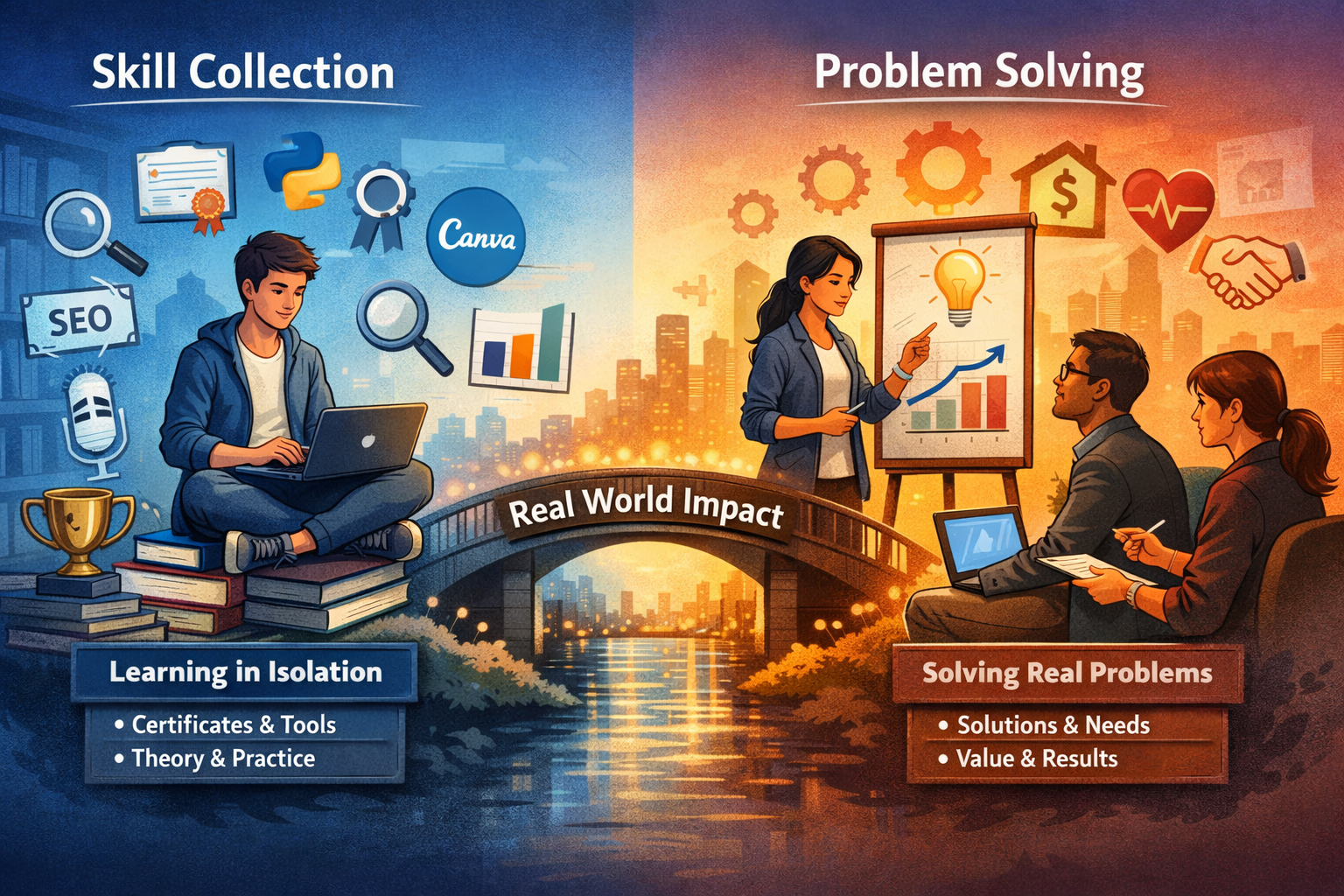
11. The Difference Between Skill Collection and Skill Application
Many people collect skills like trophies.
They say:
“I know Canva, ChatGPT, Excel, and SEO.”
But the real question is:
- Can you use Canva to help a small business increase brand visibility?
- Can you use Excel to help a company reduce errors?
- Can you use SEO to help a blog rank and attract traffic?
Collection is easy.
Application is rare.
The market rewards application.
Conclusion
Skills are powerful.
But skills alone are not enough.
In a world full of certificates, tutorials, and online courses, what truly stands out is the ability to solve real problems.
Because:
- Problems create demand.
- Demand creates income.
- Income creates stability.
- Stability creates growth.
And growth creates impact.
So the next time you decide to learn something, don’t just ask:
“What skill is trending?”
Ask:
“What real problem can I solve with this skill?”
That single question can change your career direction, your confidence, and your long-term success.
Skills are tools.
Problems are opportunities.
When the two meet — that’s where real value is created.






Leave a Reply