Introduction
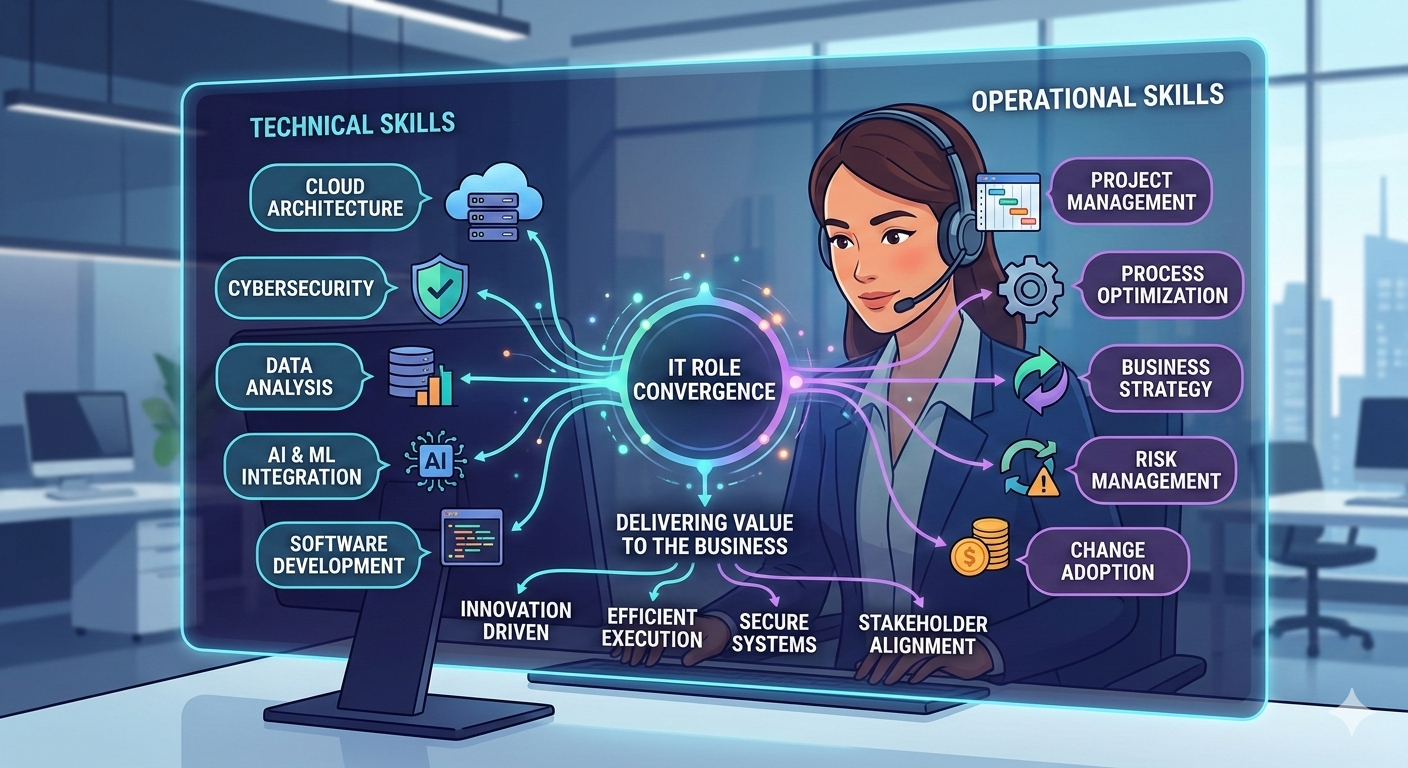
The definition of an IT role has changed dramatically over the last decade. Earlier, technical professionals were expected to write code, manage servers, or troubleshoot hardware in isolation. Operations teams handled deployment, monitoring, and process management separately. Today, those boundaries are no longer rigid. Modern IT professionals are expected to understand not only how systems are built but also how they run, scale, and support business goals. This shift explains how IT roles blend technical and operational skills in today’s interconnected digital environment.
Technology is no longer a standalone department. It powers customer experience, revenue systems, analytics, and internal workflows. As a result, IT professionals must combine deep technical expertise with operational awareness to deliver reliable and scalable solutions.
Development now includes deployment responsibility
In traditional setups, developers wrote code and handed it over to operations teams for deployment. However, with the rise of DevOps practices, this separation has reduced significantly.
Developers are now expected to understand deployment pipelines, version control, rollback strategies, and performance monitoring. They must ensure that code works not only in development environments but also in production systems.
This shared responsibility demonstrates how IT roles blend technical and operational skills within modern teams.
Infrastructure knowledge supports system reliability
IT professionals today are expected to understand infrastructure components such as cloud platforms, servers, networking, and storage systems.
Even software engineers benefit from knowing how infrastructure affects performance and scalability. This knowledge helps them write optimized code that aligns with operational requirements.
Understanding infrastructure ensures technical solutions remain reliable under real-world workloads.
Monitoring and incident management responsibilities
Technical roles now include monitoring system performance and responding to incidents. IT professionals must track logs, analyze alerts, and identify performance bottlenecks.
This requires operational awareness beyond coding or configuration tasks. Employees must understand service-level agreements, uptime requirements, and risk management processes.
Blending monitoring responsibilities with technical skills improves system stability.
Data-driven decision-making in IT environments
Modern IT roles involve working with performance metrics and analytics dashboards. Professionals track system usage, response times, and failure rates to optimize performance.
Operational data helps guide technical improvements. Engineers use metrics to refine code, adjust configurations, and enhance system efficiency.
Data literacy bridges technical execution with operational strategy.
Cross-functional collaboration with business teams
IT professionals increasingly collaborate with product managers, operations teams, and customer support departments. They must translate technical challenges into business-friendly insights.
Operational understanding allows IT teams to align technical solutions with customer expectations and business priorities. This coordination improves product delivery and service quality.
Business alignment is now part of technical responsibility.
Security and compliance integration
Security is no longer handled exclusively by dedicated teams. Developers and IT engineers must integrate security practices into their workflows.
This includes understanding compliance requirements, implementing secure coding standards, and managing access controls. Operational awareness ensures that systems remain secure and regulatory-compliant.
Security integration is a clear example of blended technical and operational roles.
Automation and process optimization
Automation tools are widely used to improve efficiency in IT environments. Professionals design scripts, configure CI/CD pipelines, and automate repetitive operational tasks.
This requires technical expertise along with process understanding. Automation reduces manual errors and increases deployment speed while maintaining operational control.
Process optimization becomes part of the technical toolkit.
Customer-centric technology delivery
IT roles now directly impact customer experience. System downtime, slow performance, or integration failures affect end users immediately.
Professionals must think operationally about user impact while building technical solutions. This mindset ensures smoother service delivery and improved satisfaction.
Customer awareness strengthens the integration of operational thinking.
Leadership and growth opportunities
IT professionals who combine technical strength with operational insight often move faster into leadership roles. They understand not only how systems function but also how they affect broader organizational performance.
Roles such as technical lead, DevOps engineer, cloud architect, and IT operations manager require this hybrid skill set. Organizations prefer professionals who can manage both system design and operational execution.
Blended expertise supports long-term career progression.
Conclusion
Modern IT environments demand professionals who can build systems and ensure those systems operate efficiently under real-world conditions. That is precisely how IT roles blend technical and operational skills in today’s digital landscape.
From deployment and monitoring to data analysis and cross-team coordination, IT professionals must balance innovation with reliability. Those who develop both technical depth and operational awareness position themselves for stronger performance, greater organizational impact, and faster career growth. To discover IT opportunities that value this hybrid skill set and long-term advancement, use the best job tool to explore roles aligned with your evolving expertise.
Find Your Dream Job Today – Explore Endless Career Opportunities and Secure Your Next Role with Best Job Tool.


Leave a Reply