Introduction
When most people evaluate a job, they look at three things first: salary, title, and company brand.
That’s normal.
But if you’re thinking long term — especially as someone building a meaningful career — the real question should be different:
“How much will this role help me grow?”
Because income grows when skills grow.
Confidence grows when competence grows.
Opportunities grow when capability grows.
And capability grows when you choose roles with strong learning value.
If you want a career that compounds instead of stagnates, you must learn how to evaluate roles based on how much they will teach you — not just how much they will pay you.
Let’s break this down in a simple, practical way.
What Is Learning Value?
Learning value is the rate and depth of skill development a role provides.
It answers questions like:
- Will I learn new skills here?
- Will I deepen existing skills?
- Will I understand how things actually work?
- Will I become more valuable in the market after 1–2 years?
A high-paying role with low learning value might feel good today.
A moderate-paying role with high learning value might change your entire trajectory.
Especially in the early and middle stages of your career, learning is leverage.
Why Learning Value Matters More Than Comfort?
Comfort feels safe.
Growth feels uncomfortable.
But here’s the truth:
Comfort slows growth.
Challenge accelerates it.
Roles with high learning value usually:
- Stretch you beyond your current abilities
- Expose you to decision-making
- Give you ownership
- Put you closer to real problems
Roles with low learning value usually:
- Keep you doing repetitive tasks
- Shield you from bigger context
- Limit exposure to impact
- Avoid accountability
One builds your future.
The other maintains your present.
How to Evaluate Roles Based on Learning Value?
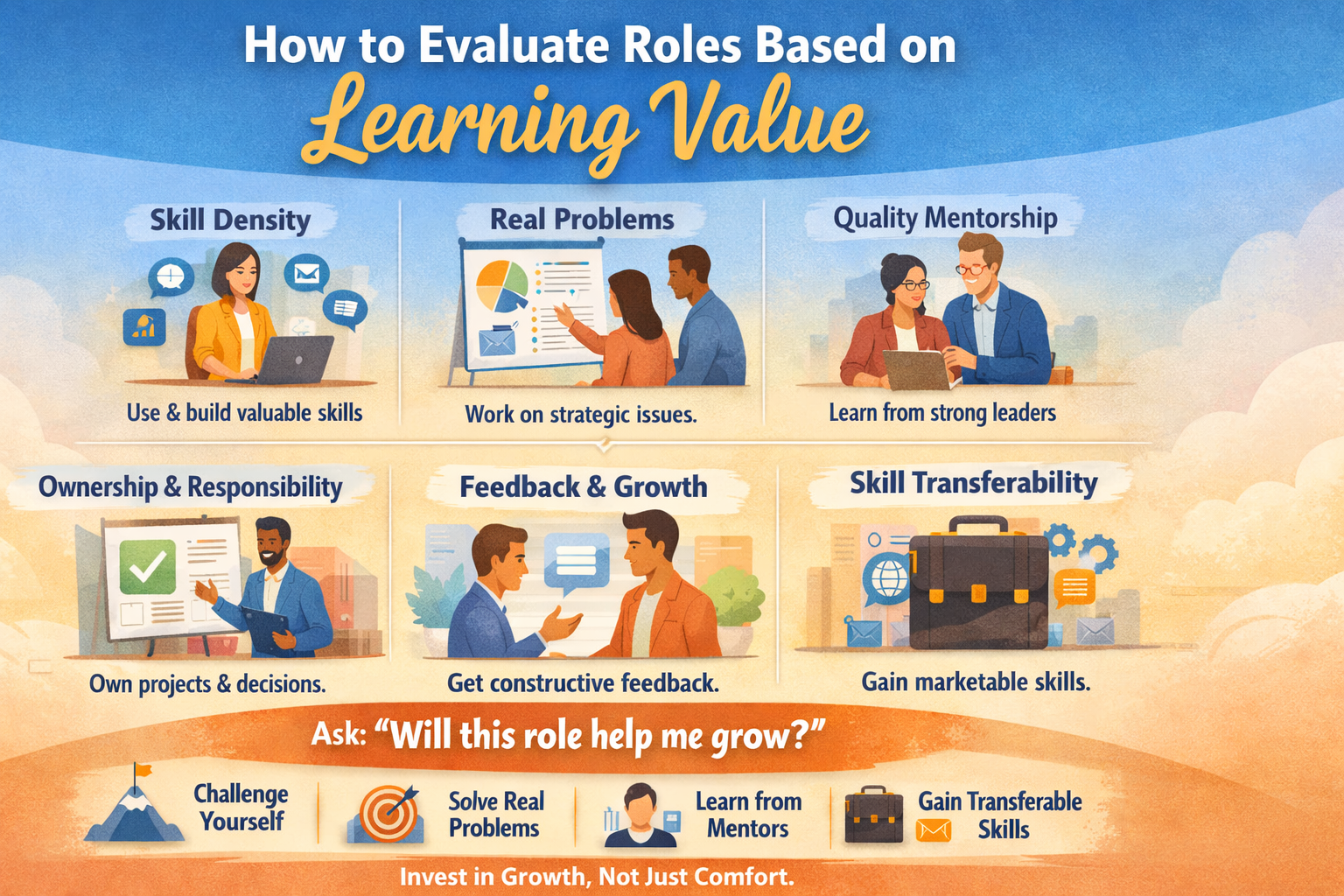
1. Evaluate the Skill Density of the Role
Ask yourself:
How many valuable skills will I use or build here?
Skill density means the concentration of useful, transferable skills in your daily work.
For example:
- Are you just following instructions?
- Or are you writing, researching, communicating, analyzing, deciding?
A high-learning role usually includes:
- Communication skills
- Problem-solving
- Analytical thinking
- Execution under constraints
- Stakeholder management
The more cross-functional exposure you get, the higher the learning density.
If a role limits you to one narrow repetitive task for years, learning will plateau.
2. Look at the Problems You’ll Solve
Not all experience is equal.
Some roles expose you to real business problems.
Others expose you to surface-level tasks.
Ask:
- What kind of problems will I work on?
- Are they strategic or operational?
- Will I understand how my work impacts revenue, growth, or customers?
The closer you are to meaningful problems, the higher the learning value.
When you solve real problems, you:
- Understand trade-offs
- Develop judgment
- Learn prioritization
- Improve decision-making
That’s the kind of growth that compounds.
3. Evaluate the People You’ll Learn From
Your environment shapes your growth.
Even a good role becomes average if you’re surrounded by people who don’t challenge or inspire you.
Ask:
- Who will be my manager?
- Do they have experience I respect?
- Are they known for mentoring?
- Will I receive constructive feedback?
Working under a thoughtful manager can double your learning speed.
Sometimes, a slightly lower salary with a high-quality mentor is a smarter long-term move.
Because strong mentors don’t just teach skills.
They teach thinking.
4. Assess Ownership and Responsibility
Ownership accelerates learning.
When you are responsible for outcomes — not just tasks — you learn faster.
Ask:
- Will I own projects?
- Will I make decisions?
- Will I be accountable for results?
- Or will I just execute instructions?
Execution teaches process.
Ownership teaches judgment.
And judgment is what makes you valuable.
A role that gives you even small areas of ownership is far more powerful than one that keeps you “safe” but invisible.
5. Check Feedback Loops Based on Learning Value
Growth requires feedback.
Without feedback, you repeat mistakes.
Ask:
- How often will I receive feedback?
- Is performance reviewed thoughtfully?
- Are mistakes discussed constructively?
- Is there a culture of improvement?
High learning environments:
- Encourage questions
- Review work deeply
- Give clear improvement directions
- Allow space for experimentation
If a company avoids feedback or ignores mistakes, learning slows dramatically.
6. Analyze Skill Transferability Based on Learning Value
Not all skills are equally valuable outside the company.
Ask:
- If I leave after 2 years, what skills can I confidently demonstrate?
- Will these skills be relevant across industries?
- Or are they specific to internal systems?
Transferable skills include:
- Writing
- Analysis
- Project management
- Communication
- Strategy
- Sales
- Marketing
- Technical depth
The more transferable the skill set, the higher the learning value.
7. Evaluate Exposure to Decision-Making
One of the most underrated growth factors is exposure.
Even if you’re not making the final decisions, observing decision-making teaches:
- Risk assessment
- Prioritization
- Leadership thinking
- Trade-offs
Ask:
- Will I attend planning meetings?
- Will I understand why decisions are made?
- Or will decisions simply be handed down to me?
Proximity to decision-makers increases your understanding of how businesses actually function.
And that’s powerful.
8. Look at Speed of Learning
Some roles stretch you slowly.
Others immerse you deeply.
Startups, for example, often offer rapid exposure because you wear multiple hats.
Larger organizations may offer structured growth but slower pace.
Ask yourself:
- Do I need fast growth right now?
- Or structured depth?
There is no universal right answer.
But clarity about your growth stage matters.
9. Evaluate Challenge Level
A simple test:
If you already know how to do 80–90% of the role perfectly, learning will slow down.
The ideal growth zone is when:
- You understand 50–70%
- The remaining 30–50% stretches you
Too easy = boredom.
Too hard = overwhelm.
Balanced stretch = growth.
When evaluating offers, be honest about whether the role excites and scares you slightly. That’s usually a good sign.
10. Ask About Internal Mobility
A role’s learning value also depends on future flexibility.
Ask:
- Are there opportunities to switch teams?
- Can I experiment with new functions?
- Does the company support skill growth?
If internal movement is possible, even an initially narrow role can become a broader platform.
11. Understand the Long-Term Signal
Every role sends a signal to the market.
Ask:
- After 2 years here, how will my profile look?
- Will I be seen as more capable?
- Will recruiters view this experience as meaningful?
Think beyond today’s salary.
Think about tomorrow’s narrative.
Conclusion
A job is not just a paycheck.
It’s a platform.
Some platforms keep you stable.
Some platforms elevate you.
When evaluating roles, look beyond:
- Salary
- Title
- Company name
And focus on:
- Skill growth
- Ownership
- Exposure
- Mentorship
- Challenge
- Transferability
Because in the long run, your earning power and career freedom depend more on what you learn than what you earn.
Choose roles that build you.
Money follows value.
Value follows learning.
And learning begins with choosing wisely.
To explore more such blogs, you can visit the Best Job Tool.




Leave a Reply