
Introduction
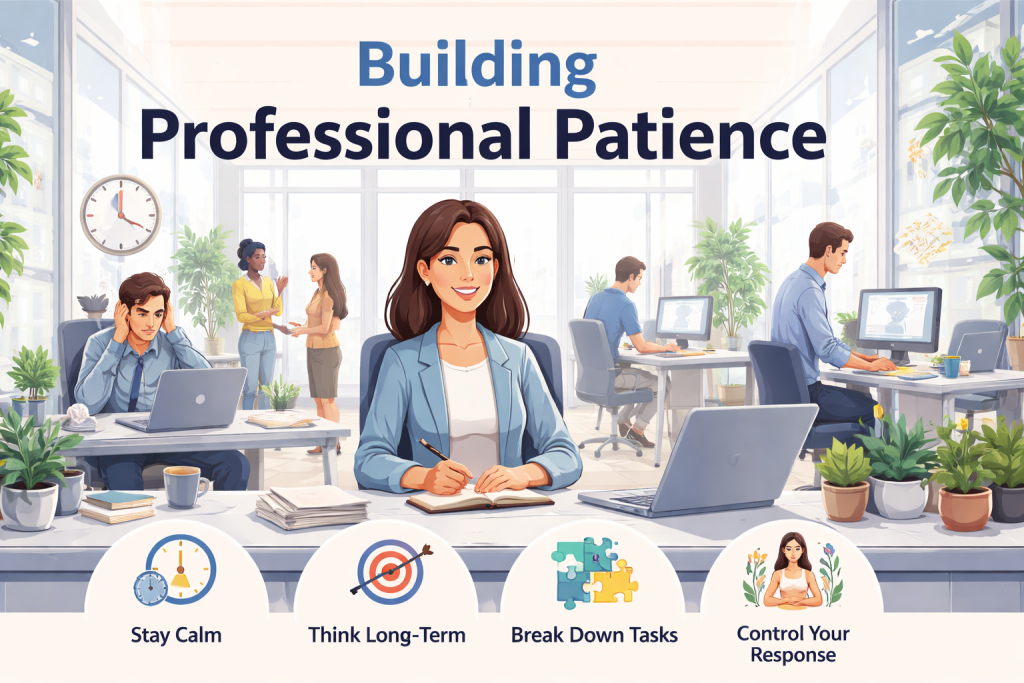
Professional patience means staying calm, composed, and consistent in your work, no matter how much pressure or stress you face. You should behave properly even in difficult situations.
Professional patience is very important for every employee. If you do not behave well at your workplace—with your colleagues or your work—and if you panic when problems or pressure come, you will not be able to grow properly. Even small tasks will feel difficult for you.
So, if you want to grow in your career, you need to build professional patience.
This article will help you a lot in building professional patience because today we will learn some easy tips to develop it.
How to Build Professional Patience?
1. Understand Why Professional Patience Matters
Nothing is fixed in the workplace. Things keep changing. Sometimes new tools are introduced, sometimes new team members join, sometimes work gets delayed, and sometimes we face rejection. All these things can make work more difficult.
In such situations, if you do not stay calm and think properly before taking steps, your work can get affected. Because of pressure and stress, you may panic and make wrong decisions in your work. This can have a negative effect on both the company and your career.
That is why patience is important. When you stay patient, you are able to think clearly and handle every task in a better way.
2. Slow Down Your Immediate Reactions
The most effective and best tip to build professional patience is this: whenever you face pressure or something frustrating at work, do not react immediately. Do not start taking stress from the beginning.
First, calm yourself. Try to understand the problem properly. Then ask yourself how you can handle this situation in the best way.
When you do not react immediately and give yourself some time to think and understand, you are able to handle the problem better. You can find the right solution according to the situation and complete your work smoothly.
That is why professional patience is very important for every person in the workplace.
3. Focus on Long-Term Growth
Every person works at a job to build a stable career for the long term. You should always keep this in mind that you need long-term growth, not just short-term success.
If you want long-term growth, patience is very important at your workplace. People who are impatient always want quick results. But when you stay patient, give yourself time, and focus on learning, you are able to grow in the long term.
4. Break Work into Smaller Steps
At the workplace, employees get many tasks to complete. Some tasks are small and some are big. Small tasks are usually easy to complete, but when employees get big tasks, they often feel pressure and become overwhelmed. Because of this, the work starts to feel difficult.
But if you do the work with patience, you can complete it easily and in a better way.
The best way to handle big tasks with patience is to divide them into smaller steps. As you complete these small steps one by one, you start feeling motivated. Your frustration reduces, and you can complete even big tasks smoothly with patience.
5. Practice Active Listening for Professional Patience
In the workplace, it is important for everyone to be included in meetings. But just being physically present is not enough. You should participate in the meeting and share your ideas.
However, this does not mean you should speak without listening to others or interrupt them just to share your points.
If you do this, it can be bad for your growth. In meetings or conversations, you should not interrupt anyone. First, listen carefully and understand what others are saying, then give your response.
This improves your communication skills and also helps you build patience.
6. Accept What You Can’t Control
At the workplace, there are many things, many tasks, and many decisions to handle. There are also different systems to work with. It is not necessary that you will be able to complete or control everything perfectly.
There are many things that are out of your control, such as team delays, client decisions, or system issues. In such cases, you should not keep putting effort again and again or take unnecessary stress, because you cannot control these things.
Instead, you should focus more on the things you can control, like your effort, attitude, and response. This will help you reduce unnecessary frustration.
Conclusion
Professional patience is a key skill that helps you stay calm, think clearly, and act wisely in any work situation. It allows you to handle delays, challenges, and pressure without losing focus or confidence. Instead of reacting emotionally, you respond with maturity and control.
In the long run, professional patience builds trust, improves relationships, and supports steady career growth. It reminds you that success does not happen instantly—it comes through consistency, learning, and time.



Leave a Reply