Introduction
Do you also use a generic resumes to apply for every job?
If you do, then you are making a very big mistake. This is one of the main reasons for your rejection. In today’s competitive job market, at least hundreds of candidates apply for a single job. A recruiter spends only 8 to 10 seconds scanning each resume. In these few seconds, they can easily understand whether your resume is customized or just a generic one. If your resume is generic, they usually do not shortlist you.
But why does this happen? Do you know the reason behind it?
In this article, we will talk about why generic resumes fail in competitive markets and why it is essential to tailor your resume for each job.
What Is a Generic Resume?
First, let us understand what a generic resume is.
A generic resume is a standard resume that is used for many job applications without making any changes. It follows the same approach for every job, even though each job has different requirements.
In a generic resume, everything remains the same—such as the summary, skills, and work experience—and the same resume is sent for every job role. This is the main reason for resume rejection, because a generic resume does not match the job description and also fails to pass the ATS (Applicant Tracking System).
Why Generic Resumes Fail in Competitive Markets?
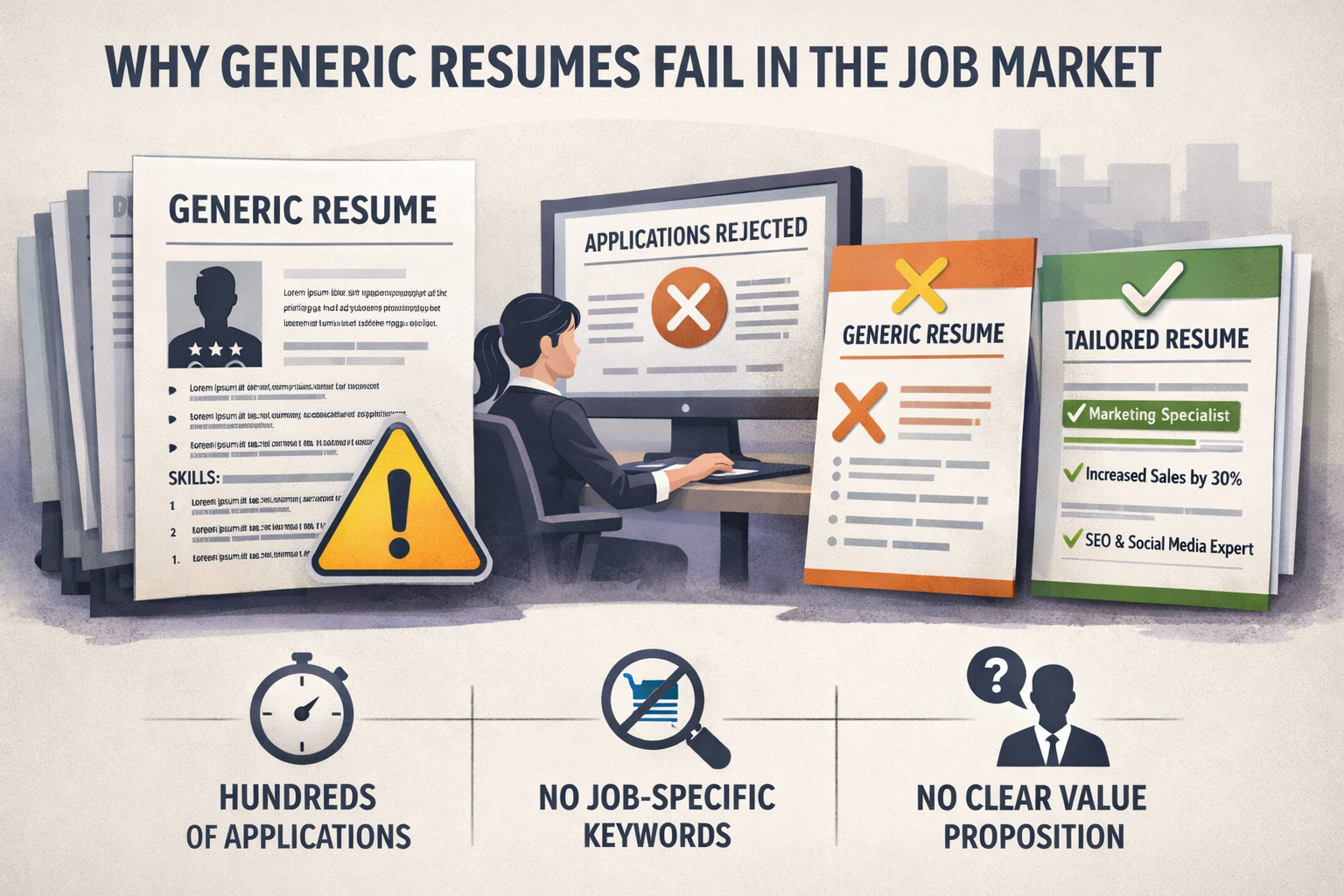
1. Recruiters Receive Hundreds of Applications
The first main reason why a generic resume fails in a competitive market is that recruiters receive hundreds of job applications in a single day. Because of this, a recruiter spends only a few seconds scanning each resume.
When a recruiter looks at a resume, they notice specific details that are important and match the job description. But when they receive a generic resume, they do not find any important information that is clearly related to the job description. Because of this, recruiters easily skip generic resumes.
2. Lack of Job-Specific Keywords in Generic Resumes
The second reason is the lack of job-specific keywords.
Many companies use an ATS (Applicant Tracking System) to scan resumes. Only if a resume passes the ATS does the recruiter read it carefully. But when you use a generic resume, the ATS often rejects it because a generic resume does not include job-specific keywords. Because of this, your resume does not even reach the recruiter.
A generic resume usually includes common or broad terms instead of job-specific keywords, because it is not customized according to the job description. That is why such resumes get rejected easily.
If you want to know more about ATS in detail, you can visit our other blog here.
3. No Clear Value Proposition in Generic Resumes
Another main reason why a generic resume gets rejected is that it does not have a clear value proposition. A value proposition means explaining to the recruiter why they should hire you and what you can offer to the company.
Recruiters like to see your value proposition along with your skills. But if this is missing from your resume, it creates a negative impression. A generic resume mostly focuses on routine responsibilities instead of showing results and achievements. Because of this, recruiters cannot clearly understand how you are different from other candidates, and that is why they reject generic resumes.
4. Poor Alignment With Job Requirements
Every job has different requirements, and recruiters look for those specific requirements in your resume. Based on this, they decide whether to move forward with your application or not. But a generic resume does not include job-specific requirements.
When a resume does not match the job description, it becomes difficult for the recruiter to understand the resume and decide whether the candidate will be a good fit or not. A generic resume includes information that is either too general or not related to the job role. Because of this, recruiters feel that the candidate is more interested in just getting any job rather than working with their company, and they consider the candidate unsuitable.
5. Fails to Reflect Industry or Role Expectations
Every industry and job role has different expectations related to skills, experience, and resume format. It is not necessary that the expectations of one industry will match those of another. That is why we should always customize our resume according to the requirements of each job role. If you send a generic resume, it is a big mistake.
A generic resume follows the same content, tone, and structure for every industry and role. Because of this, it misses important tools and industry-specific terminology.
When a resume does not match industry expectations, recruiters consider it outdated or irrelevant. That is why a customized resume is very important these days.
6. Inconsistent or Irrelevant Information in Generic Resumes
It is possible that you created your generic resume when you had fewer skills or less knowledge about the job market. Later, after gaining more skills and improving your knowledge, if you still keep sending that old resume for job applications, it’s a mistake because a generic resume does not include all your updated information.
A strong resume clearly highlights your career achievements and skills, while a generic resume includes inconsistent or irrelevant information that can confuse the recruiter. That is why using a customized resume is always the best option if you want to succeed in your career.
Tips to Make an Impressive Resume
If you want your resume to easily pass the ATS filter, then you have to keep some important points in mind. An ATS-friendly resume means a it should be so clear that software can easily read, scan, and understand.
- Use Job-Specific Keywords
You have to first read the job description carefully and notice all the keywords (like: “project management”, “Excel”, “content writing”) in the job description. And try to include all the keywords naturally, so that it can be easily shortlisted by ATS.
- Keep the Format Simple
Avoid using complex layouts, tables, images, or fancy fonts. Stick to a clean, basic design with standard fonts like Arial, Calibri, or Roboto. Save your resume as a .docx or PDF file (if accepted).
- Use Standard Headings
Use conventional headings such as:
Work Experience, Education, Skills, Certifications.
Avoid creative or unusual section titles that ATS might not recognize.
- Avoid Graphics and Icons
ATS cannot read visual elements like logos, icons, charts, or images. Keep your resume 100% text-based to ensure all content is scannable.
- Include Both Hard and Soft Skills
Mention relevant hard skills (e.g., Excel, Python, SEO) as well as soft skills (e.g., leadership, teamwork, communication) that are aligned with the job.
- Customize for Every Job
Never send the same resume everywhere. Tailor it for each job application by updating the summary, keywords, and skills to match the role.
Conclusion
If you use a generic resume, you must now understand why you should avoid it and what the results will be. As we saw in the article, recruiters receive hundreds of applications every day. Resumes are either scanned by an ATS system or quickly reviewed by the recruiter in a few seconds. Generic resumes fail in both cases because they do not match the job description.
Although a generic resume may save time, it significantly reduces your chances of getting hired. That is why it is important to spend some time customizing your resume according to the job description. Show yourself as unique among the crowd, and only then will you achieve success in your career.
You can also explore more such blogs here.


Leave a Reply