Introduction
In today’s fast-changing world, education and careers are no longer limited to classrooms and degrees. For many years, certificates were considered the main proof of knowledge and success. People believed that if you had more certificates, you had better chances of getting a good job. But now, this thinking is changing.
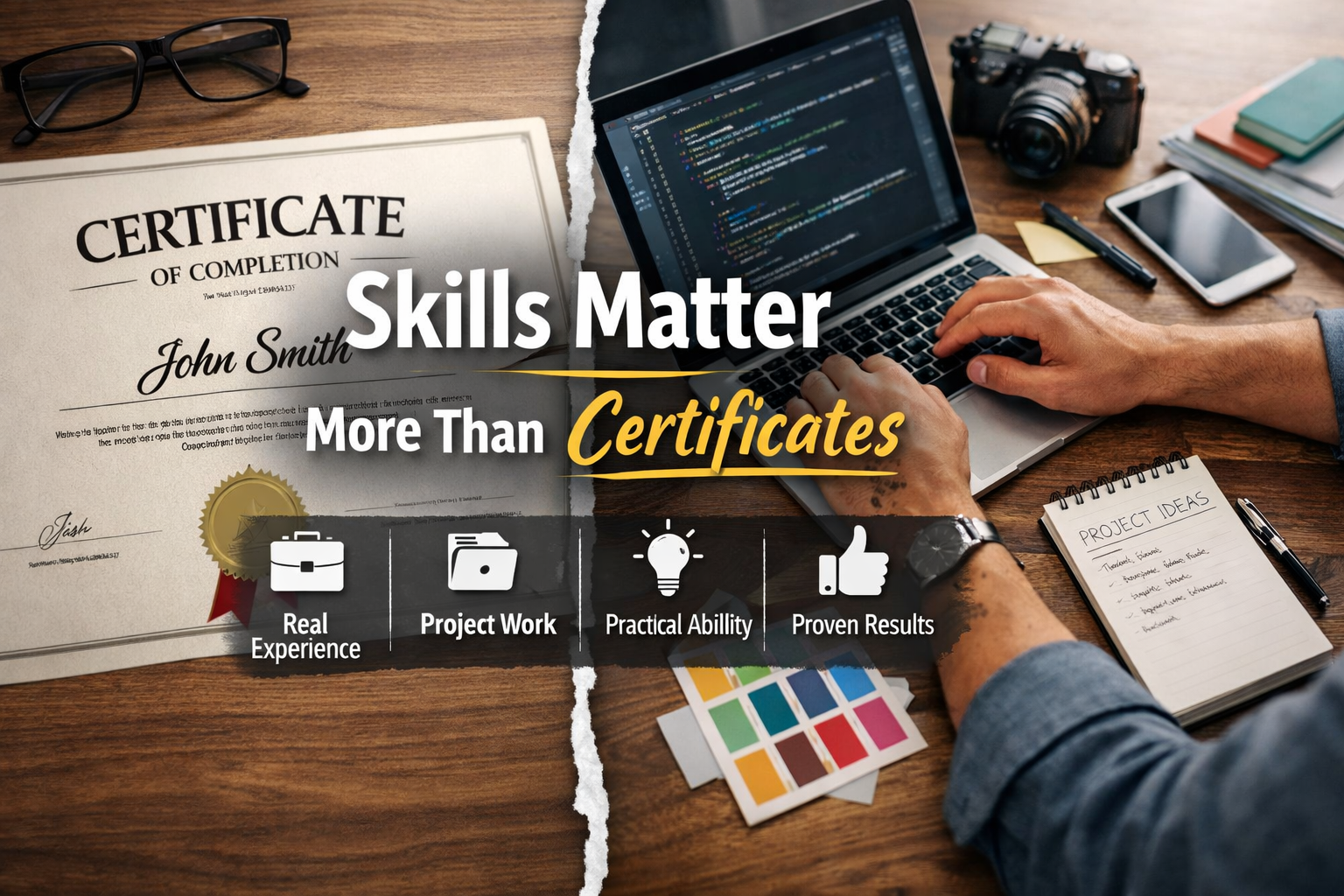
Today, companies, clients, and even individuals are focusing more on skill validation rather than certificates. Skill validation means proving what you can actually do, not just what you studied. This article explains why skill validation matters more than certificates, especially in the modern job market.
Understanding the Difference Between Certificates and Skills
A certificate shows that you completed a course, training, or degree. It tells that you attended classes and passed exams.
A skill shows your ability to perform a task in real life. For example, writing articles, designing graphics, coding websites, or managing people.
Certificates focus on theory, while skills focus on practical application.
You can have many certificates, but if you cannot apply the knowledge, those certificates have little value.
Why Skill Validation Matters More Than Certificates?
1. The Changing Job Market
The job market has changed a lot in recent years. Technology, automation, and remote work have transformed how companies hire people.
Earlier:
- Degrees were enough
- Experience was optional
- Skills were assumed
Now:
- Skills are required
- Experience matters
- Certificates are optional
Companies want employees who can start working immediately without long training periods. That is why skill validation has become more important.
2. Employers Want Results, Not Papers
Employers do not hire certificates. They hire people who can solve problems.
When a company hires a content writer, they want:
- Writing samples
- Published articles
- SEO knowledge
- Ability to meet deadlines
They do not care much about a writing certificate if the person cannot write well.
Skill validation proves that you can deliver results, not just show papers.
3. Certificates Do Not Guarantee Performance
Many people have certificates but struggle in real work situations. This happens because:
- Courses focus on exams
- Real problems are different
- Practical exposure is limited
For example, someone may have a digital marketing certificate but does not know how to run real ad campaigns.
Skill validation shows actual performance through:
- Projects
- Portfolios
- Case studies
- Work experience
4. Skill Validation Builds Trust
When you show your skills through real work, people trust you more.
For example:
- A developer shares GitHub projects
- A writer shares published articles
- A designer shares a portfolio
- A marketer shares campaign results
This builds confidence in your abilities. Certificates alone cannot build this level of trust.
5. Freelancing and Remote Work Depend on Skills
In freelancing platforms like Upwork, Fiverr, and Freelancer:
- Clients rarely ask for certificates
- They ask for samples
- They check ratings and reviews
Freelancing success depends completely on skill validation.
Remote jobs also follow the same pattern. Companies want proof of skills, not classroom certificates.
6. Skill Validation Encourages Continuous Learning
Certificates often make people feel “finished” with learning.
Skill validation encourages:
- Practice
- Improvement
- Learning new tools
- Updating skills
When you focus on skills, you keep learning because real work always brings new challenges.
7. Skills Are Transferable Across Industries
Certificates are usually limited to a specific field. Skills can be used in many industries.
For example:
- Writing skills work in marketing, education, and media
- Communication skills work in every profession
- Problem-solving skills are useful everywhere
Skill validation helps you shift careers more easily than certificates.
8. Startups Prefer Skills Over Degrees
Startups move fast and cannot afford long training times. They prefer people who:
- Can handle multiple tasks
- Learn quickly
- Solve problems independently
Many successful startup founders and employees do not have traditional degrees, but they have strong skills.
Skill validation fits perfectly with startup culture.
9. Certificates Can Be Easily Collected
Today, online courses are easily available. Anyone can collect certificates without deep learning.
This reduces the value of certificates.
Skill validation cannot be faked easily. Either you can do the work or you cannot.
10. Real-World Projects Matter More
Working on real projects teaches more than any course.
Projects help you learn:
- Time management
- Client communication
- Problem solving
- Responsibility
These qualities are not mentioned in certificates but are highly valued by employers.
11. Skill Validation Improves Confidence
When you know you can perform a task, your confidence increases.
You can:
- Speak confidently in interviews
- Negotiate better salaries
- Take bigger responsibilities
Certificates give temporary confidence, but skills give long-term confidence.
12. Interviews Are Skill-Focused Now
Modern interviews include:
- Skill tests
- Assignments
- Practical questions
- Problem-solving tasks
This shows that companies care more about what you can do, not what you studied.
13. Skill Validation Supports Career Growth
Career growth depends on:
- Performance
- Impact
- Value creation
Promotions are given to people who perform well, not to those with more certificates.
Skills help you grow faster in your career.
14. Learning by Doing Is More Effective
Skill validation promotes learning by doing.
This type of learning:
- Is practical
- Is long-lasting
- Builds experience
- Improves understanding
Certificates often focus on memorization, which fades with time.
15. Clients Pay for Skills, Not Certificates
In freelancing and business:
- Clients pay for solutions
- They want results
- They care about outcomes
They do not pay extra because you have certificates. They pay because you can solve their problems.
16. Skill Validation Helps You Stand Out
Many candidates have similar degrees and certificates.
Skills help you stand out because:
- Your work is unique
- Your experience is personal
- Your approach is different
A strong portfolio makes you memorable.
17. Certificates Are Still Useful, But Not Enough
This does not mean certificates are useless.
Certificates are helpful for:
- Basic knowledge
- Structured learning
- Entry-level understanding
But they should support skills, not replace them.
Certificates without skills are incomplete.
Conclusion: Skill Validation
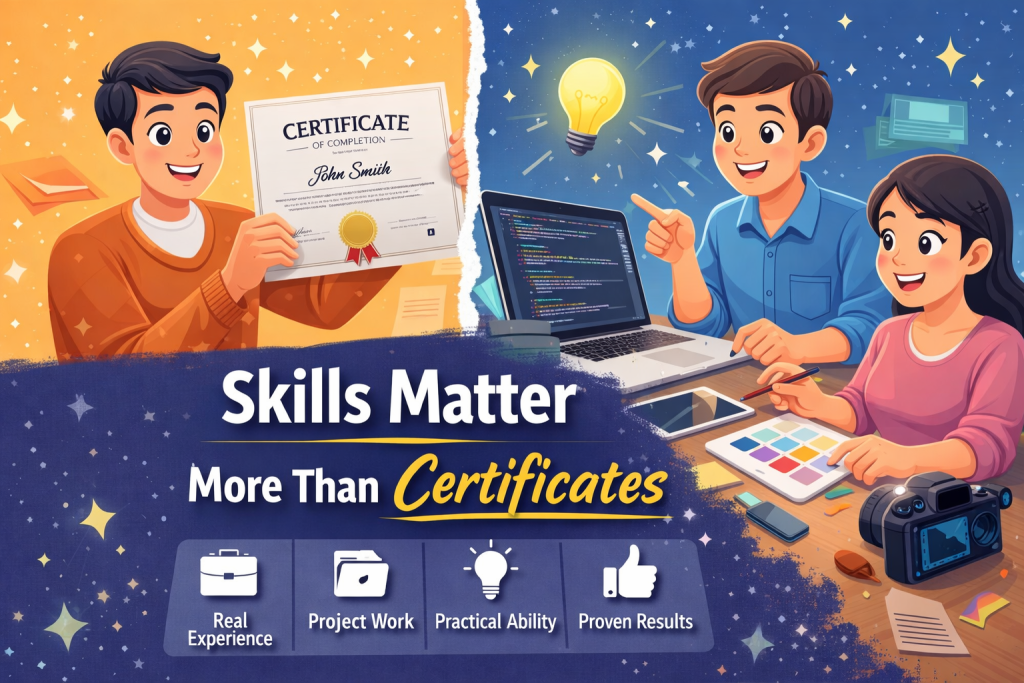
Certificates may open doors, but skills keep you inside.
In today’s world, skill validation matters more than certificates because it proves real ability, builds trust, improves confidence, and supports long-term career growth. Employers, clients, and companies want people who can perform, not just show papers.
Certificates are useful, but they are not enough. Skills are the real currency of success.
If you want a strong and future-proof career, focus on validating your skills through real work, practice, and experience.
Because in the end, what you can do matters more than what you can show on paper.
To explore more such blogs, visit here.




Leave a Reply