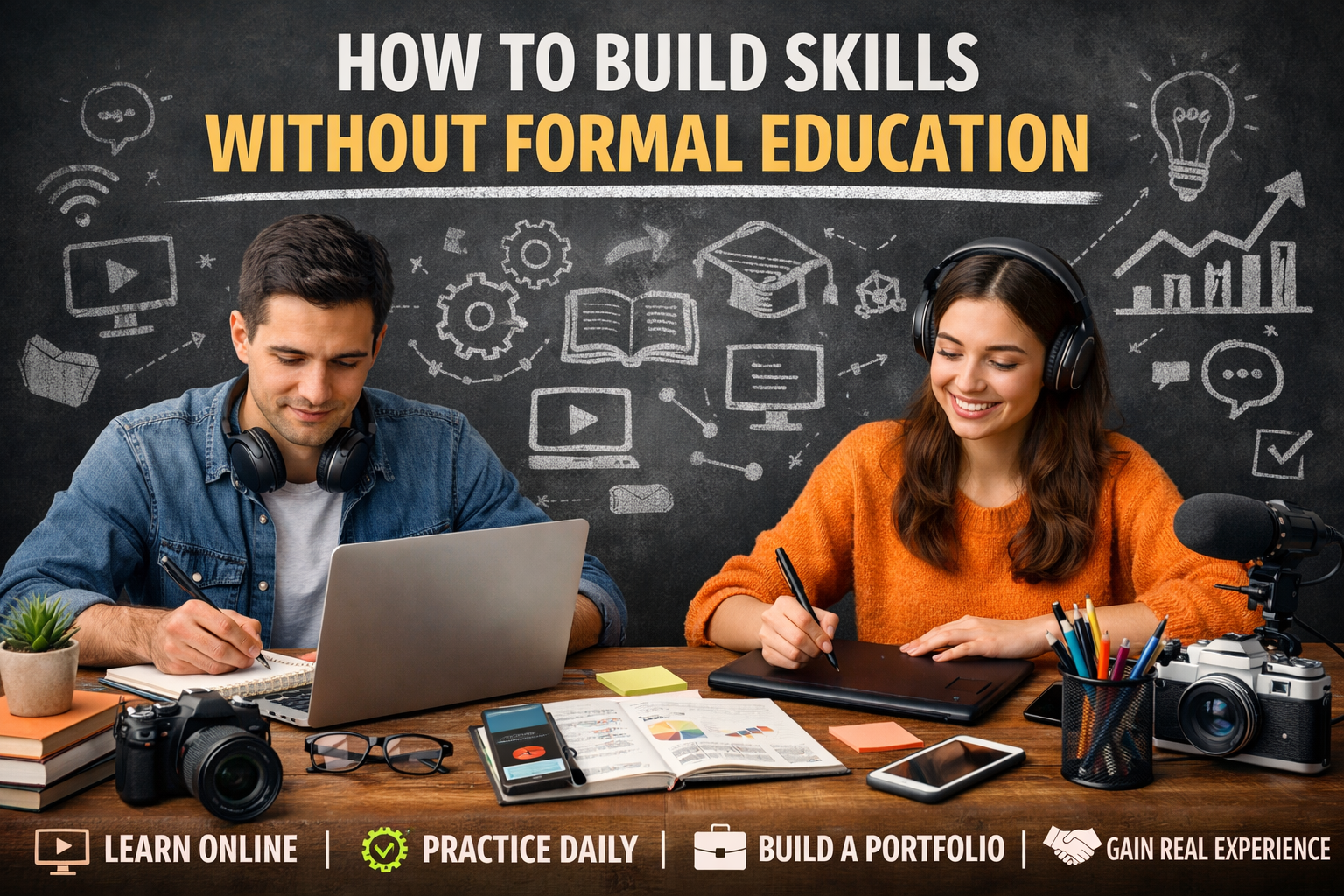
Introduction
In today’s fast-changing world, formal education is no longer the only way to build skills and succeed in life. Many people believe that a college degree or certificate is necessary to get a good job or build a career. But the reality is different. Thousands of successful people have built strong skills without formal education. They learned through self-study, practice, experience, and real-world exposure.
The internet, digital tools, and global opportunities have made learning more accessible than ever. If you have the willingness to learn, discipline to practice, and patience to grow, you can build valuable skills without attending a traditional school or college.
This article explains how you can build skills without formal education, step by step, using practical and realistic methods.
Understanding What Skills Really Are
Skills are abilities that help you perform tasks effectively. Skills can be technical, creative, or personal. Examples include writing, coding, graphic design, communication, problem-solving, time management, marketing, and leadership.
Skills are not limited to classrooms. They are developed through practice, experience, mistakes, and improvement over time. Many skills are learned best by doing, not by memorizing theory.
When you focus on skill-building instead of degrees, you shift your mindset from “qualification” to “capability.”
How to Build Skills Without Formal Education?
1. Change Your Mindset About Learning
The first step to building skills without formal education is changing your mindset.
Many people think:
- “I am not educated enough”
- “I don’t have a degree”
- “I cannot compete with educated people”
These thoughts limit growth. Skills do not depend on certificates. They depend on effort, consistency, and learning attitude.
You must believe that learning is a lifelong process and not restricted to schools. Once you accept that, you open yourself to endless learning opportunities.
2. Identify the Skill You Want to Learn
You cannot learn everything at once. The first practical step is to choose one skill and focus on it.
Ask yourself:
- What am I interested in?
- What skills are in demand?
- What problems can I solve with this skill?
- Can I practice this skill daily?
Examples of skills you can learn without formal education:
- Content writing
- Copywriting
- Graphic design
- Video editing
- Social media marketing
- Web development
- Data analysis
- Public speaking
- Freelancing skills
- Entrepreneurship skills
Choose one skill and commit to learning it seriously.
3. Use Free Online Resources to Build Skills
The internet is the biggest classroom in the world. You can learn almost any skill online for free or at a low cost.
Some popular learning resources include:
- YouTube tutorials
- Blogs and articles
- Online forums
- Free courses
- Podcasts
- Educational social media pages
YouTube alone has thousands of step-by-step tutorials created by experts. You can pause, rewind, and practice at your own pace.
The key is not just watching but applying what you learn.
4. Learn by Doing, Not Just Watching
Many people make the mistake of consuming content without practicing. This creates false confidence.
Skill-building requires action.
For example:
- If you are learning writing, write daily.
- If you are learning coding, build small projects.
- If you are learning design, create designs regularly.
- If you are learning speaking, speak daily.
Practice turns knowledge into skill. Even small daily practice creates long-term improvement.
5. Start With Small and Simple Steps
You don’t need to master everything at once. Start small.
Break the skill into smaller parts. For example:
- Writing: grammar, clarity, headlines, storytelling
- Coding: basics, syntax, simple programs
- Design: color, fonts, layout, tools
Learning small parts reduces fear and confusion. As you grow, connect these small parts into advanced skills.
6. Create a Daily Learning Routine to Build Skills
Consistency matters more than intensity.
You don’t need to study for 5 hours a day. Even 30 to 60 minutes daily can create strong skills over time.
Create a simple routine:
- Decide a fixed learning time
- Practice daily
- Avoid distractions
- Track progress weekly
Daily effort builds discipline and confidence.
7. Learn From Real-Life Projects
Real learning happens when you apply skills in real situations.
You can:
- Start personal projects
- Volunteer for free work
- Help friends or small businesses
- Create sample work
- Do internships or part-time work
Real projects teach problem-solving, communication, and practical thinking. These experiences matter more than certificates.
8. Use Feedback to Improve
Feedback helps you grow faster.
Share your work with:
- Online communities
- Mentors
- Experienced people
- Social media audiences
Listen to feedback with an open mind. Don’t take criticism personally. Use it to improve your skills.
Improvement comes from correction, not perfection.
9. Build a Portfolio Instead of Degrees
When you don’t have formal education, your work becomes your proof.
A portfolio shows:
- What you can do
- Your experience
- Your improvement
- Your style and skills
Your portfolio can include:
- Writing samples
- Designs
- Websites
- Case studies
- Projects
- Results
Clients and employers care more about what you can do than where you studied.
10. Learn Soft Skills Along With Technical Skills
Technical skills are important, but soft skills make you successful.
Important soft skills include:
- Communication
- Time management
- Discipline
- Problem-solving
- Emotional intelligence
- Adaptability
These skills are learned through experience, self-awareness, and practice. They help you work with people and grow professionally.
11. Find Mentors and Role Models
Mentors guide you in the right direction and save time.
You can find mentors:
- Online
- Through social media
- In professional communities
- Through content creators
Follow people who are already successful in your field. Learn from their journey, mistakes, and advice.
You don’t always need personal mentorship. Learning from their content is also powerful.
12. Use Failure as a Learning Tool
Failure is part of learning.
When you build skills without formal education, mistakes will happen. You may face rejection, slow progress, or self-doubt.
Instead of quitting:
- Analyze what went wrong
- Improve weak areas
- Try again
Failure teaches lessons that classrooms cannot. Every mistake makes you stronger and smarter.
13. Stay Updated With Industry Trends
Skill changes with time. What works today may not work tomorrow.
Stay updated by:
- Reading industry blogs
- Following experts
- Learning new tools
- Updating your skills
Continuous learning keeps you relevant and competitive.
14. Be Patient With Your Growth
Skill-building takes time. You may not see results immediately.
Avoid comparing your journey with others. Everyone learns at a different pace.
Focus on:
- Daily progress
- Learning quality
- Long-term growth
Patience and consistency create mastery.
15. Monetize Your Skills Gradually
Once you gain confidence, start using your skills to earn.
You can:
- Freelance
- Offer services
- Start a small business
- Create digital products
- Teach others
Start small and grow step by step. Experience increases value and income over time.
16. Balance Learning and Earning
Don’t wait to be perfect before starting.
Learn while working.
Improve while earning.
Real-world experience improves skill faster than theory alone.
Conclusion
Building skills without formal education is completely possible in today’s world. It requires discipline, consistency, curiosity, and patience. The internet has removed learning barriers and created opportunities for anyone willing to learn.
Skills are built through practice, experience, and continuous improvement. Degrees may add value, but skill create impact.
If you commit to learning daily, applying knowledge, and improving yourself, you can build a strong career without formal education.
Your growth depends not on where you study, but on how much effort you put into learning.
You can explore more such blogs here.


Leave a Reply