Introduction
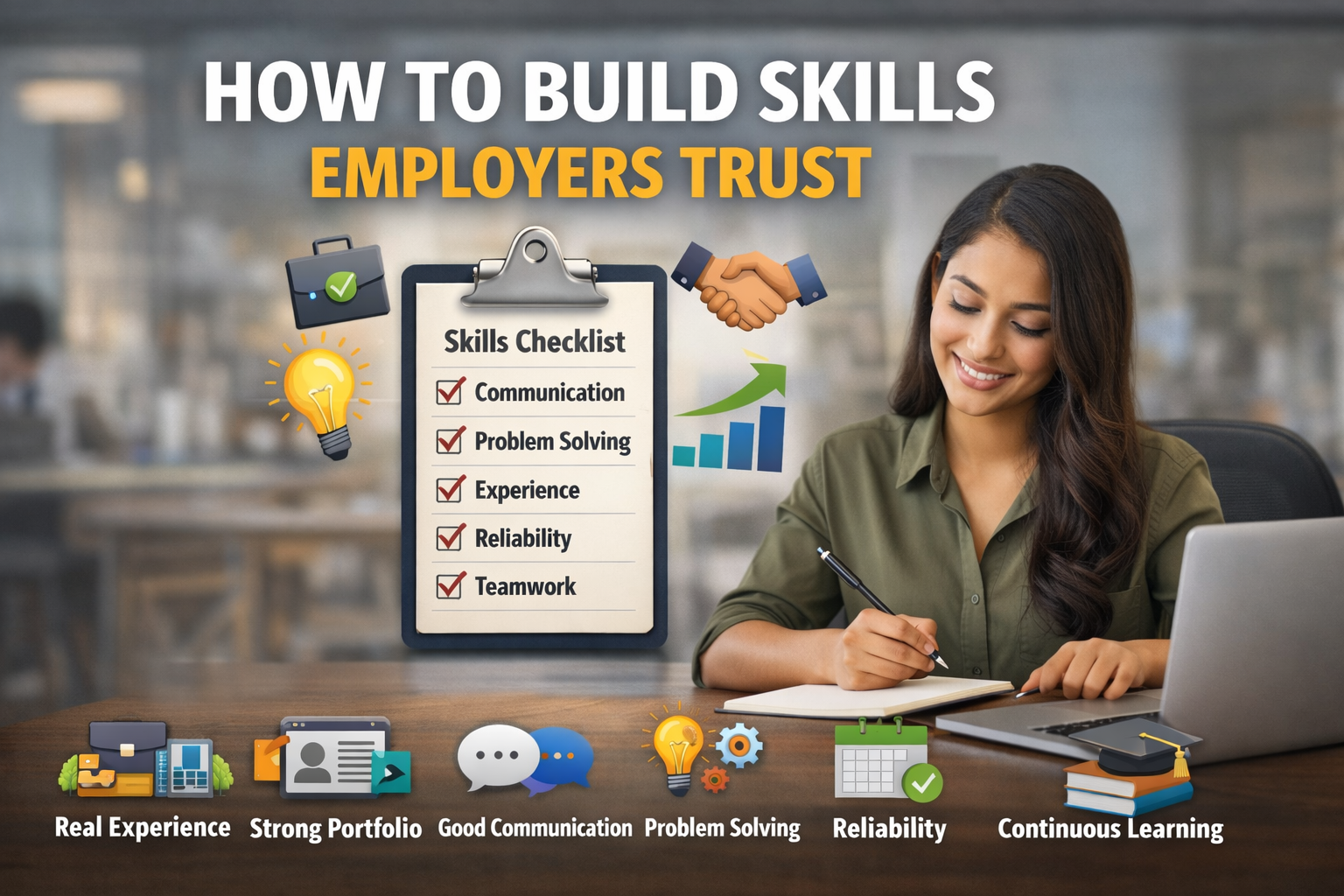
In today’s competitive job market, having a degree is not enough. Many people have qualifications, certificates, and experience. But still, not everyone gets selected for good jobs. Why? Because employers are not only looking for skills. They are looking for skills they can trust.
There is a big difference between saying “I know this skill” and proving “You can trust me with this work.” Employers want people who can handle responsibility, solve problems, and deliver results without constant supervision.
So the real question is not just how to build skills. The real question is:
How to build skills that employers trust?
Let us understand this step by step.
How to Build Skills Employers Trust?
1. Understand What Employers Really Want
Before building any skill, you must understand what employers expect.
Employers usually look for:
- Strong communication skills
- Problem-solving ability
- Time management
- Teamwork
- Adaptability
- Basic technical knowledge
- Responsibility
- Consistency
Many candidates focus only on technical knowledge. But employers trust people who are reliable, disciplined, and solution-oriented.
If you want to build trusted skills, first research your industry. Look at job descriptions. Notice common requirements. This will help you build relevant skills instead of random skills.
2. Focus on Strong Foundations
If your foundation is weak, your confidence will also be weak.
For example:
- If you are a content writer, improve grammar, research skills, and clarity.
- If you are a designer, understand design basics like color theory and layout.
- If you are in marketing, learn customer psychology.
Do not rush to advanced topics. Master the basics first.
Employers trust people who have clarity in fundamentals. When your basics are strong, you make fewer mistakes and work more confidently.
3. Practice More Than You Study to Build Employers Trust
Many people watch courses but do not practice.
Watching tutorials is not equal to building skills.
If you want to build trusted skills:
- Practice daily
- Do small projects
- Work on real examples
- Create samples
For example, if you want to become a freelance content writer, write articles regularly. Publish on Medium. Create a portfolio. This shows proof of your skills.
Employers trust proof, not promises.
4. Build Real-World Experience
Experience builds trust.
Even if you are a beginner, you can:
- Do internships
- Work on freelance platforms
- Volunteer
- Help small businesses
- Create personal projects
Real experience teaches you:
- How to handle deadlines
- How to manage clients
- How to solve practical problems
- How to deal with feedback
When you face real challenges, your skills improve faster. And employers trust candidates who have handled real situations.
5. Improve Communication Skills to Build Employers Trust
No matter your field, communication is very important.
You may have great technical knowledge, but if you cannot explain your ideas clearly, employers may hesitate.
To improve communication:
- Practice speaking clearly
- Improve writing skills
- Learn to listen actively
- Avoid overcomplicated language
- Be confident but respectful
Good communication builds trust because it reduces misunderstanding.
When employers see that you can explain work clearly and respond professionally, they feel secure giving you responsibility.
6. Learn to Solve Problems Independently
Employers do not want employees who ask questions for every small issue.
They trust people who:
- Think before asking
- Try to find solutions
- Research properly
- Take initiative
Next time you face a problem:
- Understand the issue clearly
- Think of possible solutions
- Try at least one solution
- Then ask for help if needed
This shows maturity and responsibility.
Problem-solving ability is one of the most trusted skills in any workplace.
7. Be Consistent and Reliable
Trust is built through consistency.
If you:
- Submit work on time
- Deliver quality regularly
- Keep your promises
- Stay professional
Then employers start trusting you.
Even small actions matter:
- Replying to emails on time
- Being punctual
- Meeting deadlines
- Accepting mistakes honestly
Reliability is more powerful than talent.
8. Develop Emotional Intelligence
Emotional intelligence means understanding your emotions and others’ emotions.
In the workplace, you will face:
- Stress
- Criticism
- Different personalities
- Pressure
If you react emotionally, employers may lose confidence in you.
Instead:
- Stay calm
- Accept feedback positively
- Avoid arguments
- Be respectful
Employers trust emotionally stable people because they create a healthy work environment.
9. Keep Learning and Updating Yourself to Build Employers Trust
Industries change quickly.
If you stop learning, your skills become outdated.
To stay relevant:
- Read industry blogs
- Take online courses
- Follow experts
- Learn new tools
- Upgrade regularly
When employers see that you are improving yourself, they trust that you will grow with the company.
A growth mindset builds long-term trust.
10. Build a Strong Portfolio to Build Employers Trust
A portfolio shows practical proof of your work.
If you are:
- A writer – show published articles
- A designer – show designs
- A developer – show projects
- A marketer – show campaign results
A portfolio increases credibility.
Instead of saying “I can do this,” your work shows “I have already done this.”
Employers trust visible results.
11. Take Responsibility for Mistakes
Everyone makes mistakes. But not everyone accepts them.
When you hide mistakes, trust breaks.
When you:
- Accept errors
- Inform early
- Suggest solutions
- Improve next time
Then trust grows.
Employers respect honesty more than perfection.
12. Build Professional Habits
Small habits create big impact.
Some professional habits include:
- Planning your day
- Organizing tasks
- Keeping notes
- Tracking deadlines
- Following up on work
These habits make you dependable.
Employers trust organized people because they reduce chaos.
13. Work on Time Management
Time management is a powerful trust-building skill.
If you cannot manage time:
- Deadlines will be missed
- Quality will drop
- Stress will increase
To improve time management:
- Break tasks into small parts
- Set priorities
- Avoid distractions
- Use simple tools like to-do lists
When you respect time, employers respect you.
14. Build Teamwork Skills to Build Employers Trust
Most workplaces require collaboration.
Even if you are talented, you must work with others.
Teamwork includes:
- Listening to others
- Sharing ideas
- Supporting teammates
- Avoiding ego conflicts
Employers trust team players because they improve overall performance.
15. Maintain Professional Ethics to Build Employers Trust
Ethics means doing the right thing even when no one is watching.
Examples:
- Do not copy work
- Do not take credit for others’ ideas
- Keep client information confidential
- Respect company policies
Trust is impossible without ethics.
Employers value integrity highly.
16. Show Confidence Without Arrogance
Confidence attracts trust.
But arrogance destroys it.
Confidence means:
- Believing in your skills
- Speaking clearly
- Standing by your work
Arrogance means:
- Ignoring feedback
- Thinking you know everything
- Disrespecting others
Stay confident and humble at the same time.
17. Build Long-Term Discipline to Build Employers Trust
Motivation is temporary. Discipline builds skills.
You may not feel motivated daily. But if you practice consistently, improvement will happen.
Set routines:
- Fixed learning time
- Fixed practice time
- Weekly review of progress
Discipline builds mastery. Mastery builds trust.
18. Ask for Feedback and Improve
Feedback helps you grow faster.
Instead of feeling bad about criticism:
- Ask what can be improved
- Note suggestions
- Apply changes
Employers trust people who improve quickly.
Growth mindset shows maturity.
19. Develop Decision-Making Ability
Decision-making is a leadership skill.
Start with small decisions:
- Prioritizing tasks
- Choosing tools
- Managing time
Over time, your confidence will increase.
Employers trust people who can make practical decisions without confusion.
20. Build a Positive Professional Reputation
Your reputation matters.
Reputation is built through:
- Good work
- Professional behavior
- Honest communication
- Respectful attitude
In freelancing and corporate jobs, reputation spreads through word of mouth.
Trust grows slowly but stays strong if maintained carefully.
Conclusion
Building skills is not difficult. But building skills that employers trust requires patience, discipline, and real effort.
Degrees may get you an interview.
But trusted skills get you long-term success.
Remember:
- Focus on basics
- Practice consistently
- Build real experience
- Communicate clearly
- Be responsible
- Stay ethical
- Keep learning
Trust is not built in one day. It is built through daily actions.
When employers see that you are reliable, solution-oriented, and committed, they will not just hire you — they will depend on you.
And when someone depends on you, your career becomes stable and strong.
To explore more such blogs, read here.

Leave a Reply