Introduction
Many students and fresh graduates think internships are small experiences. They feel internships are not equal to full-time jobs. Because of this thinking, they write internships in a very simple and weak way in their resume or interviews.
But the truth is different.
An internship can be as powerful as a full-time job if you present it correctly.
Recruiters do not only look at job titles. They look at skills, responsibilities, results, and impact. If you know how to present your internship properly, it can become your strongest career asset.
In this article, you will learn how to present internships like full-time work in resumes, LinkedIn, and interviews.
How to Present Internships Like Full-Time Work?
1. Change Your Mindset First
Before changing your resume, you need to change your mindset.
Many candidates write:
“I was just an intern.”
“I only helped the team.”
“I did small tasks.”
This mindset reduces your value.
Internships are real work. You worked with real teams, handled real tasks, followed deadlines, and solved problems. That is professional experience.
Instead of thinking:
“I was just learning.”
Start thinking:
“I was contributing while learning.”
Confidence changes presentation.
2. Focus on Responsibilities, Not the Title
The title “Intern” is not weak.
What makes it weak is how you describe it.
Instead of writing:
- Worked as a content writing intern.
- Helped senior team members.
Write like this:
- Created 10+ blog articles on health and lifestyle topics.
- Researched trending topics to improve website traffic.
- Coordinated with the SEO team to optimize content.
See the difference?
You are not just an intern.
You are a contributor.
Full-time employees also:
- Create content
- Attend meetings
- Meet deadlines
- Collaborate with teams
If you did similar work, present it clearly.
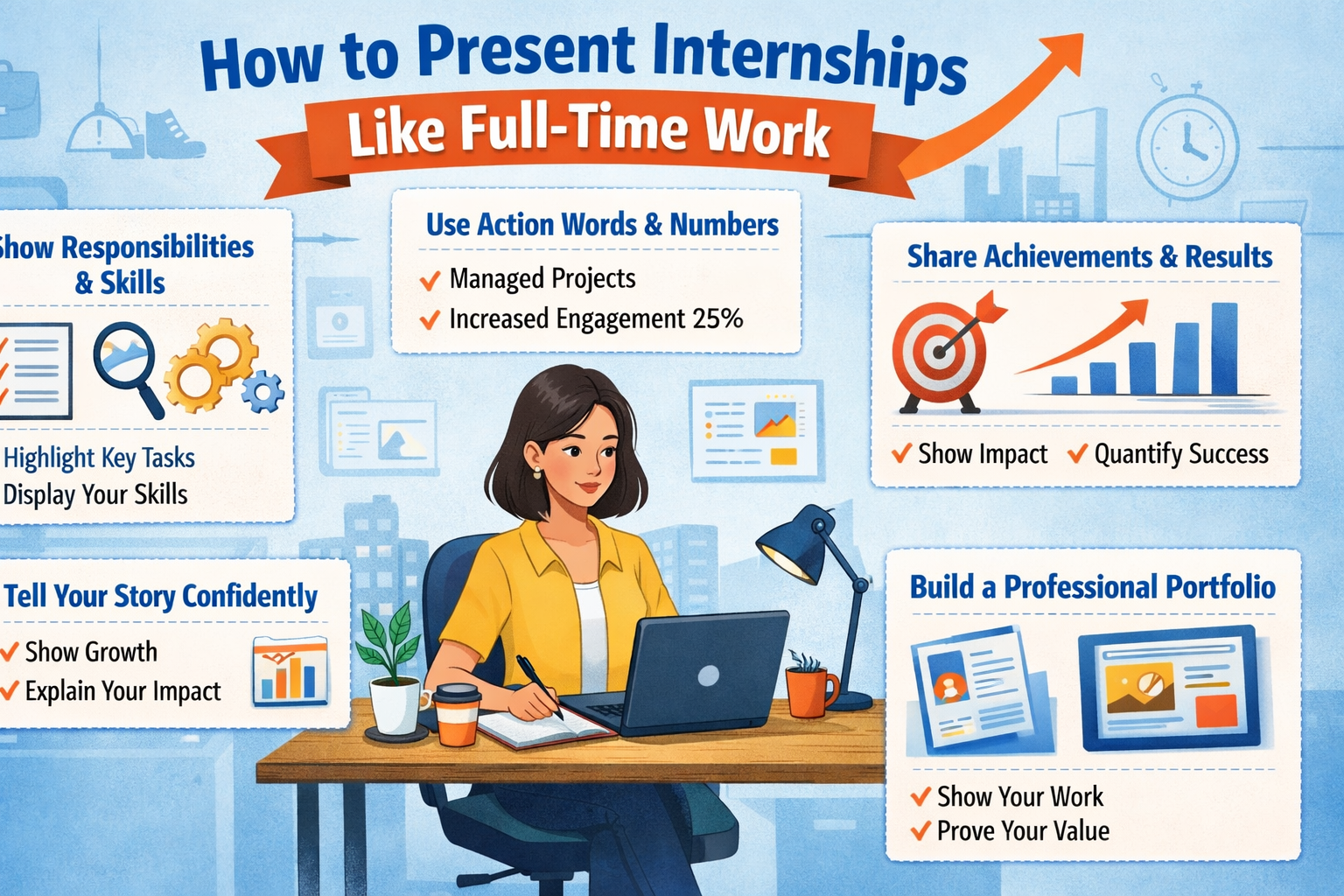
3. Use Action Words to Present Internships
Strong action words make your internship look professional.
Avoid weak words like:
- Helped
- Assisted
- Supported
Instead, use:
- Created
- Managed
- Developed
- Designed
- Led
- Improved
- Coordinated
- Analyzed
- Executed
For example:
Weak:
“I helped in social media posting.”
Strong:
“Managed social media posts for Instagram and LinkedIn, increasing engagement by 20%.”
Even if you did not increase engagement, you can still say:
“Planned and scheduled weekly social media content.”
Action words show ownership.
4. Add Results and Numbers
Full-time jobs are measured by performance.
Your internship should also show results.
Numbers make your work look serious.
For example:
- Wrote 15 articles in 3 months.
- Increased website traffic by 10%.
- Handled 5 client emails daily.
- Completed projects before deadline.
Even small numbers matter.
If you do not have exact numbers, estimate honestly.
Instead of:
“Worked on many articles.”
Write:
“Published 12 articles during internship period.”
Results make your experience look real and professional.
5. Show Skills You Used in Internships
Recruiters hire based on skills.
When you describe your internship, mention:
- Technical skills
- Communication skills
- Teamwork
- Time management
- Problem solving
For example:
“Used keyword research tools to improve blog visibility.”
“Communicated with designers to finalize article graphics.”
“Managed multiple deadlines efficiently.”
This makes your internship equal to job experience because you are showing real abilities.
6. Present Internships by Highlighting Ownership
One big difference between a weak and strong presentation is ownership.
Weak presentation:
“I was given tasks.”
Strong presentation:
“I managed weekly content calendar.”
Even if someone assigned you tasks, you still managed them.
Ownership shows maturity.
Recruiters want someone who takes responsibility, not someone who waits for instructions.
7. Present Internships Properly on Resume
Here is the correct structure:
Company Name
Content Writing Intern
Duration
Then bullet points:
- Wrote 12+ SEO-optimized articles on youth motivation and lifestyle.
- Researched industry trends to improve topic relevance.
- Coordinated with editorial team for timely publishing.
- Edited and proofread content before submission.
Do not write long paragraphs.
Use clear bullet points like full-time work experience.
Your internship section should look exactly like a job section.
8. Use LinkedIn Smartly
On LinkedIn, do not hide your internship.
Add:
- Clear description
- Skills used
- Achievements
- Portfolio links
You can also write posts like:
“During my internship, I learned how content strategy impacts audience engagement.”
This shows reflection and growth.
LinkedIn is not only for full-time employees. It is for professionals.
And you are a professional.
9. In Interviews, Tell Stories
When recruiters ask:
“Tell me about your experience.”
Do not say:
“I was an intern. I just wrote some articles.”
Instead, use storytelling.
Example:
“During my internship, I noticed that our blog engagement was low. I researched trending keywords and suggested new topics. After implementing those ideas, we saw improvement in reader interaction.”
This sounds like full-time responsibility.
Storytelling makes your internship sound impactful.
10. Show Learning and Growth
Internships are about growth.
Explain:
- What challenge you faced
- How you handled it
- What you learned
Example:
“At first, I struggled with meeting tight deadlines. So I created a weekly schedule and improved my time management.”
This shows professional development.
Recruiters like candidates who improve themselves.
11. Connect Internship to Future Role
If you are applying for a full-time job, connect your internship experience to that role.
For example:
If applying for content writer:
“My internship helped me understand SEO, audience targeting, and content planning, which are important for this role.”
If applying for marketing:
“I gained experience in social media strategy and analytics during my internship.”
This shows relevance.
12. Do Not Apologize for Being an Intern
Never say:
“I don’t have much experience.”
Instead say:
“I gained practical experience during my internship where I handled real projects.”
Confidence matters.
Recruiters can feel your energy.
If you present yourself as inexperienced, they will believe it.
If you present yourself as capable, they will consider you seriously.
13. Build a Portfolio to Present Internships
Internships become powerful when supported by proof.
If you:
- Wrote articles → Share links
- Designed graphics → Show samples
- Managed campaigns → Share screenshots
A portfolio makes your internship look like professional work.
It shows that you did real tasks, not just learning.
14. Emphasize Professional Behavior
Full-time jobs require:
- Punctuality
- Communication
- Accountability
- Teamwork
If you showed these qualities, mention them.
Example:
“Maintained consistent communication with team members.”
“Delivered assignments before deadlines.”
Professional behavior makes you job-ready.
15. Understand Recruiter’s Perspective
Recruiters ask one main question:
“Can this person handle responsibility?”
If your internship description shows:
- Responsibility
- Results
- Skills
- Growth
Then it already looks like job experience.
They care about capability, not label.
Conclusion
Internships are not small experiences. They are early professional experiences.
The difference between a weak and strong profile is not the title.
It is the presentation.
If you:
- Use strong action words
- Add numbers
- Show results
- Highlight skills
- Tell stories confidently
Your internship can look like full-time work.
Remember this:
You were not “just an intern.”
You were a professional in training who contributed to real work.
And when you present it with clarity and confidence, it becomes your stepping stone to bigger opportunities.
Start rewriting your internship experience today.
Because how you present your experience decides how the world sees your potential.
You can read more such blogs with the Best Job Tool.



Leave a Reply