Introduction
Building a career is very important for every person, whether male or female. Without building a career, it becomes difficult to survive. That is why thinking about your career and making it strong is very important. While building a career, many problems come. We have to take many decisions. Because of this, sometimes we feel motivated and sometimes we feel frustrated. We face career doubts as well.
Career doubts is completely normal. But if it is not controlled, it is not good for your growth. That is why managing career doubt is very important. And in this article, we are going to talk about how to manage career doubts rationally.
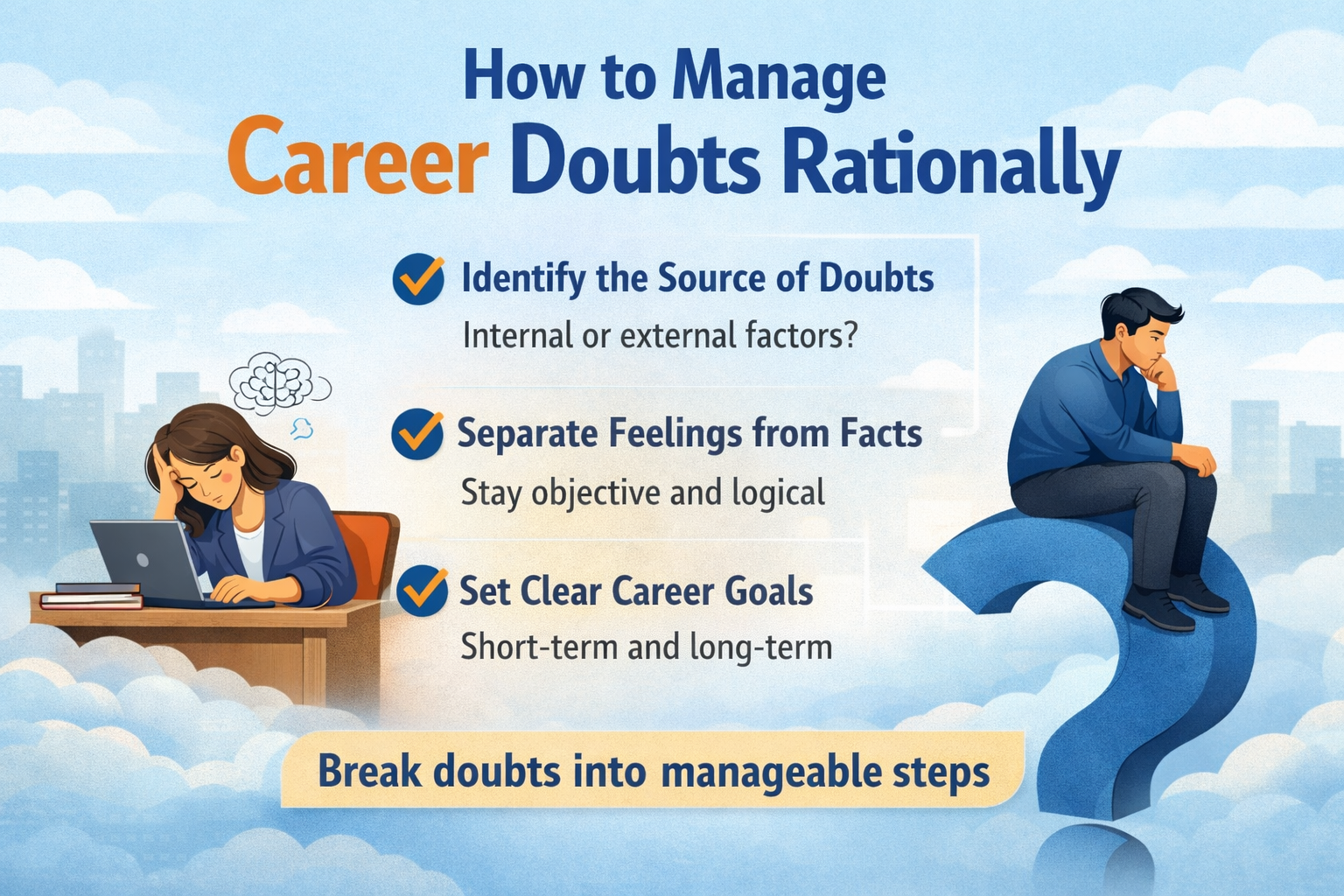
How to Manage Career Doubts Rationally?
1. Focus on What You Can Control
Many people overthink and take stress about things without even talking about them. They worry about things in which they have no role and no control, like “What if I don’t get selected?” or “What if I fail?”
The truth is, you cannot control the outcome. It depends on the recruiter and different conditions. That is why you should focus only on the things that are in your control, such as your skills, preparation, effort, and consistency.
If you focus more on these things, you will automatically take every action with full preparation and confidence. When your actions are good, the chances of getting good results also increase.
2. Limit Comparison to Manage Career Doubts
It is very important for all of us to understand that every person is different. Everyone has different goals and different thinking. But many people compare themselves with others and start doubting their own work. Because of this, they feel demotivated and take stress, which increases career doubts.
They need to understand that every person has different goals. If someone has achieved something different, it does not mean you also need to achieve the same thing. It is possible that your goal is even bigger or different from theirs.
If you stop comparing yourself with others, you will be able to focus more on your own work. This will reduce your stress and help you avoid career doubts.
3. Separating Emotions from Facts
Another mistake that professionals regret is selecting a career under family pressure or by copying someone else.
Many times, it happens that when our friends, classmates, or cousins choose a particular career, we also select the same stream without thinking properly. Sometimes, due to family pressure, we plan a career that does not make us happy or that we do not like. Later, the work starts to feel like a burden, and because of this, professionals end up regretting their career choices.
4. Setting Clear Career Goals to Manage Career Doubts
In today’s time, many young professionals start their careers without clear goals. They just know that they want a job but they do not know the direction, what to achieve, or how to grow.
Setting career goals is important because clarity gives direction. When you know in which field you have to go, at what position you want to reach, and what efforts you need then only you can shape your career confidently.
You need to divide your goals into two parts one short-term and another long-term;
- Short-term goals
Short-term goals are the goals that can be achieved in a year such as learning a specific skill, doing an internship, or completing a certification. - Long-term goals
Long-term goals are the goals that can be completed within 5 to 10 years such as reaching a leadership position, starting a business, or creating a strong personal brand.
If you do not have this clarity then you can feel confused and dissatisfied easily. That’s why set your goals in starting. Understand your interests and strengths and create a career road map on the basis of that. When you have a clear goal then your decisions will be smarter and your career growth will also be consistent.
5. Seeking Reliable Mentor to Manage Career Doubts
Taking guidance or mentorship is very important for anyone who is starting their career or is already in the early stage of it. When someone is new, they often don’t understand which first step to take or how to work in the right way—and the first step is very important for building a strong career. That’s why taking guidance from someone who is already experienced and doing well in their field is extremely important.
However, many professionals ignore this, and later they regret not seeking guidance or mentorship earlier.
6. Evaluating Skills and Interests
Before choosing any career, the most important thing is to know yourself deeply. First, we should understand our strengths and weaknesses—what we like to do and what we do not like to do—and then choose a career accordingly.
However, many professionals choose a career without understanding themselves, and later they regret their decision.
You can also read “Career Mistakes Young Professionals Should Avoid”.
7. Risk Assessment and Planning
One of the most effective and simple ways to manage career doubts is to make a career plan. If you create a plan from the beginning and follow it properly, you will clearly know which step to take and when to take it. If one step is completed, you will know what the next step should be.
You will understand how to achieve your goals and what exactly you want to achieve. When a person already has answers to these questions, they do not take too much stress. They only feel a small amount of stress, which is completely normal.
That is why making a plan is very important. It helps you manage career doubts easily from the beginning.
8. Learning from Past Experiences
Many professionals ignore feedback in their starting phase. When a boss or a senior gives some suggestions then people think that as criticism. But actually, constructive feedback is a shortcut to growth.
If you take feedback positively then you can identify your mistakes quickly and improve them. This habit makes you better in every role. People who accept their weaknesses and work on them become successful and confident in their careers.
Also having a mentor is very valuable. A mentor is a person who guides with their experience whether taking the right career decisions handling office politics or building self confidence. You can avoid those mistakes that can harm your career through their guidance.
That’s why you should not avoid feedback instead make it the tool for your improvement. Also, find a mentor in your professional circle which can give you honest advice.
Conclusion
Career doubts are a natural part of professional life, but they don’t have to hold you back. By understanding the root of your doubts, separating emotions from facts, and taking a structured approach to decision-making, you can regain clarity and confidence in your path.
Rational reflection, goal-setting, and seeking reliable information empower you to make informed choices rather than reacting impulsively to uncertainty. Remember, every career journey involves moments of doubt—but with patience, planning, and self-awareness, these doubts can become stepping stones toward growth and long-term success.
Want to explore more such blogs? Visit here.


Leave a Reply