Introduction
We all want to choose the right skills to invest in.
But here’s the problem: time is limited. Energy is limited. Focus is limited.
If you’re building your career — especially as someone like you, Nagma, who is exploring content writing, freelancing, and different writing formats — you can’t afford to go “all in” on every new skill that sounds exciting.
The real question isn’t:
“What skill should I learn?”
It’s:
“How do I test a skill before I commit deeply to it?”
Because commitment without testing is risk.
And testing before commitment is strategy.
Let’s talk about how to do it the smart way.
Why You Should Never Commit Too Early?
We often get excited too fast.
You watch a video about copywriting. Suddenly, you want to become a copywriter.
You see someone making money on YouTube. Now you want to start a channel.
You read about AI tools. You feel like you must master them immediately.
Excitement is normal. But excitement is not evidence.
Before investing months (or years), you need proof in three areas:
- Do I enjoy this skill in practice?
- Am I naturally inclined toward it?
- Does the market value it?
If you don’t test for these three things, you may end up stuck — or worse, burned out.
Step 1: Start Testing Skills With Low-Stakes Experiments
The biggest mistake people make is overcommitting too early.
Instead of:
- Buying expensive courses
- Announcing a career switch publicly
- Building an entire brand around one skill
Do this instead:
Run a 30-day experiment.
Let’s say you’re thinking about copywriting.
Don’t redesign your LinkedIn bio yet.
For 30 days:
- Write 10 ad copies.
- Rewrite 5 landing pages.
- Study 20 real ads.
- Post 3 samples publicly.
That’s it.
Low cost. Low pressure. Real exposure.
Testing should feel like exploration — not like marriage.
Step 2: Use Real Work, Not Theory
Reading about a skill doesn’t test it.
Watching tutorials doesn’t test it.
Even taking notes doesn’t test it.
Execution tests it.
If you want to test blog writing:
- Write 5 real blogs.
- Publish them on Medium or WordPress.
- Track engagement.
If you want to test freelance pitching:
- Send 20 proposals on Upwork.
- Track replies.
- Improve based on feedback.
Real friction reveals truth.
When you work on actual projects, you’ll quickly notice:
- Do I feel energized?
- Do I avoid starting?
- Does time pass quickly?
- Do I get better with practice?
Theory is comfortable.
Practice is honest.
Step 3: Measure Energy, Not Just Results
Most people only measure outcomes:
- Did I make money?
- Did I get likes?
- Did I get hired?
But when testing skills, energy is more important than early success.
Ask yourself after each session:
- Did this drain me?
- Did I feel curious to improve?
- Would I do this even if nobody paid me yet?
In the beginning, you may not be great.
That’s normal.
But if the process excites you, that’s a strong signal.
Energy compounds faster than talent.
Step 4: Look for Small Wins to Test Skills
You don’t need huge success to validate a skill.
You need small signs.
For example:
- Someone comments that your writing helped them.
- A recruiter responds positively to your sample.
- Your article gets more reads than your previous ones.
- A client asks for revision instead of rejecting you.
These are micro-validations.
They show potential.
Skill testing isn’t about instant mastery.
It’s about early traction.
Step 5: Test Demand Alongside Interest
Liking a skill is not enough.
The market must want it.
For example, if you’re exploring:
- Blog writing
- Email marketing
- LinkedIn ghostwriting
- Product descriptions
Check:
- Are people hiring for this?
- What are they paying?
- What experience do they expect?
- What results do top freelancers show?
Use platforms like:
- Upwork
- Fiverr
Search real job posts.
If companies are actively hiring, that’s market validation.
If demand looks weak or saturated without differentiation, think carefully.
Testing skills means testing market reality — not just personal preference.
Step 6: Shadow the Skills at a Small Scale
Before going full-time, simulate the role.
Want to test content strategy?
Don’t call yourself a strategist yet.
Instead:
- Audit 5 creators’ content.
- Create strategy documents for practice.
- Analyze what works and what doesn’t.
- Publish your insights.
You’re doing the work — without the pressure.
This builds clarity.
You either:
- Feel more excited.
- Or realize it’s not for you.
Both outcomes are success.
Step 7: Calculate the Learning Curve
Some skills show results fast.
Some take longer.
For example:
- Short-form content writing → quick feedback.
- SEO writing → slow but measurable.
- Brand strategy → long learning curve.
Ask:
- How long am I willing to struggle?
- Do I have patience for delayed rewards?
Testing includes understanding the timeline.
If you give up after two weeks, maybe the problem isn’t the skill — it’s expectations.
Step 8: Get Feedback Early to Test Skills
Don’t test skills in isolation.
Share your work.
Post on LinkedIn.
Submit to publications.
Send samples to mentors.
Join communities.
External feedback shortens confusion.
Sometimes you think you’re bad — but others see potential.
Sometimes you think you’re good — but the market disagrees.
Both insights are valuable.
Testing without feedback is incomplete testing.
Step 9: Compare Opportunity Cost to Test Skills
Every skill has a cost.
If you spend six months learning video editing, what are you not learning?
If you spend a year mastering SEO, what are you postponing?
Skill testing helps you avoid deep investment in low-leverage areas.
For example:
If you notice your blog writing gets traction but graphic design doesn’t — double down on writing.
Your experiments will show patterns.
Patterns guide commitment.
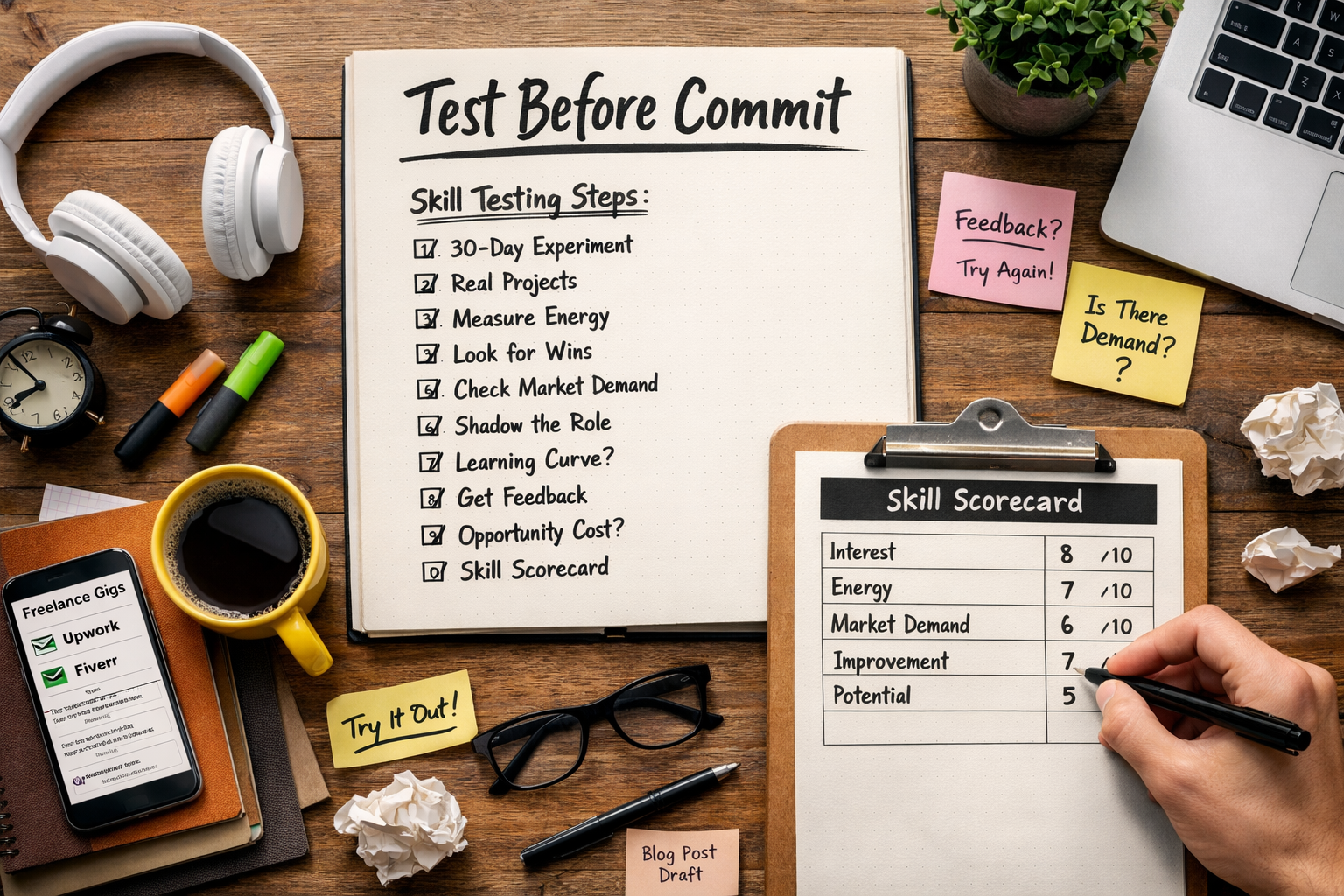
Step 10: Create a Skill Scorecard
Make testing objective.
After 30–60 days, rate the skill on:
- Interest (1–10)
- Energy (1–10)
- Improvement speed (1–10)
- Market demand (1–10)
- Monetization potential (1–10)
Add them up.
If the score is high → commit deeper.
If the score is average → test longer.
Or if the score is low → move on.
Simple system. Clear thinking.
When to Commit Deeply?
After testing, commitment should feel calm — not impulsive.
Commit when:
- You’ve done real work.
- You’ve received external validation.
- You understand market demand.
- You enjoy the process.
- You’re willing to improve long-term.
Commitment means:
- Structured learning.
- Portfolio building.
- Focused practice.
- Strategic positioning.
Not random effort.
Conclusion
Deep commitment is powerful.
But deep commitment without testing is risky.
The smartest professionals don’t jump blindly.
They:
- Run small experiments.
- Gather feedback.
- Study market demand.
- Measure energy.
- Look for traction.
Then they commit.
You don’t need to know your “forever skill.”
You just need to know your next experiment.
Start small.
Test honestly.
Observe yourself.
Let evidence guide you.
Commitment should feel earned — not forced.
And when you finally go deep into a skill, you’ll do it with confidence, clarity, and conviction.
To explore more such blogs, you can visit the Best Job Tool.


Leave a Reply