Introduction: Some Candidates Are Remembered
Getting selected in an interview is not only about answering questions correctly. Many candidates give similar answers, have similar qualifications, and even similar experience. But still, after the interview, some candidates are remembered clearly by recruiters, while others are forgotten within hours.
So the real question is: Why do some candidates stay in the interviewer’s mind?
The answer is not luck. It is a mix of psychology, communication, behavior, and small details that create a strong impression. In this article, we will understand the main reasons why some candidates are remembered after interviews.
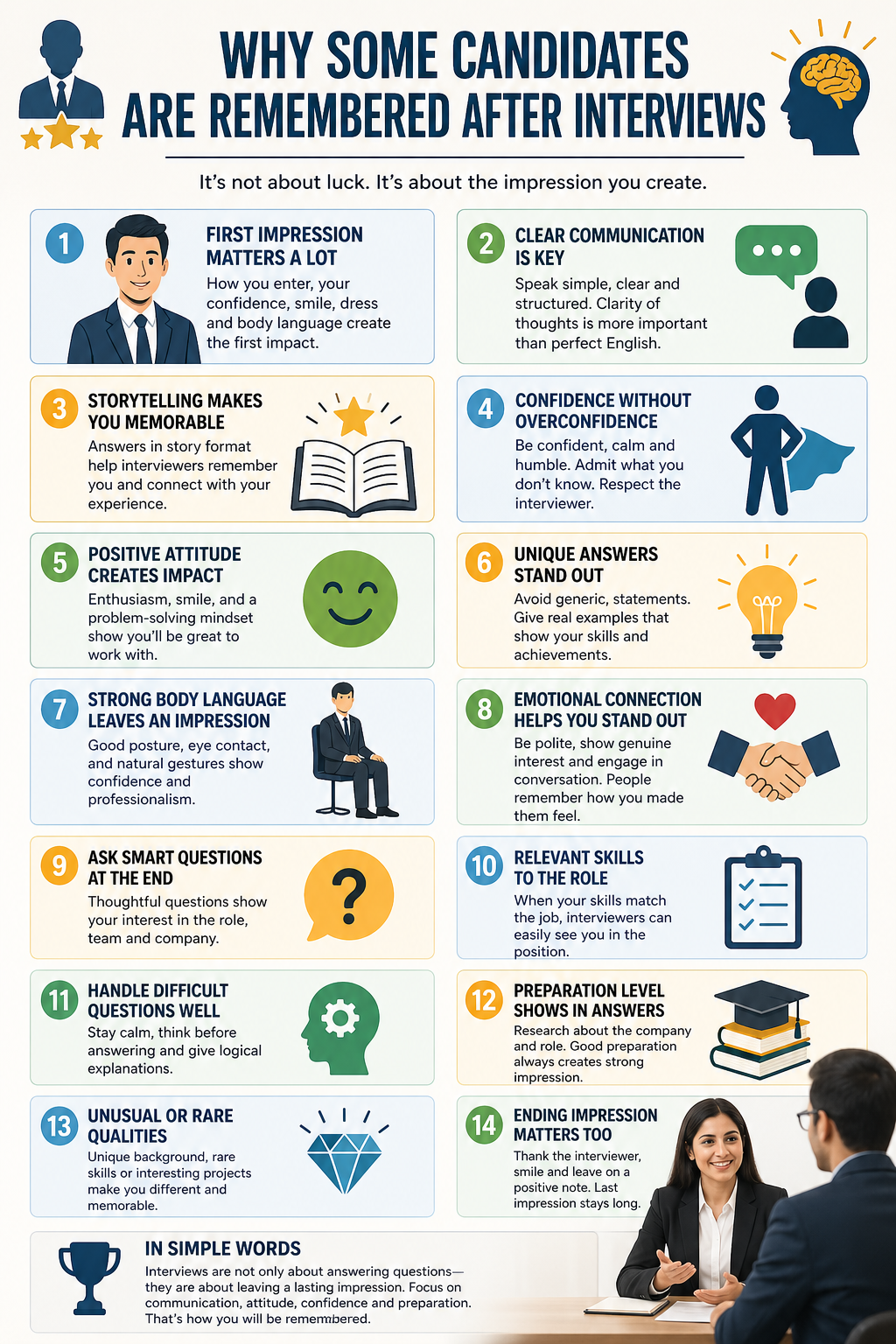
1. First Impression Matters a Lot
The first few seconds of an interview are very important. In psychology, it is known as the first impression effect. Interviewers start forming an opinion about the candidate even before the interview officially begins.
Simple things create this impression:
- Dressing neatly
- Smiling while entering
- Confident body language
- Polite greeting
- Eye contact
If a candidate enters the room with confidence and calmness, the interviewer automatically feels positive. On the other hand, nervous behavior or lack of confidence can create a weak impression.
Many candidates think only answers matter, but the truth is that how you enter the room matters as much as what you say inside it.
2. Clear Communication Is More Important Than Perfect English
Many candidates believe that they need very strong English to impress interviewers. But this is not fully true.
What interviewers actually want is:
- Clear thoughts
- Simple explanation
- Confidence while speaking
- Proper structure in answers
A candidate who speaks simple English but explains ideas clearly is more memorable than someone who uses difficult words but sounds confusing.
For example:
Instead of saying:
“I have synergized my skills to optimize productivity outcomes.”
Say:
“I used my skills to improve my productivity and complete tasks better.”
Clear communication always leaves a stronger impact.
3. Storytelling Makes Candidates Memorable
Humans remember stories more than facts. Interviewers also remember candidates who answer in a story format.
Instead of saying:
“I worked on a project in college.”
A memorable candidate says:
“In my final year, I worked on a project where we faced a problem with time management. I took the responsibility to organize tasks, and we completed the project before deadline.”
This type of answer:
- Shows experience
- Shows problem-solving
- Shows leadership
- Feels real and human
Stories create emotion, and emotion creates memory. That is why storytelling is one of the strongest tools in interviews.
4. Confidence Without Overconfidence
Confidence is one of the biggest reasons candidates are remembered. But there is a difference between confidence and overconfidence.
Confident candidates:
- Speak calmly
- Admit when they don’t know something
- Stay respectful
- Maintain good posture
Overconfident candidates:
- Interrupt interviewer
- Try to dominate conversation
- Pretend to know everything
- Sound arrogant
Interviewers prefer candidates who are confident but humble. This balance creates a positive and lasting impression.
5. Positive Attitude Creates Strong Impact
Attitude plays a huge role in interviews. Even if skills are average, a positive attitude can make a candidate memorable.
Positive candidates:
- Show enthusiasm for learning
- Stay calm under pressure
- Smile naturally
- Accept mistakes politely
- Show interest in company
Interviewers think:
“This person will be easy to work with.”
And this thought makes them remember the candidate.
6. Unique Answers Stand Out
Many candidates give same type of answers like:
- “I am hardworking”
- “I am a quick learner”
- “I work well in a team”
But these answers are common. Interviewers hear them again and again.
Memorable candidates add examples:
Instead of saying:
“I am hardworking.”
They say:
“I am hardworking. In my last internship, I worked extra hours to complete a client report before deadline.”
This makes the answer real and different.
Unique answers always stay in memory longer than generic statements.
7. Strong Body Language Leaves a Lasting Impression
Even before speaking, body language communicates a lot.
Positive body language includes:
- Sitting straight
- Not crossing arms
- Good eye contact
- Natural hand movements
- Calm expressions
Negative body language includes:
- Looking down
- Nervous movements
- Poor posture
- Lack of eye contact
Interviewers often remember how a candidate felt in the room more than what they said. Body language creates that feeling.
8. Emotional Connection with Interviewer
Candidates who create a small emotional connection are more likely to be remembered.
This does not mean being overly personal. It means:
- Being polite
- Showing genuine interest
- Smiling naturally
- Engaging in conversation, not just answering
Sometimes even a small moment like a shared laugh or thoughtful answer can create connection.
When interviewers feel comfortable with a candidate, they remember them more easily.
9. Asking Smart Questions at the End
At the end of most interviews, candidates are asked:
“Do you have any questions for us?”
Many candidates say “No.” This is a missed opportunity.
Memorable candidates ask smart questions like:
- “What does success look like in this role?”
- “What skills are most important for this position?”
- “What challenges is the team currently facing?”
These questions show:
- Interest in the role
- Seriousness about job
- Long-term thinking
Interviewers often remember candidates who ask meaningful questions.
10. Relevance of Skills to Job Role
Even if a candidate is good, they are remembered more when their skills match the job clearly.
For example:
- A content writing role candidate talks about writing samples
- A marketing role candidate talks about campaigns
- A tech role candidate talks about projects and tools
When skills directly match the job needs, interviewers quickly connect the candidate to the role in their mind.
Conclusion: Some Candidates Are Remembered
Being remembered after an interview is not about luck or being perfect. It is about creating a complete impression that includes communication, confidence, attitude, and behavior.
The most memorable candidates are not always the most qualified ones. They are the ones who:
- Communicate clearly
- Show confidence with humility
- Use storytelling
- Stay positive
- Connect with the interviewer
- Prepare well
- And leave a strong final impression
In simple words, interviews are not only about answering questions—they are about leaving a lasting impression in the interviewer’s mind.
If you learn to focus on these small but powerful details, you will not just attend interviews—you will be remembered in them.

Leave a Reply