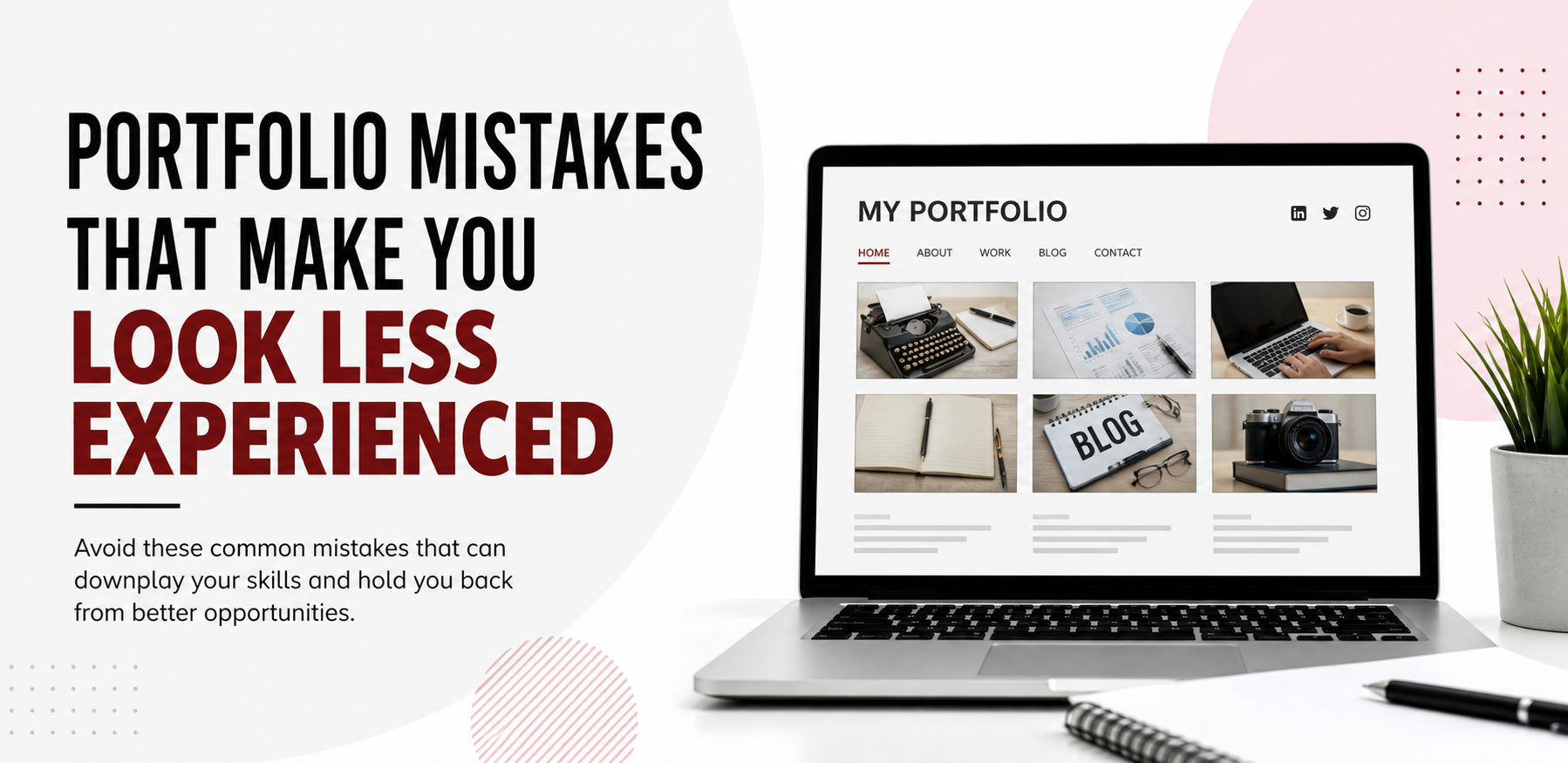
Introduction: Portfolio Mistakes
A portfolio is very important for a candidate because it helps them show their work in a proper way. Through a portfolio, a person can easily showcase their skills. That is why having a strong portfolio is very important so that others can understand your value and trust your work.
But many candidates unknowingly make several mistakes in their portfolio. If you don’t want to make those common mistakes, then you must read this article so that you can avoid portfolio mistakes that make you look less experienced.
Portfolio Mistakes That Make You Look Less Experienced
1. Including Too Many Unpolished Samples
When a candidate creates a portfolio, the first thought that comes to their mind is to include all the work they have done so far. They think that showing everything will help the other person understand what they have done and what kind of work they have handled.
But this is actually the biggest mistake. When someone tries to show everything in their portfolio, it starts looking messy and complex. That is why, whenever you are creating your portfolio, you should remember that you only need to include your best samples.
Just add your top 5 to 10 strongest pieces so that the other person can clearly understand the quality of your work.
2. No Clear Niche or Focus
Another mistake that many candidates make, but they don’t realize it is actually a mistake, is not having a clear niche or focus.
Not having a clear niche is a problem because if you include random topics in your portfolio, the other person may feel that you are unfocused. It gives the impression that you try everything but are not really consistent or focused on one clear direction.
That is why you should avoid adding too many different niches in your portfolio. Otherwise, you may look like a beginner who is still experimenting.
A better approach is to group your work into one or two clear niches, such as motivation, lifestyle, or SEO blog writing.
3. Weak or Missing Headlines
A weak or missing headline can also reduce your professionalism in a portfolio. Including headings in your portfolio is very important because if you only add links or simple titles without any proper headline, it can create confusion.
It may give the impression that your thinking ability is weak, you are not very creative, and your work looks unfinished.
That is why you should always remember to include clear and strong headlines in your portfolio because they create your first impression.
4. Not Showing Results or Impact
What work you have done is important to include in your portfolio, but if you also add results with it, it becomes even more effective. It gives proof to the other person that your work has actually created some impact or benefit. Even if the results are small, you should try to include them in your portfolio.
You should also add context wherever possible, such as engagement numbers, publication name, or the purpose of the piece. This makes your work look less theoretical and more practical. It helps you appear more like a professional rather than just a beginner.
5. Poor Formatting and Visual Clutter
Another common mistake that most candidates make is poor formatting and visual clutter.
This means that if your portfolio layout is not clean and looks messy, then even if your work is very good, it will still look confusing to the other person. It may look unprofessional and difficult to read, almost like an unorganized draft folder, which can reduce trust instantly.
That is why you should use a better approach. Keep your portfolio clean with a consistent font, proper spacing, and clear sections.
6. No “About Me” Clarity
The “About Me” section in a portfolio is another very important part, and ignoring it is a mistake.
You should write this section in a strong way so that it does not sound generic but instead feels unique. If you write a generic “About Me” section, it does not build any personal positioning. It does not give clarity and also does not help in building trust.
That is why you should write a short and focused introduction that includes what you do, your niche, and your experience level.
Conclusion: Portfolio Mistakes
A portfolio is often your first impression, and in many cases, your only chance to convince someone of your skills. The difference between getting noticed and getting ignored usually comes down to small but critical mistakes.
When your portfolio is unfocused, cluttered, or lacks clarity, it can make you look less experienced—even if your actual skills are strong. On the other hand, a clean structure, selective samples, and a clear message can instantly improve how professional you appear.
The goal is not to show everything you’ve done, but to show the right work in the right way. Keep it simple, relevant, and updated regularly. A strong portfolio doesn’t just display your work—it builds trust in your potential.
“Fix your portfolio and stand out to recruiters — explore opportunities on Best Job Tool where strong profiles get noticed faster.”


Leave a Reply