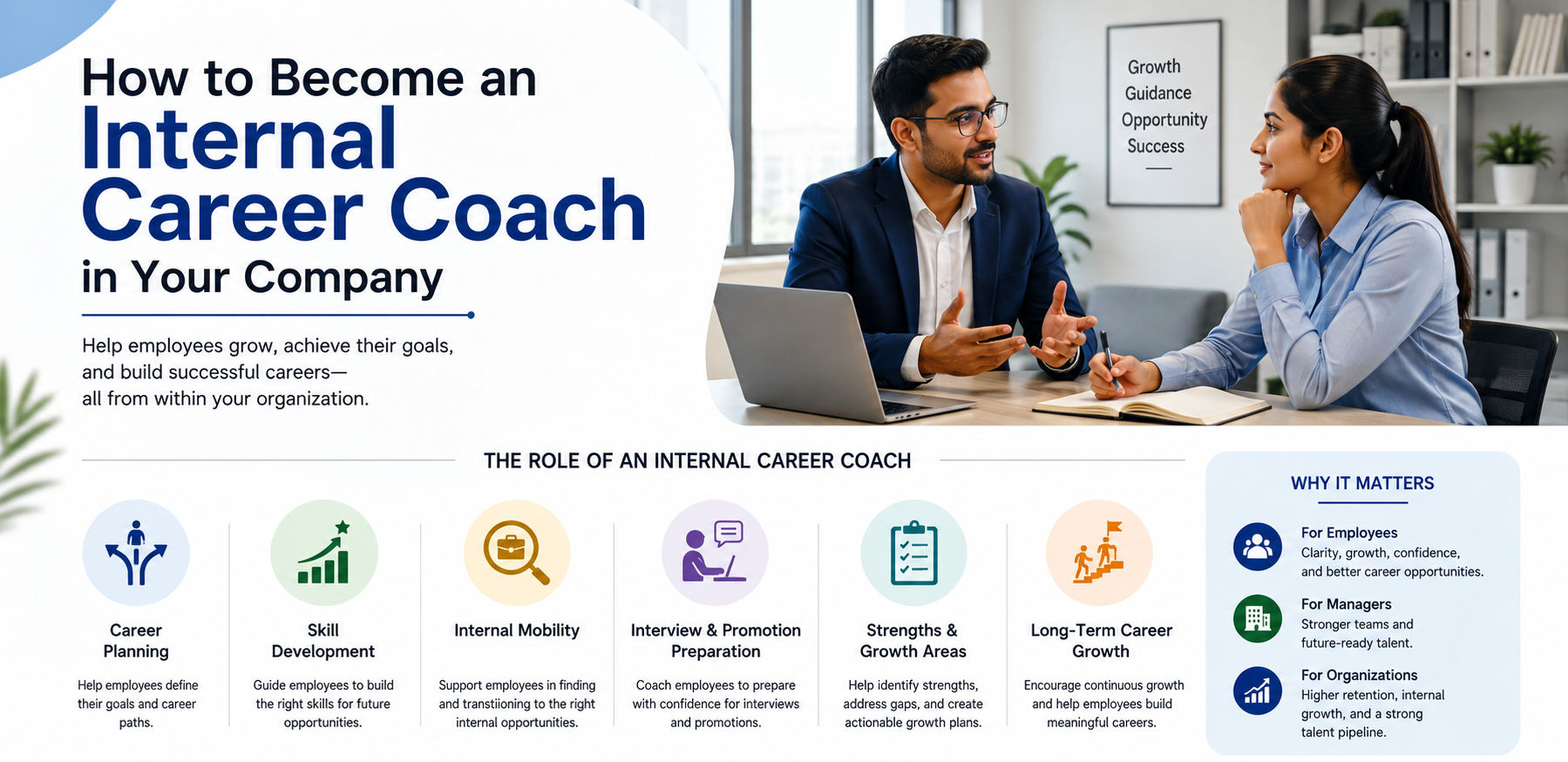
Introduction: Internal Career Coach
An internal career coach is a person in a company who helps employees grow in their careers so they can build a better future within the same organization.
If you also want to become and are interested in helping employees build their careers in the same company, it is not difficult. Today, we will share some effective and practical ways through which you can become an internal career coach in your company.
How to Become an Internal Career Coach in Your Company?
1. Understand What “Internal Career Coach” Means in Your Company
Before becoming an internal career coach, you need to understand what the role is called in your company. Different companies use different titles for the same role.
For example, it may be called Learning and Development Advisor, Talent Development Partner, Internal Mentor, or Coaching Lead. So, you should find out what title is used in your company for this role.
You also need to check whether someone is already doing this job in your company, because in many companies, the HR team handles these responsibilities. Without knowing this, you cannot apply for the role.
2. Build Strong Performance in Your Current Role
Another very important thing you need to focus on is building strong performance in your current role. If you are not able to handle your current responsibilities properly, then there is no point in the company involving you in another role.
That is why, before coaching others, you need to build credibility so that the people you guide can trust you. They should be able to see your work and know that you have achieved something and you complete your tasks effectively.
To build credibility, focus on consistent high performance in your job, develop strong communication skills, and improve your problem-solving ability.
3. Develop Coaching-Related Skills
If you want to coach employees, the most important thing is that you should have the right skills related to it. If you don’t have coaching skills, you will not be able to guide anyone properly.
Coaching does not require any formal degree. You only need the right skills, such as active listening, asking powerful questions, emotional intelligence, and a basic understanding of career paths.
If you have coaching-related skills, you will be able to easily guide others, answer their questions, and they will also trust you.
4. Start Informally Inside Your Company
To become an internal career coach, it is not necessary to have a specific title. Even without a title, you can help people build their careers.
So, if you really want to become an internal career coach and help employees, don’t wait for a title. Take initiative and start practicing. You can begin with small tasks like mentoring junior colleagues, helping them prepare for internal interviews, and guiding your teammates.
Through this, employees and your colleagues will start trusting you. When they face any problem, they will come to you for solutions. In this way, you can guide and support them like a coach.
5. Connect with HR / L&D Team
One of the most important steps to become a coach in your company is to connect with the HR or L&D team. The HR team also helps employees with coaching and development.
So, you can join hands with them and help employees. This can also help you become an internal career coach.
You can politely ask HR and approach them for this role. In this way, you can easily become an internal career coach.
6. Get Involved in Career Development Projects
You can also get involved in career development projects to become an internal career coach. Try to participate in internal mobility programs, training workshops, performance review support sessions, and employee engagement initiatives.
In these programs, you will get a chance to guide people. This will help you increase your visibility and show others that you can be a good internal career coach.
Conclusion
An internal career coach plays an important role in helping employees grow, improve their skills, and achieve their career goals within the company. They guide employees in making better career decisions, preparing for new opportunities, and building long-term professional growth.
For companies, it help improve employee engagement, retention, and overall workplace development. For employees, they provide support, direction, and confidence in their career journey.
“Support career growth inside your workplace and explore opportunities on Best Job Tool where mentorship and leadership truly matter.”


Leave a Reply