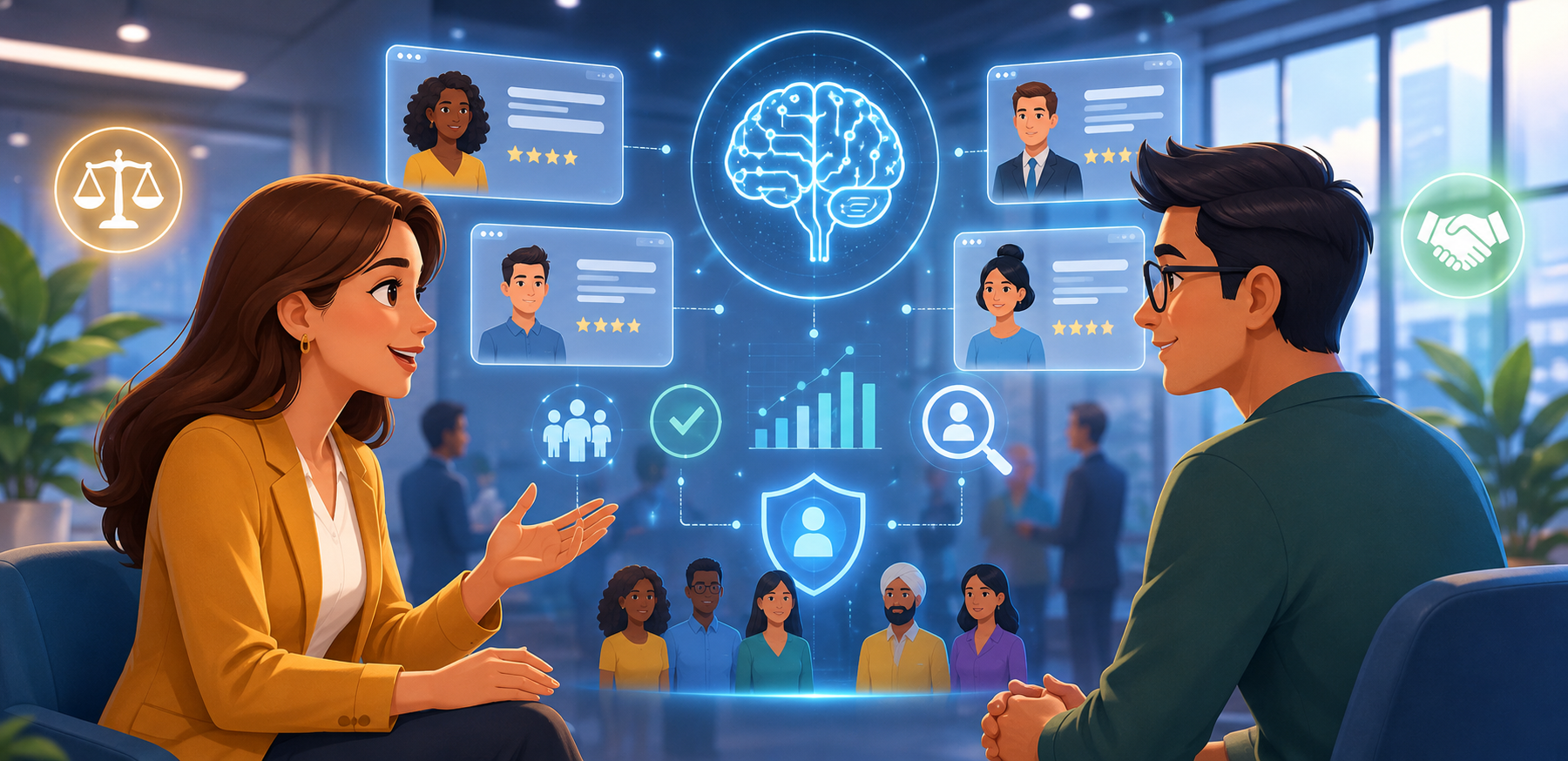
Introduction: Recruiters Can Use AI Ethically
There has been a major shift from traditional recruitment to modern recruitment because the job market is changing very quickly. One of the biggest changes is the introduction of Artificial Intelligence (AI).
AI has transformed many parts of the recruitment process and has helped make hiring faster and smoother. However, if recruiters do not use AI properly, it can also lead to poor hiring decisions.
Using AI in recruitment is a smart strategy, but depending on it too much can be risky. That is why recruiters should use AI carefully and responsibly to create a better hiring process.
In this article, we will understand how recruiters can use AI ethically without losing the human touch.
How Recruiters Can Use AI Ethically Without Losing the Human Touch?
1. Understand That AI Is a Tool, Not a Decision Maker
The first and most important thing is that both companies and recruiters need to understand that AI is only a tool, not a decision-maker.
Many companies and recruiters rely heavily on AI for recruitment, but this is not the right approach. AI can help analyze resumes, identify keywords, and rank candidates. However, it cannot fully understand a candidate’s character, behavior, personality, or potential. Because of this, AI alone cannot ensure the right hiring decision.
To make good hiring decisions, human evaluation is just as important as AI. Human involvement helps recruiters understand candidates better, assess their behavior, evaluate their communication skills, and gain a deeper understanding of their abilities and potential.
2. Be Transparent About AI Usage
The next important thing is to be transparent about the use of AI.
Both recruiters and candidates are equally important in the hiring process. That is why recruiters should inform candidates if AI is being used during recruitment. They should also clearly explain where AI is being used, such as resume screening, skill assessments, interview scheduling, or candidate matching.
When recruiters are transparent about AI usage, candidates are more likely to trust the company. It also helps candidates prepare themselves better for the recruitment process because they understand what to expect.
3. Regularly Check for Bias in AI Systems
Another important thing that many recruiters do not pay attention to, or may not be aware of, is that AI systems can be biased.
AI systems are trained on historical data. If past hiring decisions were biased, the AI system may learn the same patterns and continue making biased hiring decisions. As a result, companies may miss out on the best candidates.
The solution is to regularly check AI systems for bias. This helps recruiters understand how the system is making decisions and whether it is treating candidates fairly. If any bias is detected, the AI system should be updated and improved.
To identify bias, recruiters can review candidate screening results, shortlisting patterns, and assessment outcomes. Regular monitoring helps ensure that the hiring process remains fair, accurate, and inclusive.

4. Keep Human Review in the Hiring Process
Using AI tools in the recruitment process is a smart approach, but if you become completely dependent on them, it can lead to poor hiring decisions. That is why it is important to keep human review as part of the hiring process.
AI mainly works by analyzing keywords. If a resume contains the exact keywords the system is looking for, the candidate may be selected. If those keywords are missing, the candidate may be rejected.
However, this can sometimes cause talented candidates to be overlooked. A candidate may have valuable skills, experience, and potential, but their resume may not contain the specific keywords that the AI system is searching for.
Including human review at key stages of the recruitment process helps prevent this problem. Human recruiters can look beyond keywords, understand a candidate’s strengths, and identify talent that AI might miss.
5. Protect Candidate Privacy
During the recruitment process, companies collect some personal information from candidates. Protecting this information is the responsibility of the organization. That is why, if AI systems are being used in recruitment, they should have strong privacy and security protections.
It is the responsibility of recruiters to ensure that candidate data is stored securely, that AI tools follow privacy regulations, and that personal information is not shared unnecessarily.
When companies respect and protect candidate privacy, it helps build trust with applicants and improves the reputation of the organization. Candidates are more likely to feel confident in a company that handles their personal information responsibly and securely.
Conclusion: Recruiters Can Use AI Ethically
AI has changed the recruitment process by making many tasks faster and more efficient. However, ethical AI usage is important to ensure fair and effective hiring. Recruiters should use AI as a support tool rather than a decision-maker, remain transparent about its use, regularly check for bias, include human review in key hiring stages, and protect candidate privacy.
By combining the efficiency of AI with human judgment and empathy, recruiters can create a hiring process that is both effective and fair.
“Use AI to improve efficiency, but never forget that hiring is ultimately about people. Explore smarter recruitment strategies with Best Job Tool.”




Leave a Reply