Introduction
Modern talent acquisition is no longer just about filling vacancies. Today’s talent teams play a strategic role in workforce planning, employer branding, employee retention, and long-term business growth. As organizations compete Modern for skilled professionals in increasingly dynamic labor markets, data-driven decision-making has become essential.
Tracking the right metrics helps talent teams identify bottlenecks, improve hiring processes, optimize recruitment spending, and enhance candidate experiences. Without clear performance indicators, it becomes difficult to understand what is working and where improvements are needed.
The rise of remote work, skills-based hiring, workforce analytics, and AI-powered recruitment tools has further increased the importance of measurement. Talent leaders are now expected to provide insights that directly support business objectives.
This guide explores the most important metrics modern talent teams should monitor and how these indicators contribute to stronger hiring and workforce outcomes.
Why Recruitment Metrics Matter
Metrics transform recruitment from a reactive process into a strategic function.
Effective measurement helps organizations:
- Improve hiring efficiency
- Reduce recruitment costs
- Increase retention
- Enhance candidate experience
- Strengthen workforce planning
- Support business growth
Data allows talent teams to make informed decisions rather than relying on assumptions.
Organizations that consistently monitor recruitment performance are often better positioned to attract and retain top talent.
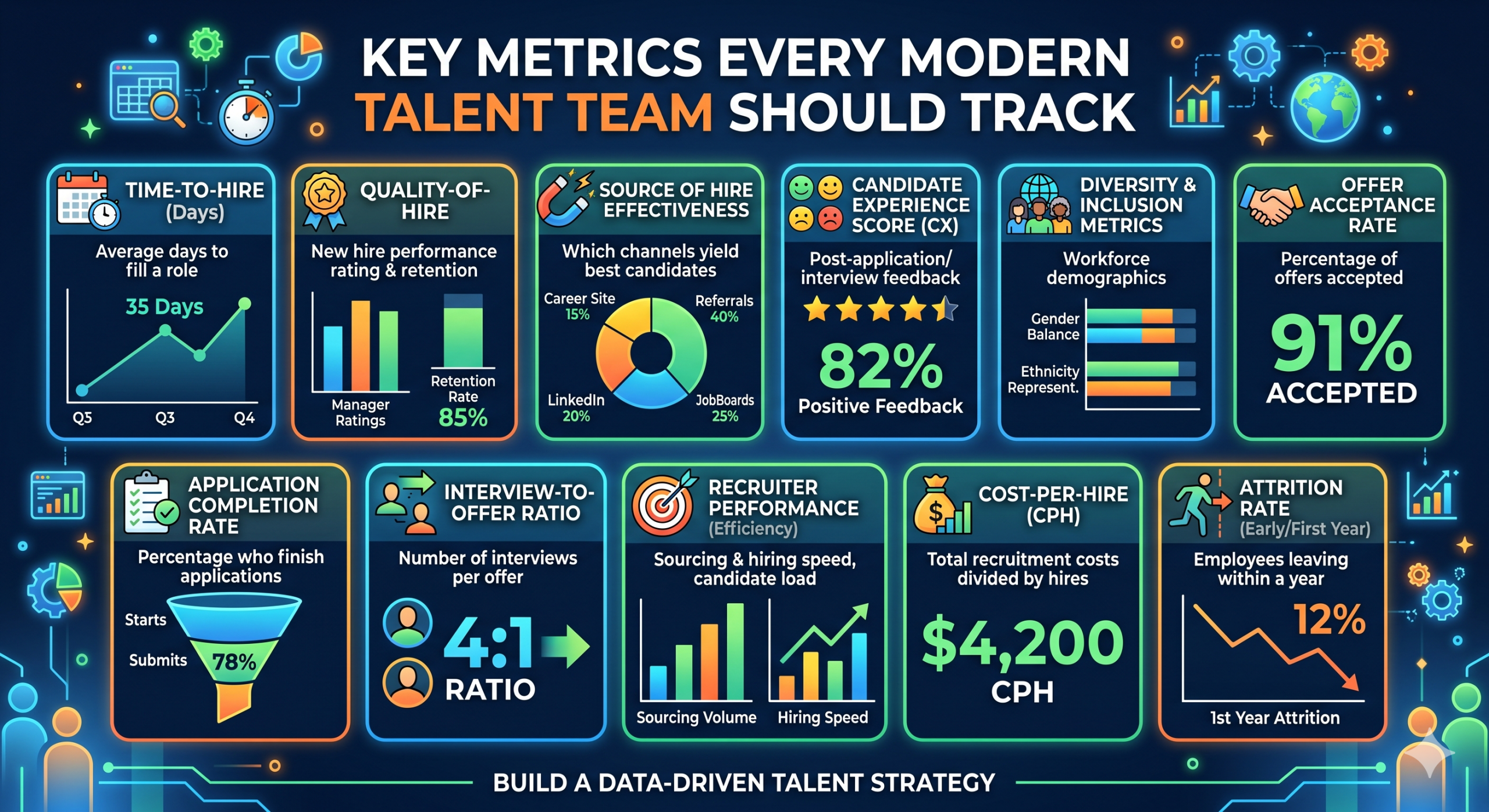
Time to Fill
Time to Fill measures the number of days required to fill a position after it becomes available.
Formula:
Time to Fill = Date Position Filled – Date Position Opened
This metric helps organizations understand recruitment efficiency.
A lengthy hiring process may indicate:
- Inefficient workflows
- Limited candidate pipelines
- Approval delays
- Market challenges
Monitoring Time to Fill helps talent teams identify opportunities to streamline recruitment activities.
Time to Hire
Time to Hire focuses specifically on the candidate journey.
Formula:
Time to Hire = Offer Acceptance Date – Candidate Application Date
This metric measures how quickly candidates move through the hiring process.
A shorter Time to Hire often improves:
- Candidate experience
- Offer acceptance rates
- Competitive hiring outcomes
Organizations that move efficiently frequently secure stronger candidates before competitors do.
Quality of Hire
Quality of Hire evaluates the long-term success of recruitment decisions.
Indicators may include:
- Performance ratings
- Productivity levels
- Manager satisfaction
- Goal achievement
- Retention rates
While more difficult to measure than speed-based metrics, Quality of Hire is one of the most valuable indicators of recruitment effectiveness.
Hiring quickly has limited value if new employees do not perform successfully.
Cost per Hire
Cost per Hire measures recruitment spending for each successful hire.
Costs may include:
- Job advertisements
- Recruitment software
- Agency fees
- Assessment tools
- Recruiter salaries
- Employer branding initiatives
Formula:
Cost per Hire = Total Recruitment Costs ÷ Number of Hires
Understanding recruitment costs helps organizations allocate resources more effectively.
Balancing efficiency and quality remains essential.
Offer Acceptance Rate
Offer Acceptance Rate measures the percentage of candidates who accept employment offers.
Formula:
Offer Acceptance Rate = Accepted Offers ÷ Total Offers × 100
Low acceptance rates may indicate:
- Compensation issues
- Poor candidate experience
- Competitive market conditions
- Employer branding challenges
Monitoring this metric helps organizations improve offer competitiveness.
Candidate Experience Score
Candidate experience directly affects employer reputation.
Organizations can measure candidate satisfaction through:
- Surveys
- Feedback forms
- Interview evaluations
- Net Promoter Scores
Positive candidate experiences contribute to:
- Stronger employer branding
- Increased referrals
- Better offer acceptance rates
Even rejected candidates can influence organizational reputation through their experiences.
Source of Hire
Source of Hire identifies where successful candidates originate.
Common sources include:
- Job boards
- Employee referrals
- Social media
- Career websites
- Recruitment agencies
- Professional networks
Tracking this metric helps talent teams:
- Optimize recruitment budgets
- Improve sourcing strategies
- Focus on high-performing channels
Understanding source effectiveness improves resource allocation.
Diversity Hiring Metrics
Diversity remains an important workforce objective for many organizations.
Relevant metrics may include:
- Candidate diversity
- Interview diversity
- Hiring diversity
- Promotion diversity
- Leadership representation
Monitoring these indicators helps organizations evaluate progress toward inclusion goals.
Diverse teams often contribute broader perspectives and stronger innovation.
Employee Retention Rate
Recruitment success extends beyond hiring.
Retention Rate measures the percentage of employees who remain with the organization over time.
Formula:
Retention Rate = Employees Remaining ÷ Total Employees × 100
High turnover may indicate:
- Poor hiring matches
- Management challenges
- Cultural issues
- Career development concerns
Retention data helps evaluate long-term recruitment effectiveness.
Early Turnover Rate
Early turnover measures employees who leave shortly after joining.
Common timeframes include:
- First 90 days
- First 6 months
- First year
High early turnover can signal:
- Inaccurate job descriptions
- Weak onboarding
- Poor candidate-job alignment
Reducing early turnover improves recruitment ROI and workforce stability.
Recruitment Funnel Conversion Rates
Modern talent teams should analyze each stage of the hiring funnel.
Examples include:
Application-to-Screening Rate
Percentage of applicants who advance.
Screening-to-Interview Rate
Effectiveness of candidate qualification processes.
Interview-to-Offer Rate
Quality of candidate selection.
Offer-to-Hire Rate
Success of final-stage recruitment efforts.
Funnel analysis helps identify bottlenecks and process inefficiencies.
Hiring Manager Satisfaction
Recruitment is most successful when hiring managers are satisfied with outcomes.
Surveys may evaluate:
- Candidate quality
- Recruitment speed
- Communication effectiveness
- Overall hiring experience
Hiring manager feedback provides valuable insights into recruitment performance.
Strong partnerships between recruiters and managers often improve hiring results.
Productivity Metrics for Talent Teams
Talent acquisition functions should also measure internal efficiency.
Examples include:
- Recruiter workload
- Requisitions managed
- Interviews coordinated
- Candidate response times
- Hiring velocity
Productivity metrics help talent leaders allocate resources effectively.
Efficient processes support better hiring outcomes.
Remote Hiring Metrics
As remote work continues to expand, talent teams should track:
- Remote candidate sourcing
- Virtual interview completion rates
- Remote offer acceptance rates
- Remote employee retention
- Distributed workforce performance
These insights help organizations optimize remote recruitment strategies.
Remote hiring often requires different approaches than traditional recruitment.
Workforce Planning Metrics
Long-term talent success depends on strategic workforce planning.
Important indicators include:
- Skills gaps
- Internal mobility rates
- Succession readiness
- Workforce growth forecasts
- Talent pipeline strength
These metrics help organizations prepare for future workforce needs.
Strategic planning reduces reactive hiring and improves organizational resilience.
Leveraging Talent Intelligence Platforms
Modern recruitment increasingly relies on workforce data and market intelligence.
Platforms such as BEST JOB TOOL provide valuable insights into hiring trends, labor market developments, remote work opportunities, and emerging skill demands.
BEST JOB TOOL helps talent teams better understand candidate availability, industry trends, and workforce dynamics, supporting more informed recruitment and workforce planning decisions.
Access to real-time market intelligence enhances the effectiveness of talent acquisition strategies.
Conclusion
Modern talent acquisition requires more than filling positions—it requires measuring outcomes that contribute to organizational success. By tracking key metrics such as Time to Fill, Quality of Hire, Cost per Hire, Retention Rate, Candidate Experience, and Workforce Planning indicators, talent teams can make smarter decisions and continuously improve performance.
Data-driven recruitment enables organizations to identify strengths, address weaknesses, and align hiring strategies with business goals. As workforce expectations evolve and remote work continues to reshape employment markets, measurement becomes increasingly important.
Organizations that consistently monitor and act on meaningful recruitment metrics position themselves to attract stronger candidates, improve retention, and build more resilient workforces. Combined with workforce intelligence from platforms like BEST JOB TOOL, these metrics provide a foundation for long-term talent success.





Leave a Reply