Introduction
The world of work is changing faster than ever. Technological innovation, artificial intelligence, automation, remote collaboration, digital platforms, and shifting consumer behavior have transformed how businesses operate. Future Jobs As a result, entirely new career paths have emerged that were either rare or virtually nonexistent just five years ago.
Many of today’s fastest-growing roles did not follow traditional career paths. Instead, they developed in response to new technologies, changing business needs, and evolving workforce expectations. This trend highlights an important reality for professionals: future career success may depend less on preparing for existing jobs and more on developing adaptable skills that can transfer into emerging opportunities.
Understanding these new professions can help job seekers, students, career changers, and professionals prepare for the future workforce and identify high-growth career paths before they become mainstream.
Why New Jobs Are Emerging Faster Than Ever
Several factors are driving the creation of new careers:
- Artificial intelligence adoption
- Remote work expansion
- Digital transformation
- Data-driven decision-making
- Creator economy growth
- Cybersecurity demands
- Automation technologies
- Workforce innovation
Organizations continually face new challenges, and new challenges create demand for specialized expertise.
As industries evolve, entirely new roles emerge to address changing business requirements.
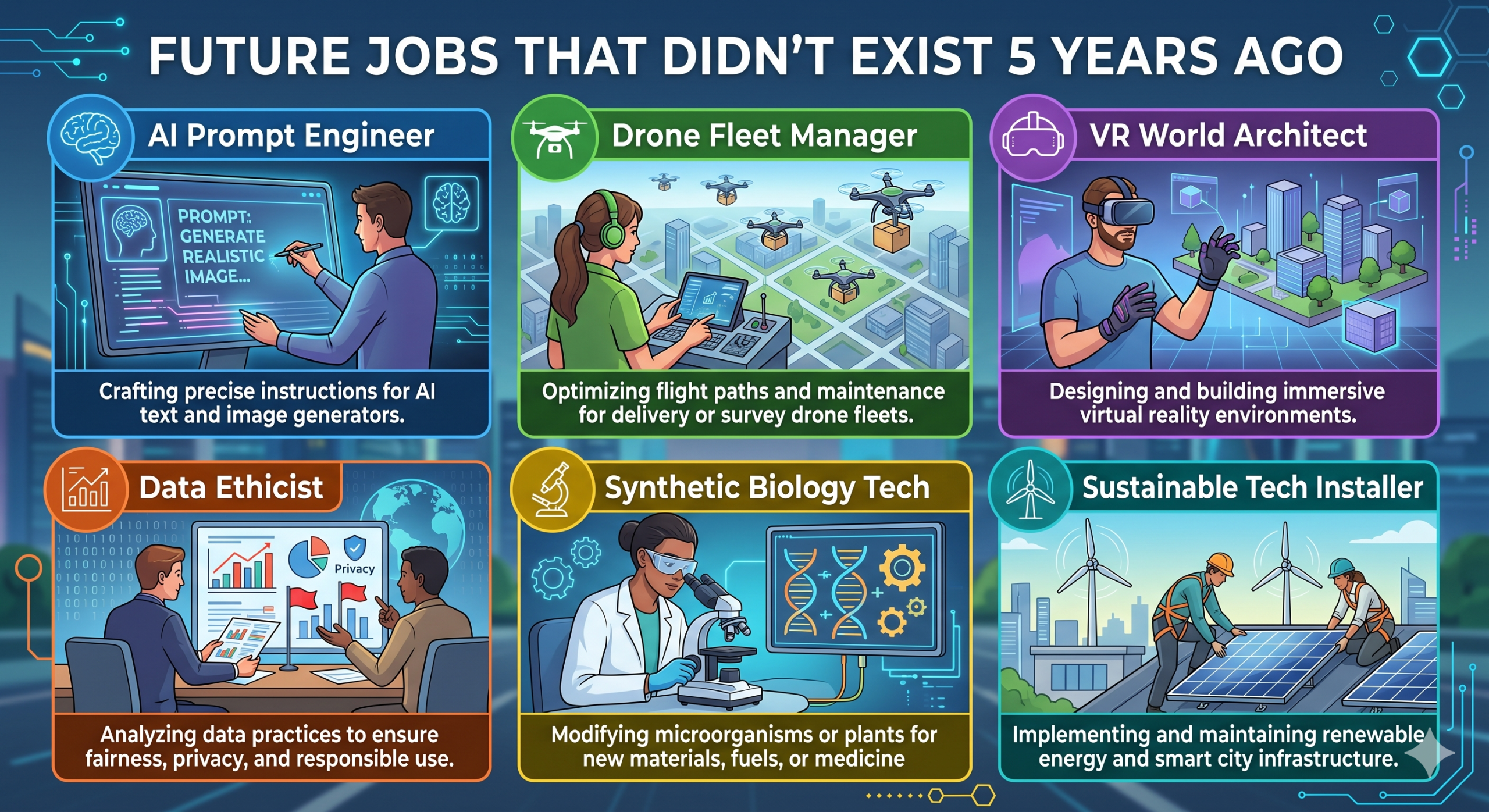
AI Prompt Engineer
One of the most talked-about new professions is the AI Prompt Engineer.
These professionals specialize in creating instructions that help AI systems generate useful outputs.
Responsibilities often include:
- Designing prompts
- Testing AI responses
- Optimizing content generation
- Improving workflow efficiency
- Developing AI usage guidelines
While AI tools existed previously, the demand for dedicated prompt expertise grew rapidly with the rise of generative AI platforms.
This role combines communication, creativity, and technical understanding.
AI Content Strategist
Organizations increasingly use AI for content production.
AI Content Strategists oversee:
- Content planning
- AI-assisted writing workflows
- Editorial standards
- Brand consistency
- Performance analysis
Rather than replacing content teams, AI has created demand for professionals who can manage and optimize AI-powered content operations.
This role blends marketing, communication, analytics, and technology.
Creator Economy Manager
The rapid growth of digital creators has created entirely new business functions.
Creator Economy Managers help organizations:
- Partner with influencers
- Manage creator relationships
- Coordinate campaigns
- Evaluate performance
- Build community engagement
Brands increasingly invest in creator partnerships, making this role more important than ever.
Remote Work Consultant
Five years ago, few organizations employed specialists dedicated to remote work strategy.
Today, Remote Work Consultants help companies:
- Design remote work policies
- Improve virtual collaboration
- Enhance productivity
- Develop hybrid work models
- Support distributed teams
The global shift toward remote and hybrid work has made this expertise highly valuable.
Digital Community Manager
Community-building has evolved significantly.
Modern Digital Community Managers focus on:
- Online engagement
- Member retention
- Community growth
- User experience
- Brand advocacy
These professionals help organizations build meaningful relationships with audiences across digital platforms.
Community-driven business models continue to increase demand for these roles.
AI Learning Experience Designer
Education and corporate training have been transformed by AI-powered tools.
Learning Experience Designers now combine:
- Instructional design
- Learning psychology
- Content development
- AI-powered personalization
Organizations need professionals who can create engaging learning experiences while leveraging emerging technologies.
This field offers opportunities for educators and training professionals seeking future-focused careers.
Sustainability Data Analyst
Sustainability has become a strategic Future Jobs business priority.
Organizations increasingly need professionals who can:
- Track environmental performance
- Analyze sustainability metrics
- Produce compliance reports
- Support ESG initiatives
The growing emphasis on environmental responsibility has created demand for specialists who understand both data and sustainability.
AI Ethics Specialist
As AI adoption accelerates, ethical concerns have become increasingly important.
AI Ethics Specialists help organizations address issues related to:
- Bias
- Fairness
- Transparency
- Privacy
- Responsible AI implementation
This role combines technology awareness, policy understanding, and ethical decision-making.
Demand is expected to grow as AI becomes more integrated into business operations.
Customer Success Operations Manager
Customer success has evolved into a strategic function.
Operations-focused professionals now help organizations:
- Improve retention
- Analyze customer behavior
- Optimize processes
- Implement automation
- Measure customer outcomes
The increasing focus on long-term customer relationships has expanded opportunities in this area.
No-Code and Automation Specialist
Modern businesses increasingly use no-code and low-code platforms.
Specialists in this field:
- Automate workflows
- Build internal tools
- Improve efficiency
- Reduce manual work
These professionals often create business solutions without traditional software development.
The rise of accessible automation tools has made this career path increasingly popular.
Virtual Event Producer
The expansion of digital events created demand for professionals who manage virtual experiences.
Responsibilities include:
- Event planning
- Platform management
- Audience engagement
- Technical coordination
- Content delivery
Many organizations now maintain hybrid event strategies, supporting ongoing demand for this expertise.
Skills Needed for Emerging Careers
While specific roles differ, many future-focused careers require similar competencies.
Key skills include:
Adaptability
Responding effectively to change.
Communication
Explaining ideas clearly and collaborating effectively.
Critical Thinking
Evaluating information and solving problems.
Digital Literacy
Understanding modern technologies and platforms.
Project Management
Coordinating initiatives and delivering results.
Continuous Learning
Keeping pace with industry developments.
Professionals who cultivate these skills often adapt more successfully to emerging opportunities.
How Remote Work Accelerates New Careers
Remote work has expanded access to global talent and created demand for new specialties.
Benefits include:
- Global collaboration
- Flexible employment models
- Distributed teams
- Digital-first workflows
Many emerging professions are designed specifically for remote environments.
Professionals who develop strong virtual communication and productivity skills often gain an advantage.
Remote work continues to influence the creation of entirely new career paths.
Financial Planning for Future Careers
Emerging fields often evolve quickly.
Professionals should invest strategically in:
- Skill development
- Certifications
- Professional networks
- Portfolio creation
- Industry education
Financial planning helps support continuous learning and career adaptability.
Long-term success often depends on staying prepared for future workforce changes.
Finding Opportunities in Emerging Fields
Identifying high-growth careers requires awareness of workforce trends and employer demand.
Global job platforms such as BEST JOB TOOL help professionals explore emerging roles, understand in-demand skills, and discover opportunities across rapidly evolving industries.
BEST JOB TOOL also provides insights into remote work trends, workforce developments, and future-focused career paths, helping candidates align their skills with market opportunities.
Staying informed about industry changes improves career readiness and decision-making.
Conclusion
Many of today’s most exciting career opportunities did not exist—or existed only in limited forms—just a few years ago. Roles related to artificial intelligence, remote work, digital communities, sustainability, automation, and creator economies demonstrate how quickly the workforce is evolving.
Rather than focusing solely on traditional career paths, professionals should develop adaptable skills that remain valuable across changing industries. Communication, problem-solving, digital literacy, continuous learning, and strategic thinking will continue to support success regardless of specific job titles.
As technology and business needs continue to evolve, new opportunities will emerge that are difficult to predict today. By staying informed, investing in skill development, and leveraging resources such as BEST JOB TOOL, professionals can position themselves to take advantage of the next generation of career opportunities before they become mainstream.




Leave a Reply