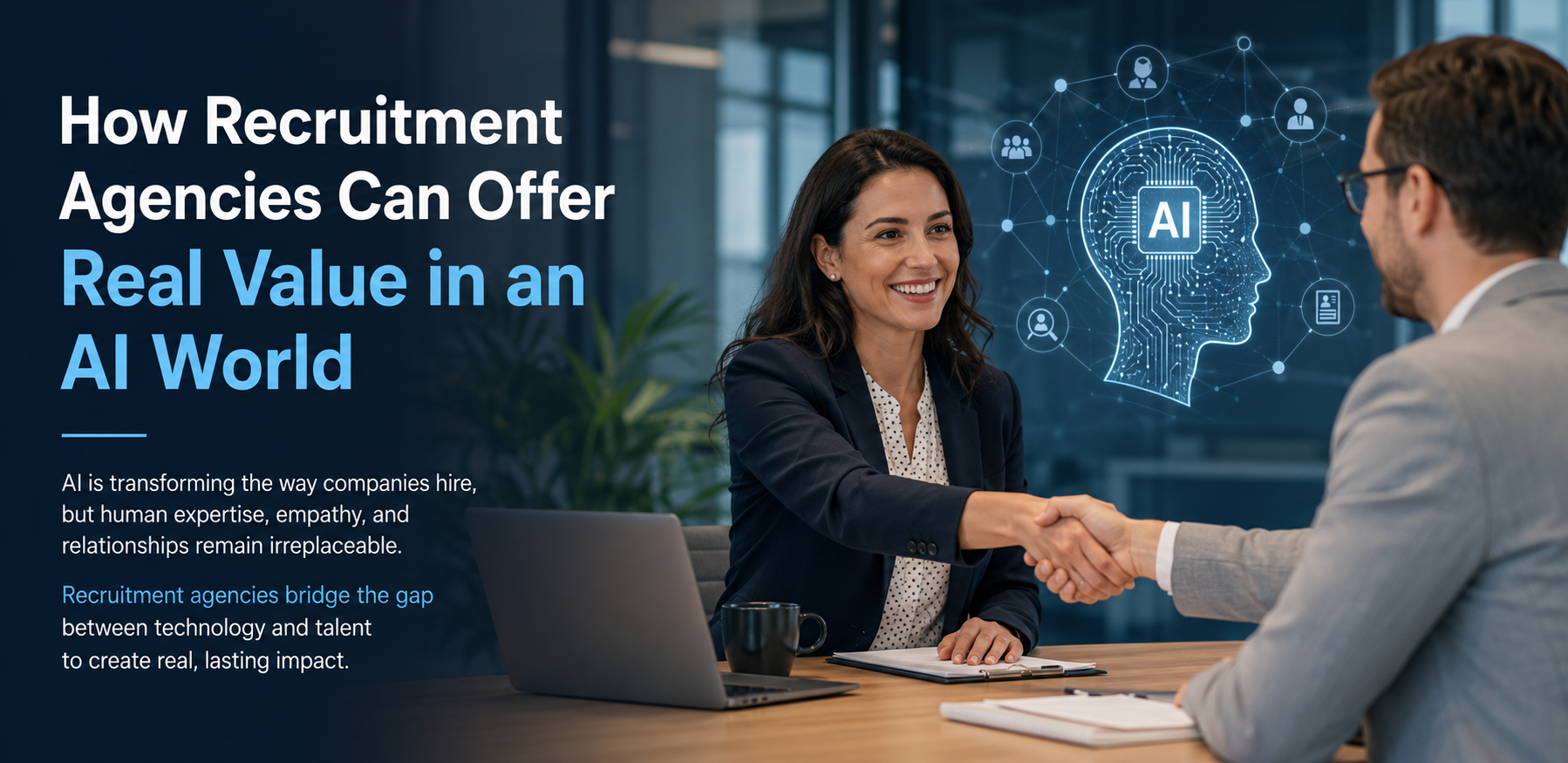
Introduction: Offer Real Value in an AI World
Artificial Intelligence (AI) is changing the way companies hire employees. Many organizations now use AI tools to screen resumes, schedule interviews, analyze candidate data, and even communicate with applicants. Because of these technological advancements, some people believe that recruitment agencies may become less important in the future.
However, the reality is different. AI can automate many tasks, but it cannot completely replace human judgment, relationship-building, emotional intelligence, and strategic thinking. Recruitment agencies that adapt to the changing environment can continue to provide significant value to both employers and job seekers.
In an AI-driven world, recruitment agencies need to focus on services that technology cannot easily replicate. By combining human expertise with AI tools, agencies can offer real value in an AI world.
How Recruitment Agencies Can Offer Real Value in an AI World?
1. Becoming a Strategic Hiring Partner
Many recruitment agencies focus only on filling open positions. In the AI era, this approach is no longer enough.
Instead, agencies should position themselves as strategic hiring partners.
Companies often struggle with questions such as:
- What skills will be needed in the future?
- How can we attract top talent?
- Which hiring channels work best?
- How can we reduce employee turnover?
Recruitment agencies can help organizations answer these questions by providing market insights and workforce planning advice.
When agencies contribute to long-term hiring strategies rather than simply sending resumes, they become trusted advisors instead of service providers.
2. Focusing on Relationship Building
One area where humans will always have an advantage over AI is relationship building.
Candidates often have concerns about:
- Career growth
- Work-life balance
- Company culture
- Salary expectations
- Job security
These conversations require empathy and trust.
A recruiter who understands a candidate’s goals can provide guidance that an AI system cannot offer. Similarly, agencies can build strong relationships with hiring managers and understand their expectations beyond what is written in a job description.
Strong relationships often lead to better hiring decisions and long-term partnerships.
3. Helping Candidates Tell Their Stories
AI systems primarily evaluate resumes based on keywords and qualifications. However, candidates are much more than a list of skills.
Many talented professionals have:
- Career gaps
- Industry transitions
- Freelance experience
- Diverse work backgrounds
These experiences may not fit perfectly into an AI screening system.
Recruitment agencies can help candidates present their stories effectively and highlight strengths that might otherwise be overlooked.
For example, a candidate changing careers may possess transferable skills that are valuable for a new role. A human recruiter can identify these strengths and advocate for the candidate.
This personalized support creates value for both employers and job seekers.

4. Providing Industry Expertise
AI tools can analyze data, but they cannot replace deep industry knowledge.
Specialized recruitment agencies often understand:
- Industry trends
- Skill shortages
- Salary benchmarks
- Competitor hiring practices
- Emerging job roles
This expertise allows agencies to provide insights that help companies make better hiring decisions.
For example, a technology recruitment agency may know which programming skills are currently in high demand and which roles are likely to grow in the future.
Such knowledge helps businesses stay competitive in rapidly changing markets.
5. Assessing Cultural Fit
Finding candidates with the right skills is important, but cultural fit is equally critical.
Many hiring failures occur because employees struggle to adapt to a company’s work environment rather than lacking technical skills.
AI can analyze data points, but it cannot fully understand workplace dynamics, team chemistry, or organizational culture.
Recruiters can:
- Evaluate communication styles.
- Understand personality traits.
- Assess workplace preferences.
- Identify cultural alignment.
By considering these factors, agencies can help companies make better hiring decisions and improve employee retention.
6. Supporting Passive Candidates
Many of the best professionals are not actively searching for jobs.
These individuals are known as passive candidates.
AI systems are effective at processing applications, but they are less effective at building trust with passive talent.
Recruitment agencies can maintain relationships with skilled professionals over time and approach them when suitable opportunities arise.
Because recruiters already have established connections, they can access talent pools that may not be available through traditional hiring methods.
This ability remains one of the biggest advantages of recruitment agencies.
7. Offering Personalized Candidate Experiences
Many job seekers complain about poor recruitment experiences.
Common issues include:
- Lack of communication
- Generic responses
- Long hiring processes
- Unclear expectations
AI chatbots can answer basic questions, but candidates often want personalized interactions.
Recruitment agencies can improve the candidate experience by:
- Providing regular updates.
- Offering interview preparation.
- Giving constructive feedback.
- Addressing concerns personally.
A positive experience enhances employer branding and increases the likelihood that candidates will recommend the company to others.
Conclusion: Offer Real Value in an AI World
Artificial Intelligence is transforming recruitment, but it is not eliminating the need for recruitment agencies. Instead, it is changing the role they play.
Routine administrative tasks are increasingly handled by AI, allowing recruiters to focus on areas where human skills matter most. Relationship building, strategic consulting, cultural assessment, career guidance, employer branding, and talent community development are all areas where recruitment agencies can provide exceptional value.
The agencies that succeed in the AI era will not view technology as a threat. They will use AI to increase efficiency while strengthening the human elements of recruitment. By combining advanced technology with empathy, expertise, and strategic insight, recruitment agencies can remain indispensable partners for both employers and job seekers in the years ahead.



Leave a Reply