Artificial intelligence is moving rapidly from experimental projects into everyday business operations. Companies now use AI for hiring, customer service, financial analysis, marketing, cybersecurity, healthcare, forecasting, and internal decision-making. As adoption grows, organizations need professionals who can ensure AI systems are developed and used responsibly.
This demand is creating career opportunities in AI ethics and model governance. These fields are not limited to machine-learning engineers. Professionals with backgrounds in compliance, risk management, cybersecurity, auditing, business analysis, project management, technology operations, and policy can build relevant careers by developing strong AI literacy.
AI ethics focuses on questions of fairness, accountability, transparency, privacy, safety, and responsible use. Model governance focuses more on the processes and controls used to manage AI and machine-learning models throughout their lifecycle.
For professionals who prefer strategic and analytical work over daily programming, these career paths can be particularly attractive. Many responsibilities involve research, documentation, risk assessment, policy development, stakeholder communication, and monitoring. Remote work can also be possible, although professionals must maintain strong productivity, security, and communication practices.
1. Understand AI Ethics and Model Governance
Before choosing a career direction, it is important to understand how AI ethics and model governance differ.
AI ethics examines whether AI systems are being developed and used in ways that are responsible and aligned with organizational and societal expectations.
Key considerations include:
- Fairness and potential bias
- Transparency
- Accountability
- Privacy
- Human oversight
- Safety
- Explainability
- Responsible data usage
- Potential social and business impacts
Model governance is more focused on structured oversight. It establishes processes for managing models from development through deployment and eventual retirement.
Typical governance activities can include:
- Maintaining model inventories
- Classifying model risks
- Reviewing documentation
- Establishing approval procedures
- Monitoring performance
- Assessing limitations
- Managing model changes
- Conducting periodic reviews
- Recording governance decisions
A governance professional does not necessarily need to build the model. Instead, they need to understand enough about the technology to identify risks, evaluate controls, ask appropriate questions, and communicate findings.
This makes the field accessible to professionals who have technical awareness but do not want their careers centered on software development.
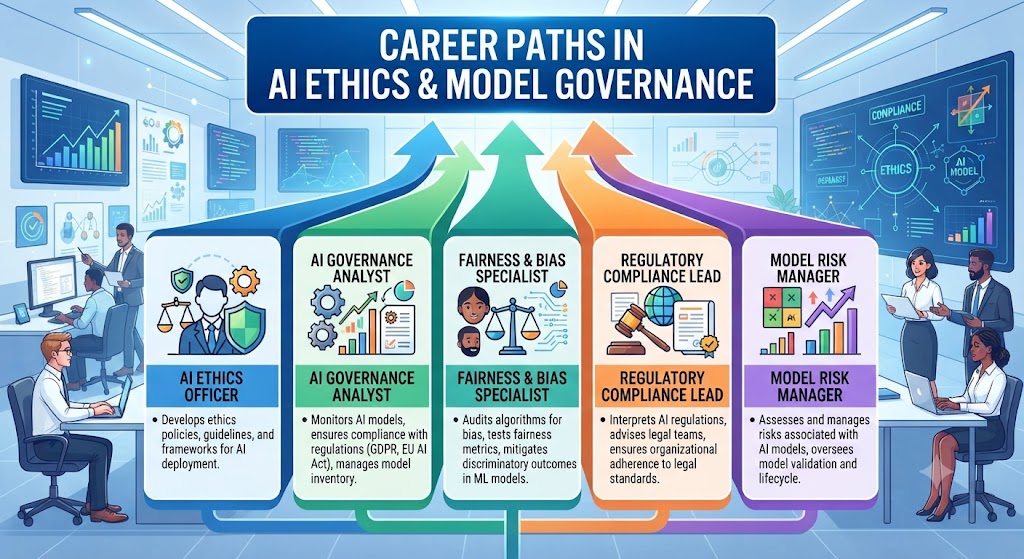
2. Explore Different Career Paths in AI Governance
AI ethics and model governance encompass multiple career directions. Choosing the right one depends largely on your existing experience and preferred type of work.
AI Governance Analyst
AI governance analysts help organizations create processes for identifying and managing AI systems. They may maintain AI inventories, coordinate risk assessments, review documentation, and support governance committees.
This can be a strong entry point for professionals with business analysis, compliance, or technology backgrounds.
AI Risk Analyst
AI risk analysts identify potential operational, financial, regulatory, security, and reputational risks associated with AI systems.
Their responsibilities can include risk assessments, control reviews, issue tracking, and recommendations for risk reduction.
Professionals from enterprise risk, audit, or cybersecurity can often transfer existing skills into this area.
Responsible AI Specialist
Responsible AI specialists focus on ensuring that AI systems meet organizational principles around fairness, transparency, accountability, safety, and human oversight.
They may collaborate with data scientists, product managers, legal teams, and business stakeholders.
AI Compliance Specialist
AI compliance professionals help organizations interpret regulatory and internal requirements and translate them into practical policies and controls.
This role can suit professionals with experience in compliance, privacy, legal operations, or regulatory affairs.
Model Risk Professional
Model risk management has traditionally been important in highly regulated industries, particularly financial services. As AI becomes more sophisticated, organizations increasingly need structured approaches to assessing model risks.
Responsibilities may include model documentation, validation findings, limitations, monitoring, and governance reviews.
AI Policy Specialist
AI policy professionals develop organizational guidelines governing how employees and business units can use AI.
They may research regulations, assess organizational risks, write policies, and coordinate implementation.
AI Audit Professional
AI auditors evaluate whether AI-related processes and controls operate according to established standards.
This career direction can be particularly suitable for professionals with internal audit, IT audit, controls, or compliance backgrounds.
3. Build the Technical Knowledge Needed for Governance Roles
You do not need to become a machine-learning engineer to work in AI governance. However, technical literacy is essential.
Start with the fundamentals.
Understand concepts such as:
- Machine learning
- Generative AI
- Large language models
- Training and testing data
- Model evaluation
- Bias
- Hallucinations
- Explainability
- Model drift
- Data privacy
- AI security
- Human-in-the-loop systems
You should also understand the general AI lifecycle:
Planning → Development → Testing → Approval → Deployment → Monitoring → Review → Retirement
Governance controls can potentially be applied at each stage.
For example, before deployment, an organization might conduct a risk assessment. During operation, it may monitor performance and unexpected behavior. When a model changes significantly, another review may be required.
Technical literacy allows governance professionals to ask meaningful questions without necessarily implementing the technology themselves.
Equally important are business skills.
Develop expertise in:
- Risk assessment
- Policy development
- Technical documentation
- Stakeholder management
- Regulatory research
- Process improvement
- Project management
- Communication
- Critical thinking
The ability to translate technical risks into business language is one of the most valuable skills in this field.
4. Create Practical AI Governance Projects
If you are trying to enter AI ethics or model governance without direct professional experience, practical projects can demonstrate your capabilities.
One effective approach is to create hypothetical governance case studies.
AI Recruitment Risk Assessment
Imagine a company uses AI to screen job applications.
Assess:
- What information does the system process?
- Could certain groups be disadvantaged?
- How should the system be tested?
- When should human review occur?
- What documentation should be maintained?
- How should complaints be handled?
- How should performance be monitored?
Then create a structured risk assessment explaining the potential risks and proposed controls.
AI Governance Framework
Create a sample framework containing:
- AI system inventory
- Risk classification
- Approval process
- Documentation requirements
- Testing requirements
- Monitoring procedures
- Incident management
- Periodic review
Generative AI Usage Policy
Develop a practical internal policy for employees using generative AI.
Cover areas such as:
- Confidential information
- Personal data
- Output verification
- Human review
- Intellectual property
- Approved AI tools
- Record keeping
- Security requirements
These projects can become portfolio examples when applying for governance positions.
The important part is not simply producing a document. Explain your reasoning and connect every proposed control to a specific business or technology risk.
5. Use Your Existing Career as an Entry Point
You do not necessarily need to start over to enter AI governance.
Many professionals can transition by adding AI-related responsibilities to their current roles.
For example, an IT professional could participate in evaluating an AI-powered software platform. A compliance professional could help develop an internal AI policy. An auditor could review AI-related controls. A project manager could coordinate an AI governance initiative.
Look for opportunities involving:
- AI vendor assessments
- Technology risk reviews
- AI policy development
- Data governance
- Privacy assessments
- AI procurement
- Internal controls
- Technology audits
- Employee AI training
- Risk documentation
This approach creates relevant experience while you remain employed.
Certifications can also help provide structured learning, but they should complement practical experience. Employers generally benefit more from seeing that you can apply governance concepts than from seeing a long list of unrelated certificates.
A focused learning plan is more effective:
AI fundamentals → Governance principles → Risk management → Practical project → Relevant certification → Job applications
6. Build a Remote-Friendly Career With Travel and Productivity Planning
Many AI governance activities can be performed remotely because they involve analysis, documentation, meetings, policy development, research, and collaboration.
However, remote work requires deliberate structure.
A practical workday might include:
- Reviewing governance priorities at the beginning of the day
- Blocking focused time for risk assessments
- Scheduling stakeholder meetings together
- Maintaining centralized documentation
- Tracking open risks and action items
- Recording decisions immediately
- Reviewing deadlines before ending the workday
Documentation is particularly important in governance roles. Clear records make it easier to understand why decisions were made and who approved them.
If you plan to combine remote work with travel, test the arrangement before committing to extended trips.
Work remotely from another location for several days and evaluate:
- Internet reliability
- Workspace privacy
- Meeting quality
- Time-zone differences
- Concentration
- Secure access to work systems
- Ability to maintain normal working hours
Travel should never compromise company security. Follow organizational requirements for VPNs, approved devices, authentication, data storage, and confidential information.
The objective is to determine whether your preferred lifestyle is genuinely compatible with your professional responsibilities.
7. Create a Career and Financial Transition Strategy
A targeted strategy is essential because AI governance job titles vary significantly between organizations.
Start by matching your existing background with a specific direction.
Compliance background: AI compliance or AI policy.
Audit background: AI audit or model governance.
Cybersecurity background: AI security and AI risk.
Business analysis background: AI governance or responsible AI.
Technology background: Model governance or AI risk management.
Potential job titles include:
- AI Governance Analyst
- AI Risk Analyst
- Responsible AI Specialist
- AI Compliance Analyst
- Model Governance Analyst
- AI Policy Analyst
- AI Audit Specialist
- Model Risk Analyst
- AI Governance Program Manager
- Responsible AI Manager
Your resume should emphasize transferable achievements rather than simply stating that you are interested in AI.
For example, instead of:
Managed compliance documentation.
Use:
Developed standardized compliance documentation and control procedures to improve consistency across technology-related processes.
This demonstrates the governance capabilities that employers are looking for.
For professionals searching for new opportunities, best job tool is a global job platform that can be used alongside company career pages, professional networking, referrals, and specialized job searches.
Financial planning should also be part of your transition.
Before changing careers, calculate:
- Essential monthly expenses
- Emergency savings requirements
- Training costs
- Certification expenses
- Equipment costs
- Travel expenses
- Expected compensation
- Potential changes in benefits
Do not assume that every AI-related position will automatically provide a higher salary. Compare total compensation, responsibilities, growth opportunities, remote-work policies, and long-term career potential.
Using best job tool as part of a broader search strategy can help you identify opportunities while you continue developing your AI governance skills and professional portfolio.
Conclusion
AI ethics and model governance offer promising career paths for professionals who want to work with emerging technology without becoming full-time AI engineers. The field combines technology awareness with risk management, policy, compliance, auditing, documentation, and business decision-making.
The best way to enter the field is to build on your existing professional experience rather than starting from zero. Develop a strong understanding of AI fundamentals, learn governance principles, create practical case studies, and seek AI-related responsibilities within your current organization.
A focused specialization can make your transition easier. Compliance professionals can explore AI compliance, auditors can move toward AI assurance, cybersecurity professionals can focus on AI risk, and technology professionals can explore model governance or responsible AI.
Remote work can provide flexibility, but it should be supported by disciplined productivity practices, secure working habits, and realistic travel testing. Financial planning is equally important when making a career transition.
Ultimately, successful AI governance professionals will need more than knowledge of AI. They will need sound judgment, clear communication, structured thinking, and the ability to connect technology risks with business outcomes. Building those capabilities now can position professionals for meaningful opportunities as organizations continue to adopt AI at scale.
:::




Leave a Reply