As digital products become more complex, businesses need more than attractive interfaces and functional technology. They need clear, useful, and purposeful language that helps people understand what to do next. This is where UX writing and microcopy have become increasingly valuable.
UX writers create the words users encounter while interacting with websites, mobile applications, software platforms, digital services, and products. Microcopy includes small but important pieces of content such as button labels, error messages, form instructions, onboarding prompts, confirmation messages, tooltips, notifications, and empty-state text.
For professionals with strong writing, communication, research, and problem-solving abilities, UX writing can provide a career path without requiring advanced programming skills. It can also offer opportunities for remote work, freelance projects, international teams, and flexible career development.
Understanding the different career options in UX writing and microcopy can help aspiring professionals choose a specialization, build a portfolio, and create a practical route into the field.
1. Understand What UX Writing and Microcopy Involve
UX writing is not simply writing shorter sentences. It is about using language to make a digital experience easier to understand and navigate.
A UX writer works closely with designers, product managers, researchers, developers, marketers, and customer-support teams. The objective is to ensure that every piece of product language supports the user’s task.
Microcopy can influence whether a user successfully completes an action.
Examples include:
- “Create account” instead of “Submit”
- “Password must contain at least 8 characters” instead of a vague validation message
- “Your payment was successful” after a transaction
- “No saved items yet” on an empty dashboard
- “Try again” after a temporary error
- “Allow notifications” when requesting permission
Good microcopy reduces confusion, establishes trust, and helps users recover from mistakes.
UX writing also involves larger product experiences, including onboarding flows, navigation terminology, account management, subscription journeys, and help content.
The profession therefore combines writing with user research, product thinking, information architecture, accessibility, and usability.
2. Explore Different Career Options in UX Writing
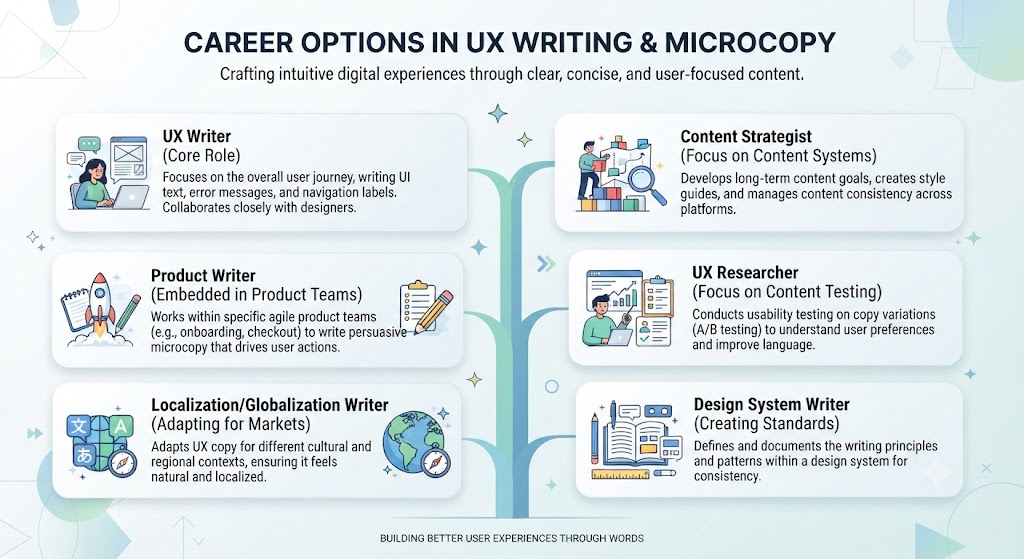
UX writing is broader than a single job title. Organizations use different names for similar responsibilities, depending on their size and product structure.
UX Writer
A UX writer focuses on the language used throughout digital products. Responsibilities may include writing interface copy, collaborating with designers, testing language with users, and maintaining content standards.
Content Designer
Content designers typically work across the entire user journey rather than focusing exclusively on individual interface elements. They may use research and data to determine what information users need and when they need it.
Product Writer
Product writers concentrate on language within software products. They often collaborate closely with product and design teams to improve onboarding, workflows, and feature adoption.
Conversation Designer
Conversation designers develop language and interaction patterns for chatbots, voice assistants, and conversational interfaces. This career path is becoming particularly relevant as organizations adopt AI-powered customer experiences.
Content Strategist
Content strategists create broader frameworks for how organizations plan, organize, maintain, and distribute content. Some content strategists specialize in product experiences.
UX Content Specialist
This role may combine UX writing, content audits, accessibility, style-guide development, and content governance.
Other related opportunities include:
- UX content researcher
- Technical content designer
- UX editor
- Content operations specialist
- Design systems content specialist
- Localization content specialist
- AI conversation designer
Understanding these distinctions allows job seekers to search beyond the exact phrase “UX writer.”
3. Build the Skills Employers Actually Need
Strong grammar is important, but professional UX writing requires more than writing ability.
Develop user-centered thinking
A UX writer should constantly ask:
- What is the user trying to accomplish?
- What information do they need?
- What could confuse them?
- What action should they take?
- What happens if they make a mistake?
This mindset changes how you approach writing.
Instead of asking, “How can I make this sentence sound better?” you ask, “How can I make this task easier?”
Learn basic UX principles
Understand concepts such as:
- User journeys
- Information architecture
- Usability
- Accessibility
- User research
- Interaction design
- Design systems
- A/B testing
- Conversion funnels
You do not need to become a UI designer, but you should understand how your words interact with visual and functional design.
Strengthen research skills
UX writers may analyze interviews, usability tests, customer-support tickets, surveys, analytics, and product feedback.
Learning how to identify patterns in user behavior can make your writing more strategic.
Learn collaboration tools
Familiarity with common design and collaboration environments can make you more effective on product teams. Learn how to review interface designs, leave comments, document decisions, and collaborate asynchronously.
4. Create a UX Writing Portfolio That Demonstrates Problem-Solving
A portfolio is one of the most important tools for entering UX writing.
A collection of polished sentences is not enough. Employers want to understand how you approach problems.
Create three to five detailed case studies.
For each project, explain:
- The original user problem
- The context
- The existing copy
- Why the existing copy created friction
- Your proposed solution
- Your reasoning
- Alternative versions considered
- Expected user impact
For example, take a confusing checkout experience from a fictional e-commerce application.
Instead of simply presenting a new button label, explain why the original wording was ambiguous, what users needed to understand before clicking, and how the revised language reduced uncertainty.
You can also create projects around:
- Mobile onboarding
- Banking applications
- SaaS dashboards
- Error messages
- Subscription cancellation
- Password recovery
- Travel booking
- Healthcare appointment flows
- AI chatbot interactions
If you are changing careers, you can use hypothetical projects as long as you clearly label them as conceptual work.
Your portfolio should demonstrate decision-making, not just writing ability.
5. Find Remote UX Writing Opportunities
UX writing can be well suited to remote work because much of the workflow can be completed through digital collaboration.
A remote UX writer may participate in:
- Video meetings
- Design reviews
- User research sessions
- Asynchronous feedback
- Content critiques
- Documentation
- Product planning
- Remote usability testing
However, remote success requires disciplined communication.
When working across time zones, document decisions rather than relying on conversations. Use clear comments, maintain project notes, and communicate deadlines early.
Search beyond traditional job titles
Use multiple keywords when searching for opportunities:
- UX Writer
- Content Designer
- Product Writer
- UX Content Designer
- Conversation Designer
- Content Strategist
- UX Editor
- Product Content Specialist
You can also search for contract and freelance positions. These opportunities can provide valuable experience before pursuing a full-time role.
For professionals seeking global remote opportunities, best job tool, a global job platform, can be included in a broader job-search strategy alongside company career pages, LinkedIn, and specialist UX communities.
The objective should be to build a targeted application pipeline rather than applying randomly to every writing position.
6. Test Remote Work and Travel Before Making Major Changes
UX writing can provide location flexibility, but remote does not automatically mean “work from anywhere.”
Some employers restrict international work because of tax, employment, data-security, client-contract, or time-zone requirements.
If you want to combine UX writing with travel, start with a controlled test.
Before traveling, check:
- Whether your employer permits international remote work
- Whether company systems can be accessed securely
- Whether your working hours overlap with your team
- Whether reliable internet is available
- Whether confidential product information can be handled safely
- Whether the destination creates tax or employment complications
Start with a short trip rather than committing to several months abroad.
During the trial, maintain your normal schedule and track your productivity.
Measure:
- Deep-work hours
- Meeting attendance
- Response time
- Writing output
- Sleep and routine stability
- Internet reliability
- Overall work quality
If productivity falls significantly, the issue may not be remote work itself. It could be the travel schedule, environment, time-zone difference, or lack of a consistent workspace.
A travel test provides useful evidence before making a larger lifestyle decision.
7. Build a Sustainable Career and Financial Plan
UX writing offers multiple directions for career growth.
A typical progression could look like:
Junior UX Writer → UX Writer → Senior UX Writer → Lead Content Designer → Principal Content Designer
You can also specialize in areas such as:
- AI and conversational interfaces
- Financial technology
- Enterprise software
- Accessibility
- Design systems
- Content strategy
- Localization
- Developer tools
- Consumer applications
Specialization can help you differentiate yourself as your experience grows.
Continue developing professionally
Set aside regular time for:
- Portfolio improvements
- UX research learning
- Product knowledge
- Accessibility training
- Industry reading
- Case-study development
- Networking
- Professional communities
Do not let your portfolio become outdated after getting your first job. Continue documenting meaningful projects and measurable outcomes.
Plan your finances around flexibility
Remote work can make travel easier, but it does not eliminate expenses.
Before combining work and travel, calculate:
- Monthly living costs
- Accommodation
- Transportation
- Internet
- Equipment
- Insurance
- Taxes
- Emergency savings
- Professional development
A strong emergency fund provides flexibility when contracts end, companies restructure, or you decide to change roles.
Freelancers should also maintain a separate buffer for periods when client work slows down.
For professionals building a global career, best job tool can support the job-discovery process, but financial stability should remain a separate priority. Finding remote work is only one part of creating a sustainable location-flexible career.
Conclusion
Career options in UX writing and microcopy extend far beyond writing button labels. The field combines communication, user psychology, research, product thinking, accessibility, and collaboration to make digital experiences easier and more intuitive.
Professionals can pursue roles such as UX writer, content designer, product writer, conversation designer, content strategist, or UX content specialist. The best entry strategy is to develop foundational UX knowledge, build a portfolio based on realistic problems, learn how product teams collaborate, and demonstrate the reasoning behind your writing decisions.
Remote work can make UX writing especially attractive for professionals seeking flexibility, but it should be approached strategically. Test remote workflows before combining work with travel, confirm company policies, protect confidential information, and maintain reliable productivity systems.
Finally, treat your career as a long-term investment. Continue developing specialized skills, document measurable results, maintain your portfolio, and build financial reserves. With a strong combination of writing expertise and user-centered product thinking, UX writing and microcopy can become a flexible and sustainable career path in the digital economy.






Leave a Reply