Introduction– Company’s Culture
How to Adapt When a Company’s Culture Changes after a Merger
A merger can introduce new opportunities, resources, customers, and ideas to a company. At the same time, however, mergers can create uncertainty for employees due to the cultural clash that emerges between two work environments and the necessity to adapt to the new circumstances.
Being able to quickly and positively adapt to the changes is essential to ensuring future job performance and professional growth. How to Adapt When a Company’s Culture Changes after a Merger is therefore a question of utmost importance to all employees and stakeholders of the merged organization.
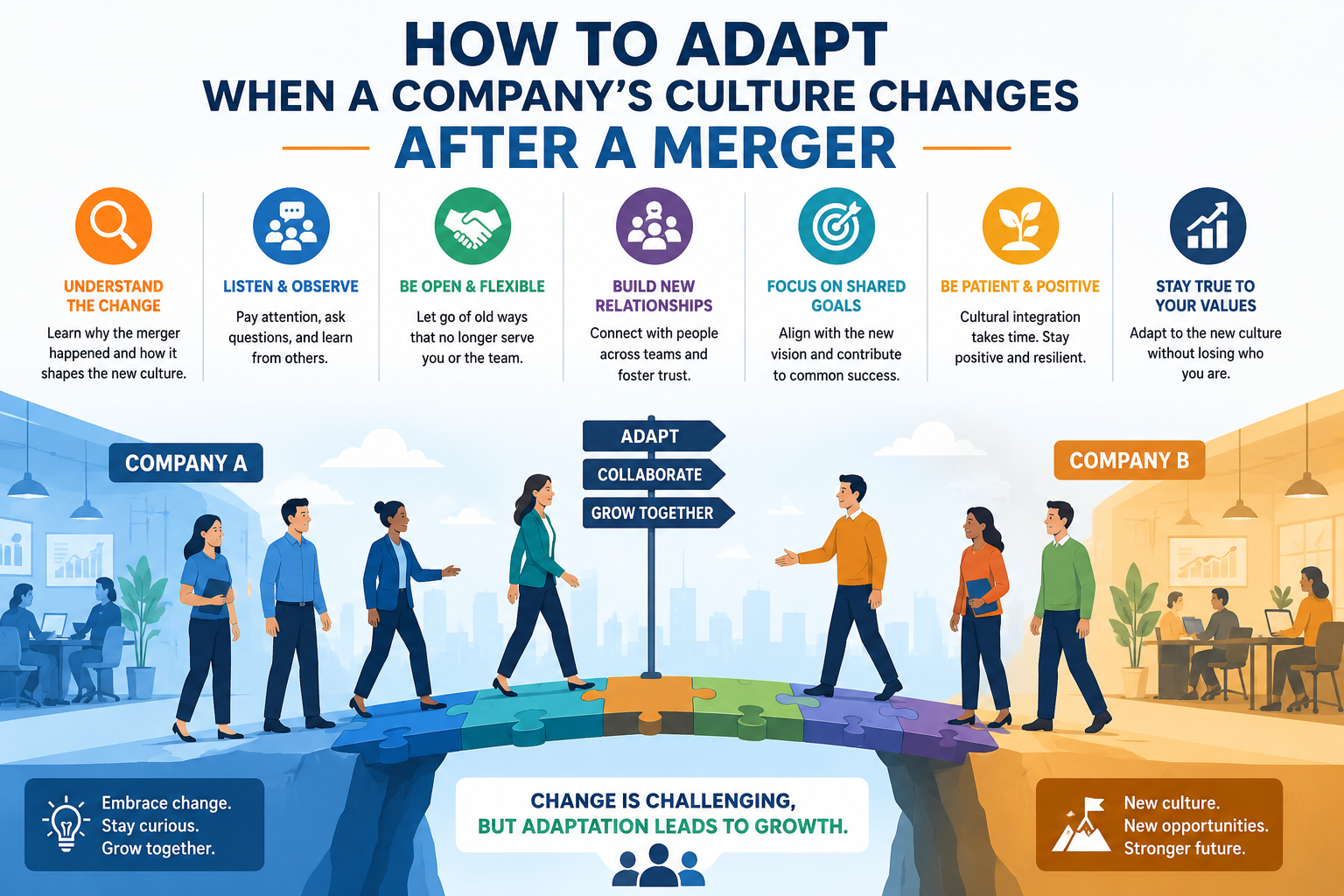
1. Understand That Change Is Normal
The initial step in adapting to the changed company culture is accepting the fact that change is normal. After the merger, it is impossible to return everything to the original state. Therefore, employees need to be prepared that some aspects of the workplace will transform. The merged company may have unique culture, which was not characterized by contradictions.
For example, one organization is more flexible and communicative while another one is stricter and more formal. In such cases, it is necessary to refrain from rushing to judgment and try to perceive the new culture from different angles. Observing and reflecting will allow the employees to become aware of the changes and find positive aspects of the new culture.
How to Adapt When a Company’s Culture Changes After a Merger suggests that the first step to adapting is to understand that resistance will not eliminate organizational change. The strategy to deal with cultural differences successfully is to adopt a flexible attitude.
2. Communicate Openly
The second step to adapting to a new company culture after the merger is to communicate openly. Most often, prior to reorganization, employees have many questions and concerns that are not addressed due to a lack of information. Therefore, after the merger, individuals are even more anxious about their future and work environment. In such cases, it is necessary to ask questions and seek answers.
To eliminate misunderstandings and confusion, employees should openly discuss concerns with managers or colleagues. The employees should also listen to recommendations and experiences from those who have already gone through the merger. Maintaining open communication channels will allow the individuals to build relationships based on trust and support.
Moreover, new employees and existing staff need to treat each other as partners rather than opponents. Communication will help to establish a feeling of community and reduce the likelihood of conflict. This strategy will allow the employees to unite rather than compete, thereby eliminating cultural differences through collaboration.
3. Identify What Has Changed
Although not everything will change, there are some aspects that will be modified after the merger. Some elements will be retained, while others will be replaced by new ones. It is necessary to distinguish between what will stay the same and what needs to be learned.
Therefore, some areas of work will require the employee’s attention. For instance, companies can impose new requirements, rules, and expectations that were not present before. Moreover, new programs, technologies, methods, and strategies may be introduced to the workers during the transition. By analyzing what has changed, one can define the competence needed to improve one’s skills in the specific area.
It is possible to make a table with the former and latter elements to see the exact spots that require additional attention. The questions that should be answered include the following: What has changed? What is different? What is the same? or What should I learn? How should I act differently?
4. Stay Open to Different Perspectives
There may be instances where cultural differences create misunderstanding. For instance, workers from one company may be used to making decisions quickly while employees from the other organization might be more inclined to discuss and deliberate before reaching a decision.
Therefore, employees should endeavor to find out the reason behind a certain behavior. Understanding different viewpoints and perspectives can educate you and help you find better solutions.
Being open-minded does not imply that one must give up his or her own values. Rather, it entails being aware that diverse methods can be practical.
As a result, employees who embrace a positive attitude towards varied approaches and respect different working styles stand a better chance to build a positive relationship with other workers.
5. Build New Relationships
The merger provides the opportunity for expanding one’s network. Therefore, it is essential that employees venture out and build new relationships. It is critical to connect and communicate with people with whom one has not interacted with in the past.
It is important to get to know people from the other organization and to learn about their work, challenges, activities, or interests. A few simple greetings could enhance the ease of working with these individuals in the future.
Building a strong network of relationships within the merged organization can facilitate the exchange of information, experience, and ideas. Consequently, employees can become effective collaborators and trusted advisers within the merged organization instead of being an outsider.
6. Focus on Learning
Perhaps, the most effective strategy for navigating cultural differences is to learn. In the process of merger, employees are expected to acquire new skills or expand on the ones they already possess.
New processes, tools, policies, leadership styles, and expectations could be incredibly intimidating or dissatisfying if not handled correctly. Instead, employees can deal with these changes by focusing on learning.
For instance, one might have to invest more time on developing certain skills, such as proficiency in using a specific software, or advancing their communicative abilities. As a result, employees would feel more confident when dealing with the new challenges.
In addition, it is vital that employees solicit feedback. The information will help the employees to determine what they are doing right or wrong. In other words, feedback can help identify areas in which they need to improve or change in order to meet the new demands.
7. Maintain Your Professional Identity
Adapting to a new company culture does not require employees to change who they are at their core. Thus, it is possible to both uphold professionalism and fit in at the same time.
The key to success is to be flexible but also to retain one’s professional attributes, values, and skills.
For instance,
individuals who excel at innovative thinking can still apply their creativity in the new environment, which would allow them to become successful in their jobs.
Conclusion- Company’s Culture
Although adapting to a new company culture after a merger can be difficult, it can also serve as a learning experience. Being flexible and open-minded, communicating effectively, establishing good relationships with other employees, and being willing to learn will help you cope better with the changes and succeed in the new work environment.
Instead of complaining about all the modifications, it is necessary to accept them, understand the motives of the management, and try to contribute to the development of a positive corporate culture. The changes will be advantageous to you in the long run if you are patient and supportive throughout the process. All things considered, after a merger, employees need to evolve individually and as a team to foster a better corporate culture and work environment.
A merger can change how teams communicate, collaborate, and work—but you can adapt without losing your professional identity. Stay open to change, understand new expectations, build relationships across teams, and focus on what you can control. Navigate workplace transitions with confidence using Best Job Tool.





Leave a Reply