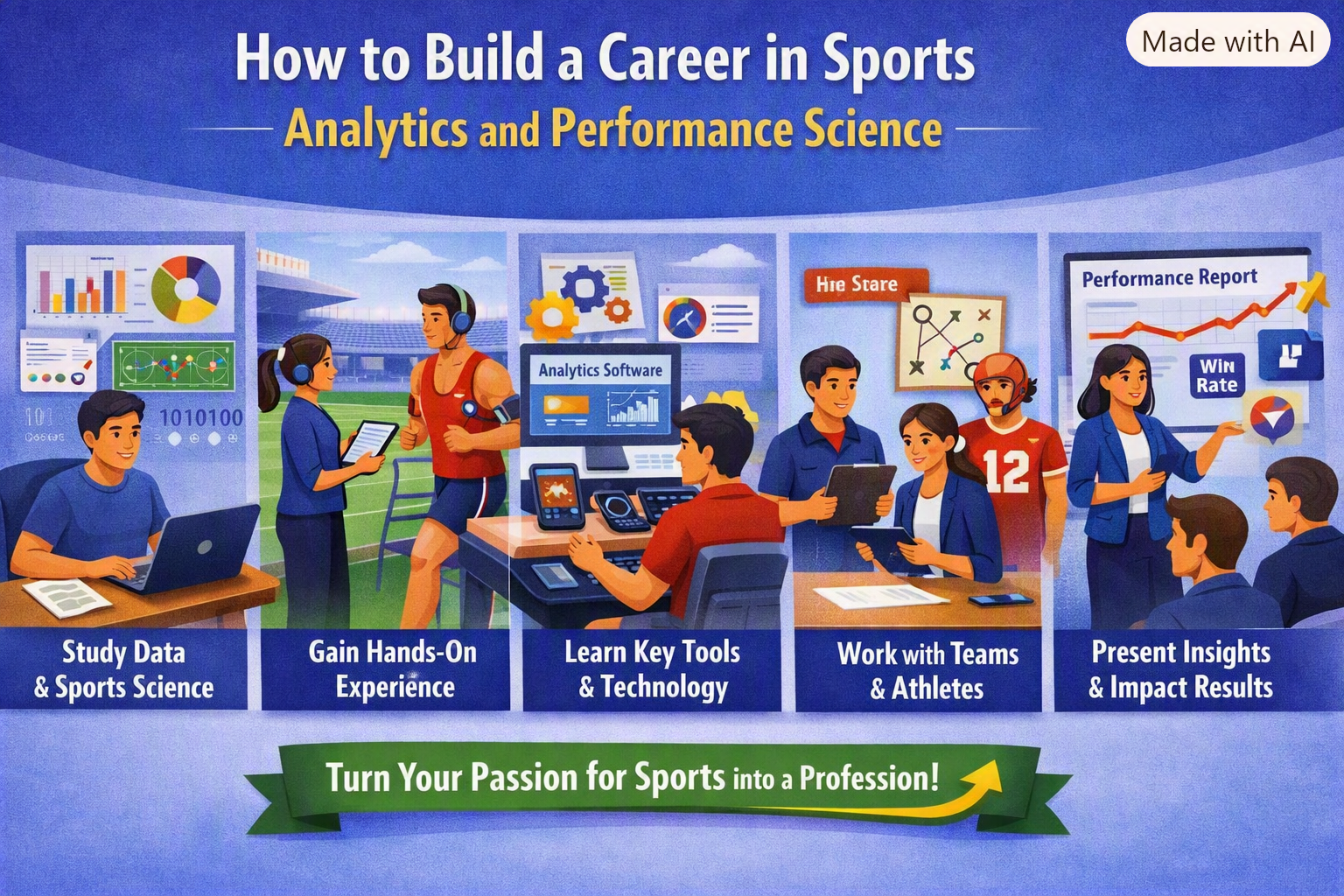
Introduction: Sports Analytics and Performance Science
Sports is increasingly becoming more than just a matter of talent, practice, and muscle. It is now all about data, and coaches, medical staff, and sports organizations are using statistics to get an edge over their competitors. This trend creates a great opportunity for sports fans who want to combine their interest for sports with their analytical skills and pursue a career in sports analytics or performance science.
How to build a career in sports analytics and performance science will introduce you to the field and show you how to break into the sports industry and move up in your career.
How to Build a Career in Sports Analytics and Performance Science?
1. Understand What Sports Analytics and Performance Science Entail
Sports analytics is the study of data relating to players, teams, matches, and other metrics. Performance science is a broader term that covers many areas connected to player performance, fitness, and well-being. The two areas have overlapping aspects but are generally different. A good understanding of both fields will give you an advantage, as the ultimate aim of performance science is to help players reach their peak while remaining injury-free.
2. Understand the Different Careers
There is a wide range of jobs that fall under the umbrella of sports analytics, including:
Sports analyst, performance analyst, sports data analyst, performance scientist, strength and conditioning analyst, sports scientist, and biomechanics analyst, and data visualization specialist.
While each area has its own requirements, they generally overlap. You can start with the least technically demanding options, such as a sports analyst. You do not need to specialize immediately, so start by experimenting with different options and discover which areas you are most passionate about.
3. Lay Your Foundation in Data Analysis
The first step in your journey toward a career in sports analytics is to learn the fundamentals of data science. At the very least, you should be able to confidently use Excel or Google Sheets, understand basic formulas, and know how to pivot tables. The next step is to invest time in learning SQL, Python, R, Tableau, Power BI, or other data analysis tools of your choice.
You do not have to be a Python master before you start your profession; start by learning how to clean, wrangle, and visualize data. Once you have the basics, practice, practice, practice! Try simple data analysis projects, such as analyzing a football match, and see how you can use data to gain valuable insights about the game.
4. Learn Sports Too
Data analysis skills will only take you so far if you do not know the sports you are working in. Learn the basics of the sports you are interested in, such as rules, tactics, formations, positions, training, and performance indicators. This way, you will know what to look for when you are analyzing data. A good understanding of the sport will help you determine which metrics are the most important and what insights can be extracted from them.
For instance, a basketball analyst will understand the importance of points per game, but he will know that there is more to extracting value from the game than just the scoring department. It is a good idea to start with 1 or 2 sports rather than trying to be an expert in all of them.
5. Build a Sports Analytics Portfolio
A sports data analysis portfolio is a collection of your work that demonstrates your skills and serves as a valuable addition to your resume. It does not have to include groundbreaking work; it can start with a few simple projects. Most employers will be more interested in seeing your process and how you present and support your findings than any specific numbers.
The projects can take many forms, including:
- A comparison of players in a league or season
- A prediction model for results
- An injury and workload analysis
- A before-and-after analysis of a change in a team’s formation or strategy
- A dashboard analysis that displays a player’s or team’s performance
- An analysis of the relationship between training load and match performance
You can use open-source data sets for your projects and present your findings in a report, explaining the processes you used and displaying the charts and graphs you created. Once again, the presentation is often more important than the actual data. Your portfolio does not have to be fancy or include complex calculations. In fact, a complex yet disorganized project may not make a good first impression.
6. Brush Up on Your Performance Science Knowledge
You do not have to dive straight into coding if you are more interested in the physiological and scientific aspects of sports analytics. Some fields, including strength and conditioning, nutrition, psychology, and physiology, require a solid understanding of the human body, the effects of training, and the mechanisms that make us move. Degrees in sports science, exercise physiology, physiotherapy, and related disciplines will work, as will relevant certifications. You can find courses and certifications to help you grow in your career at any stage.
Working with strength and conditioning coaches, physicians, physiotherapists, psychologists, and nutritionists is often part of the job, so you should work on your communication skills as well.
Conclusion: Sports Analytics and Performance Science
A career in sports analytics and performance science can be a great fit for people who enjoy sports and want to use their analytical skills to influence the game. You do not need extensive technical skills or prior experience to get started; it is all about finding a sport you are passionate about, learning the fundamentals of performance science, diving into data analysis, practicing, and building a portfolio. Once you have these basics, you can seek new opportunities, gain experience, and continue to level up your career.
Ready to turn your passion for sports into a data-driven career? Start building your skills in sports analytics and performance science, gain practical experience, and explore opportunities that match your goals. Use the Best Job Tool platform to discover relevant roles and take the next step toward a career in the sports industry.


Leave a Reply