Introduction: Free Courses
Free online courses have changed the way students, freshers, career changers, and working professionals learn. It is now possible to learn relevant skills from universities, companies, and online learning platforms without spending a lot of time and money. However, finishing a random set of free courses will not help create a strong learning profile. The trick is to use free courses to create a valuable learning path.
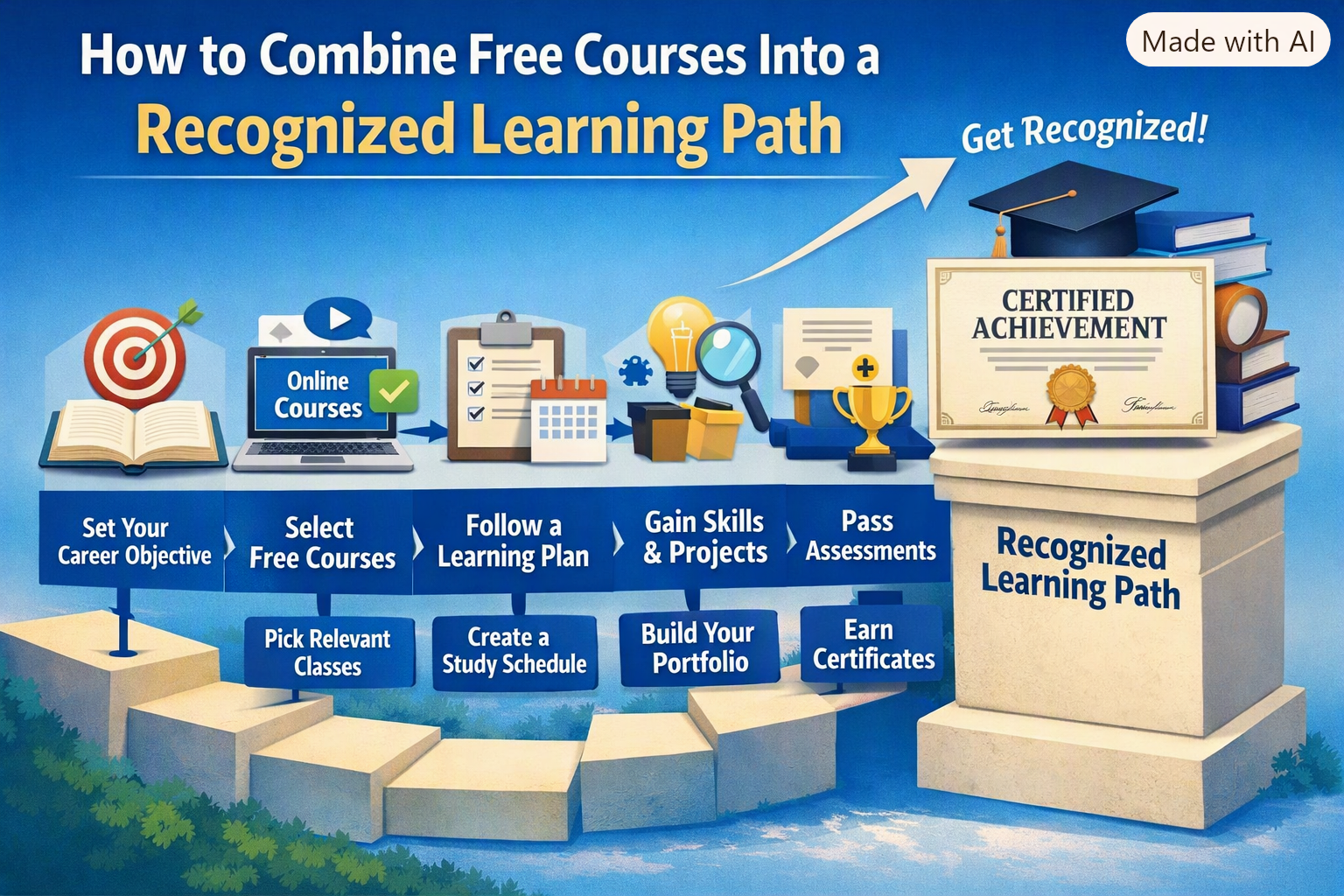
How to combine free courses into a recognized learning path provides the steps to combine free courses into a learning path by setting a career goal, choosing skill-building courses, and adding proof of accomplishment.
How to Combine Free Courses Into a Recognized Learning Path?
1. Start With a Clear Career Goal
Before choosing a course, think about what you want to learn and accomplish. Your learning path should guide you towards your career goal.
For instance, to start a career in digital marketing, you may need to learn content marketing, SEO, social media marketing, email marketing, and analytics. On the other hand, to change your career to data analysis, you may need to learn Excel, SQL, statistics, and data visualization.
A career-focused learning path discourages you from randomly choosing a free course.
2. Choose One Skill at a Time
To combine free courses into a valuable learning path, pick one skill to learn at a time. Go from the basics to more advanced skills. Do not get tempted to take up advanced courses when you lack foundational skills.
For instance, if you want to become a data analyst, you may need the following free courses:
- Introduction to data analysis
- Excel
- Statistics
- SQL
- Data visualization
- Power BI or similar data analytics software
- Data analysis project
This learning path will help sell or promote your analytical skills to potential employers.
3. Use Courses From Trusted Platforms
Not all free courses are equal. Wherever possible, choose courses from universities, renowned corporations, professional bodies, and online learning platforms.
Also, wherever possible, pick courses that come with certificates, qualifications, assessments, projects, and/or assignments. A certificate alone cannot prove your proficiency in a certain area, but a combination of a certificate and practical assignments can demonstrate that you have the required skills.
Whenever possible, use courses with verifiable certificates.
4. Build Projects Along the Way
Whenever possible, use free courses to do projects that will help showcase your expertise when searching for a job. For instance, use the skills you have learned in a free digital marketing course to develop a content marketing campaign, create an email marketing template, perform a website SEO audit, or come up with a social media growth strategy.
On the other hand, use a free data analytics course to analyze a sample data set and develop a dashboard or infographic. These projects will become your work samples and help demonstrate your analytical and marketing skills.
5. Create a Learning Portfolio
Store your learning portfolio in a central place. You can use a personal website, LinkedIn, and/or GitHub to store and showcase your free course certificates, projects, and work samples. Think of this portfolio as a showcase of your accomplishments and skills. For instance, instead of simply listing the courses you have completed, highlight how these courses have helped you gain specific skills.
From here, it is easy to tell that the individual has skills in Excel, SQL, and data visualization and has used the skills to create a sales performance dashboard.
6. Connect Courses to Your Job Requirements
Whenever possible, design your learning path to include skills that are in demand by employers. A great place to find in-demand skills is by studying relevant job descriptions. Make a list of frequently requested skills, and then design your learning path to fill these skill gaps.
For instance, if employers are asking for people with Excel, SQL, and Power BI skills for an entry-level analyst position, your free course learning path should be designed around these three areas..
Conclusion: Free Courses
Free courses can become valuable to your career if you know how to combine them into a recognized learning path. To combine free courses, know what you want to achieve, build one skill at a time, pick courses from reliable sources, and use the courses to complete relevant projects. The main idea is to use free courses to highlight the skills you have gained and how they can benefit an employer rather than simply listing all the courses taken.
Ready to turn free courses into a recognized learning path? Use the best job tool platform to organize your learning, showcase your skills, and connect your new knowledge to relevant career opportunities.

Leave a Reply