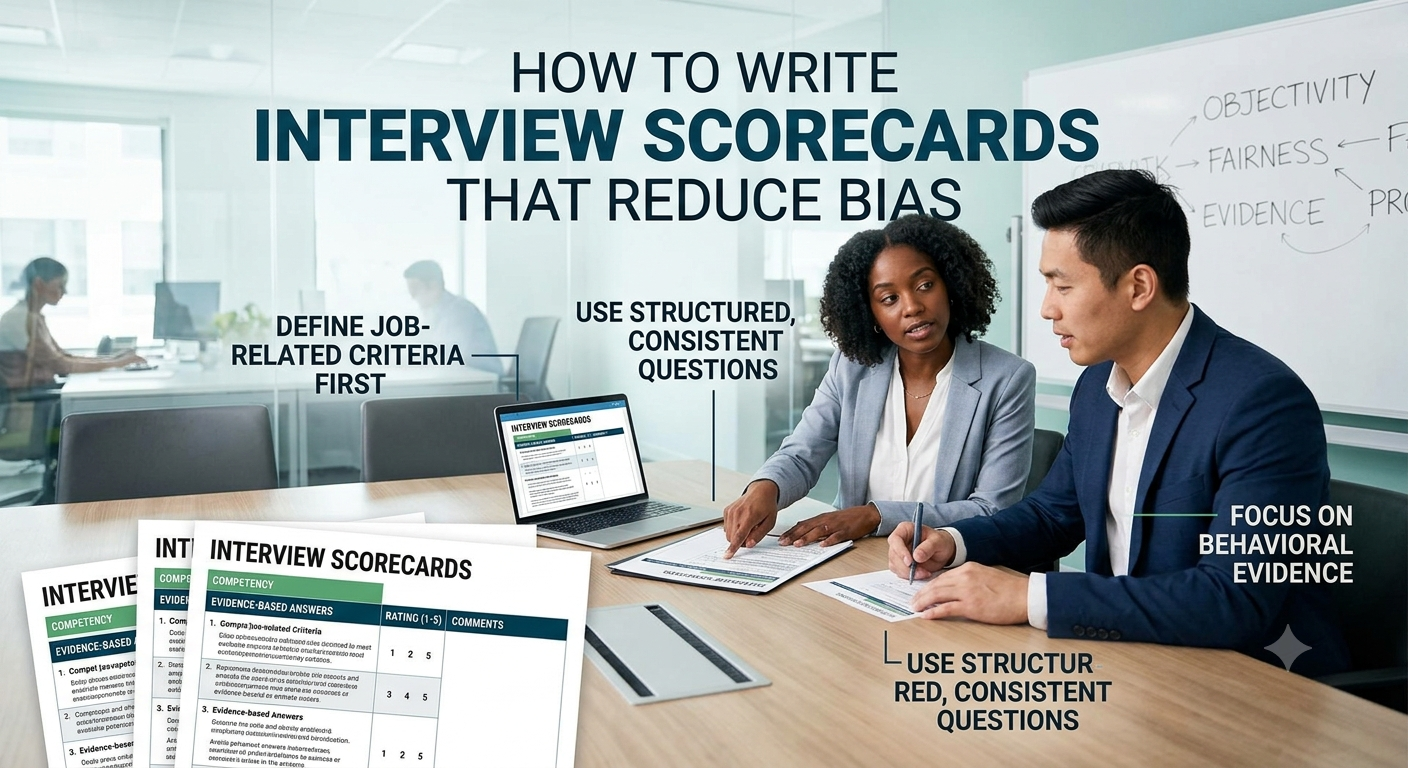
Introduction: Interview Scorecards
Hiring the right candidate is crucial for any company. Recruiters and the hiring team should review every candidate’s abilities, skills, qualifications, experience, and level of competency in the position they are applying for. Unfortunately, the hiring process is vulnerable to the recruiters’ subjective viewpoints and the candidates’ first impression. Interview scorecards are an effective tool for assessing each candidate based on their skills, qualifications, experience, and competencies required for the job.
Interview scorecards help keep track of the candidates’ evaluation data based on specific and objective criteria. Learning how to write interview scorecards that reduce bias enables companies to ensure the most fitting candidates get hired on merit, not the recruiters’ subjective viewpoints.
How to Write Interview Scorecards That Reduce Bias?
1. Define the Requirements of the Job
Before beginning the interview process, define what the exact requirements of the position are. It is not the recruiters’ responsibility to determine what skills to look for in the candidates. The list of the essential skills for the position should be based on the vacancy description.
For instance, the requirements for a content writer should include excellent writing abilities, whereas the project manager’s position should include skills in leadership, communication, and project coordination.
This information would serve as the primary basis for developing the interview scorecard and would minimize the risk of bias. The hiring team would focus only on the relevant details during the interview. The interview scorecards also become more objective since recruiters would only use the criteria necessary for the position.
2. Use the Same Evaluation Criteria for Every Candidate
It is necessary to establish identical criteria for every candidate to ensure the interview process is reliable, consistent, and free of bias. First of all, the interviewers should develop a scorecard based on the same competencies that the position requires. The same criteria should be used for every candidate. For instance, if the vacancy requires excellent communication, communication should be a category in the scorecard.
The list of categories in the scorecard should include only the job-related competencies. The interviewers should use these scorecards to evaluate candidates using the same criteria. When developing interview scorecards that reduce bias, it is necessary to allow candidates to demonstrate their abilities. This can be done by asking similar questions during the interview. Recruiters should also allow the candidates to elaborate on their answers if necessary.
It is important to mention that despite standardizing the evaluation criteria, not every aspect of the candidates’ qualifications should be identical. The individual approach should be used when the circumstances of the applicants differ.
3. Develop Clear and Measurable Rating Scales
Using the same rating scale for every candidate is essential in developing interview scorecards that reduce bias. Words such as ‘excellent,’ ‘good,’ or ‘poor’ can have different meanings for different people, which makes the evaluation process subjective. To avoid misunderstandings, interviewers should develop rating scales that include specific behavioral descriptions.
For instance, the problem-solving skill level can be measured using the following scale:
1 – Needs improvement: Cannot recognize the problem or the solution method
2 – Poor: Can recognize the problem but requires improvement
3 – Average: Can recognize the problem and the solution method
4 – Good: Can recognize the problem, solution method, and the rationale behind it
5 – Excellent: Can recognize the problem, solution method, and rationale behind it, and choose the best option
Such a scale removes ambiguity and subjectivity since every category has a precise definition. Moreover, using a rating scale that has behavioral descriptions helps assess the candidate objectively with measurable and demonstrable evidence.
4. Ask Structured, Job-Related Interview Questions
Asking appropriate questions during the interview is essential in ensuring unbiased and objective evaluation of the candidates. Structured interviews eliminate the possibility of bias, whereas unstructured interviews allow interviewers to ask questions based on their beliefs, opinions, and subjective criteria. During the interview, questions should be asked that help identify whether the candidate has the required skills and abilities for the position. Interviewers should develop a list of questions that corresponds to the criteria in the scorecard.
For instance, to assess how well a candidate can solve problems, the recruiter can ask: “Can you describe a challenging situation you encountered at work and how you dealt with it?”
Questions should be asked that would require the candidates to demonstrate their knowledge and ability in real-time. For instance, technical questions can be asked that would allow the recruiters to evaluate the candidates’ level of proficiency. A proper scorecard would also help in measuring the candidates’ performance during the interview. To ensure the interview is conducted objectively, questions that measure the candidates’ abilities should be asked. Avoid asking questions unrelated to the job, and refrain from rewarding the candidates for opinions, backgrounds, and other factors that are not job-related.
5. Record Evidence Instead of Personal Impressions
One of the most common mistakes during interviews is recording subjective viewpoints and not the evidence. Statements such as “I liked this candidate,” “They seem like a good fit for our company,” or “I did not like that she did not demonstrate confidence during the interview,” among others, are not useful in evaluating the candidates, unless there is demonstrable and measurable evidence that confirms these statements.
Instead, interviewers should write down measurable evidence that supports the statements. For instance, instead of writing that the candidate has outstanding problem-solving skills, the recruiter should write the examples of the candidate demonstrating these skills.
Evidence-based evaluations would make it easier to justify the scores and the hiring decisions based on the interview results. In addition, recording evidence would minimize the effect of first impressions on the interview outcome.
6. Separate Individual Scores From Group Discussions
When there are multiple interviewers, it is necessary to ensure that the scores given by one interviewer do not affect the scores given by others. The easiest way to avoid scoring inflation is to ask the interviewers to complete the scorecards individually and then have a group discussion about the candidates.
Individual scorecards would prevent the interviewers from influencing each other’s decisions. During the group discussion, each interviewer should defend their scores and the evidence they used to determine the scores.
It is necessary to have a thorough discussion of the candidate’s scores to ensure that the final hiring decision is based on evidence, not opinions. If the interviewers’ scores differ, this should be discussed, and the evidence should be presented that supports each interviewer’s viewpoint. In conclusion, using individual scorecards and having a group discussion about the candidates helps minimize the risk of bias.
7. Assign Appropriate Weights to Important Competencies
Depending on the vacancy, different competencies are required to varying degrees. It is essential to weigh these competencies appropriately. For instance, the content writer’s job may require excellent writing abilities, whereas the manager’s position may require exceptional leadership qualities. The categories in the scorecard should reflect this information by adding an indicator of the competency’s importance.
The weights assigned to the competencies should be established before the interviews begin and should be applied to all candidates. By implementing weighted scores, the hiring team can ensure the most important criteria are evaluated first. It is crucial to remember that the weights should only guide the decision-making, and not replace the professional judgment of the interviewers. Furthermore, when using weighted scores, essential requirements, relevant evidence, and the limitations of the score weighting should also be considered.
8. Review Scorecards for Potential Bias
Creating an interview scorecard is not a one-time activity. The hiring team should constantly analyze and improve the scorecards to ensure they do not have any built-in biases. To identify potential sources of bias, the recruiters should carefully examine the evaluation criteria, questions, and rating scales for the interview scorecards.
When analyzing the scorecards, the recruiters should pay attention to factors that may systematically favor some candidates and protect against the success of others. In addition, it is critical to examine whether the interviewers applied the criteria objectively and consistently throughout the hiring process.
Wherever permitted and protected by law, an analysis of the hiring outcomes by protected categories can also help in identifying areas for improvement. For instance, if the first-round interviews show that some candidates got low marks because of the lack of certain qualifications, the scorecard should be updated to reflect this information.
Conclusion: Interview Scorecards
Interview scorecards, if well-structured and utilized, can contribute to making the recruitment process more consistent, transparent, and evidence-based. Thoroughly defining job-related competencies and developing standardized questions and rating scales can help achieve these goals, as well as ensuring that interviewers collect enough evidence about the candidate’s competencies during the interaction.
At the same time, it is important to note that scorecards and their use in interviews cannot fully eliminate bias in the hiring process. The effectiveness of such tools in this regard depends on how carefully the selection criteria and instructions for their use are developed, as well as how consistently and attentively the scorecards are used by the recruiters.
Therefore, understanding how to remove bias when creating interview scorecards is essential to building a reliable and consistent recruitment process that helps identify the candidates who best fit the requirements of the vacant position and support the most competent applicants.
Ready to make fairer and more effective hiring decisions? Use the Best Job Tool to create structured interview scorecards, reduce hiring bias, and identify the right candidates with confidence.




Leave a Reply