Introduction: Industry Micro-Credentials
Workplace dynamics are constantly evolving. Businesses are changing their hiring practices to prioritize job-specific skills. While academic degrees remain valuable, employers increasingly recognize industry micro-credentials as proof of practical expertise.
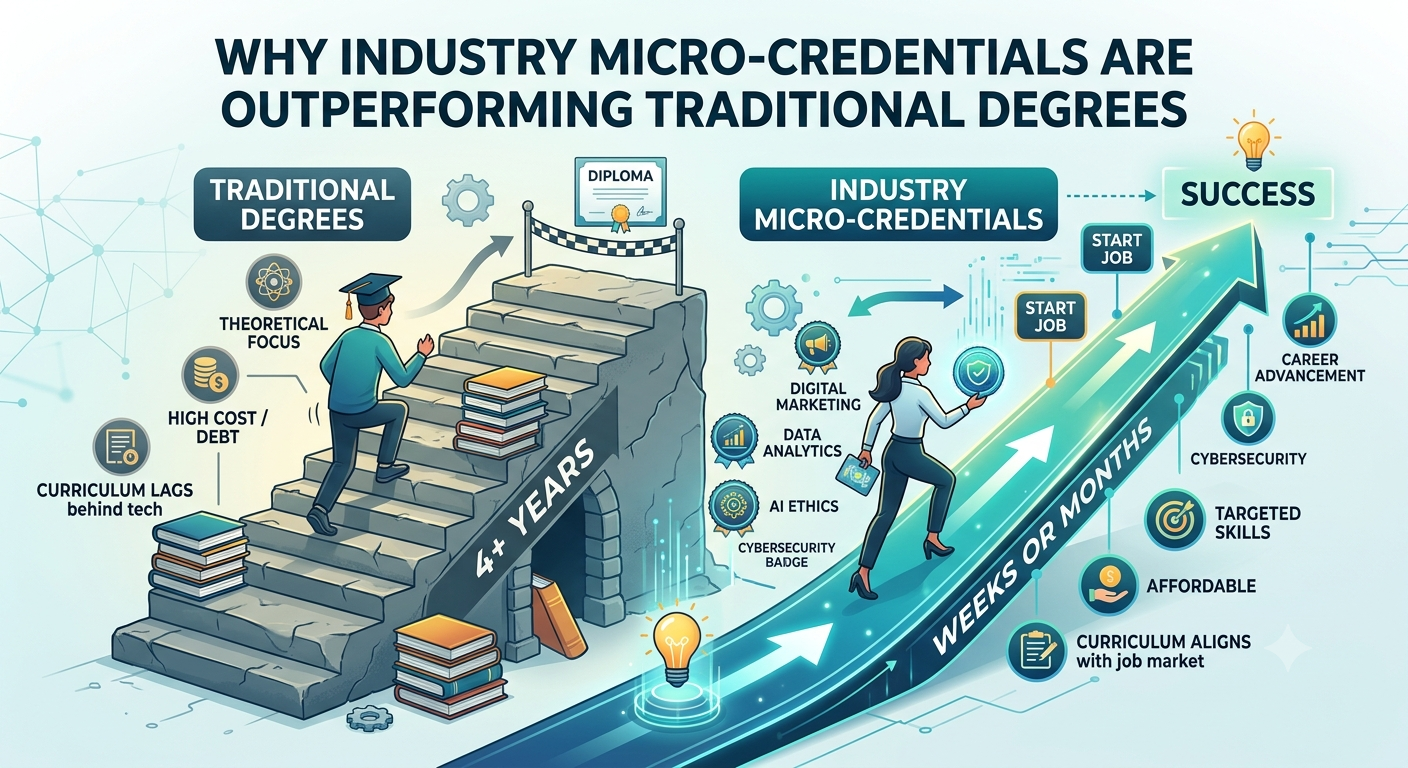
This is why industry micro-credentials beat traditional degrees in the sense of practical expertise. Micro-credentials help individuals develop job-specific skills in fields such as digital marketing, data analytics, cybersecurity, and project management.
Why Industry Micro-Credentials Are Outperforming Traditional Degrees?
1. Industry Micro-Credentials Focus on Cultivating Practical Skills
One reason why industry micro-credentials beat traditional degrees is that they focus on building practical expertise. College degrees equip students with theoretical and multi-disciplinary expertise needed for the job.
For example, candidates searching for a job in marketing can apply for search engine optimization qualifications, advertising, and marketing course. Similarly, individuals, who want to become cybersecurity experts, can complete an online course on ethical hacking and cyber intelligence. Micro-credentials demonstrate practical knowledge and job-specific skills.
2. They Require Less Time and Money
Industry micro-credentials require candidates to dedicate a relatively small amount of time and money to the program. College education is an expensive commitment, and people often burden themselves with mountains of debts to support their study. Other than that, individuals who balance their studies with work find it challenging to pursue new interests, which limits their capacity to expand their intellectual and professional horizons.
Micro-qualifications, on the other hand, allow people to gain new expertise without spending too much time on the learning process. They provide an extended array of skills needed to perform a particular task. The length of the program depends on the level of mastery and complexity of the topic. Moreover, various companies provide online certificates, some of which are even free to use.
While micro-qualifications cannot substitute traditional degrees in terms of theoretical background, they can enable continuous learning and commitment to progress without having to dedicate a significant amount of time and money.
3. Employers Need Skills That Specific Purposes
Modern enterprises operate in a highly volatile environment characterized by dynamic conditions. Technology becomes obsolete at a rapid rate, and firms need employees to develop a wide array of skills and demonstrate the ability to stay updated and committed to progress. While traditional colleges and universities offer excellent theoretical groundwork, micro-qualifications focus on a narrower set of necessary steps, which makes them useful in the context of high-tech industries.
For example, itertaintech: professionals can identify a specific, in-demand skill or area, such as artificial intelligence, data science, or cloud computing, to advance their career. Micro-credentials can showcase interest in a particular subject and prove the ability to comprehend novel concepts relevant to one’s professional experience. As always, it is important to remember that only certain certifications hold value. Therefore, before committing to a certain profession, it is necessary to research the industry and recognize the best areas of expertise that remain in demand.
4. Micro-Credentials Provide Opportunities to Change the Career
Sometimes it might be useful or even necessary to change the profession. Unfortunately, for many individuals, it is difficult to switch careers because academic requirements often dictate the necessary work. To receive a degree, the person needs to complete a large array of courses, which might become overwhelming. It would be a waste to finish a degree only to get a low-level, entry job. Industry micro-credentials can become a safe way to try different careers.
While the process of obtaining a certificate takes significantly less amount of time than earning a degree, it still provides sufficient conceptual background and allows people to get ready for the upcoming experiences. Additionally, such modular programs enable candidates to build professional competencies needed for a specific post. Micro-credentails are particularly useful for showcasing continuous learning in a specific area. When combined with practical application, they become a solid foundation for starting anew in the desired field. Nevertheless, it is always important to research the exact, in-demand qualification and requirements for the post before investing both time and effort. In short, micro-credentials enable people to change the course of their lives without breaking up their lives and going into heavy-debt.
5. They Can Be Used to Keep a Revising and Update Skills
When it comes to academic studies, professional experience, and continuous learning, it becomes evident that one’s professional expertise in a subject keeps growing. New techniques and instruments emerge, new processes are developed, new regulations are adopted, and many other changes occur in both local and global contexts. Industry micro-credentials can help to stay updated about the changes that may impact job performance.
Instead of spending the time and the money to learn new techniques, people can use the micro-credentials to gain new skills, expertise, and practical experience when needed. Not only that, but such qualification suites are ideal for employees who strive for excellence. When people demonstrate continuous learning, and willingness to accept new challenges, their chances to succeed increase.
In addition, employers also need to keep revising their qualifications and update their expertise so that they can stay competitive in their fields. Finally, it is important to remember that certificates are merely tools for proving one’s professional abilities. They should be used as a solid foundation, practical application of the learned knowledge, and professional expertise.
6. Digital Credentials Can Demonstrate and Prove Skills
Industry micro-credentials prove that individuals took part in the learning process and were able to gain a certain amount of expertise. Many providers offer digital credentials, which people can use on professional sites, such as their Linkedln profiles. Such digital certificates can be used to prove the ability to perform a certain task. For example, certain companies offer courses that provide candidates with a body of knowledge, which is necessary for applying a particular program or process. Some of such qualification even provide further details, including the assessment results, necessary for verifying if a professional has a certain amount of expertise. In some cases, the presence of digital certificates can expidite the application process, showing that a candidate has gained additional expertise outside of the academic environment.
On the other hand, it is reasonable to mention that certificates are, ultimately, proof of one’s knowledge and ability. Therefore, when assessing if a certain qualification is worth time and effort, it is needed to research what exactly the issuing company offers.
7. Traditional Degrees Will Always Be in Demand
Industry micro-credentials are valuable, and a growing number of employers begin to favor them with the increasing demand of skills-focused expertise. At the same time, it should be clear that college degrees will always retain their status and, in some industries, remain indispensable.
For example, medical professionals might need to complete years of training, academic studies, and clinical practice before receiving a license to operate. Degrees, provide a theoretical background, necessary research experience, and allow individuals to gain both practical and interpersonal expertise. Micro-qualifications should serve to provide additional expertise, which might deem necessary for the successful career in a particular field.
In short, people should always strive to attain the qualifications that are indispensable for the desired experience. Degrees can be beneficial for subjects that require extensive theoretical and practical background. At the same time, people should supplement their specialized expertise with continuous learning and practical application of novel skills.
Conclusion: Industry Micro-Credentials
Industry micro-credentials are valuable because they offer skills, which seem highly relevant nowadays. They provide people with the ability to demonstrate a clear focus, expertise in practical application, and continuous learning. In short, micro-qualifications focus on specific areas of expertise and offer modular programs with manageable time and cost commitments.
They also enable individuals to change careers, keep revising the necessary skills, and demonstrate the ability to acquire new professional knowledge. Such certificates can provide useful background experience and support the enhancement of the professional profile. They can also be used to verify the skill, which may be needed in some professions.
However, it is also important to use relevant micro-qualifications to ensure that the certificates are recognized by the employers, and that they meet all the specific requirements of a certain position. Finally, before getting a certificate, it is important to research the necessary career and the qualifications that can support achieving a greater success in terms of career development.
Ready to advance your career? Use the best job tools to identify in-demand skills, explore industry-recognized micro-credentials, and discover opportunities that match your qualifications. Take the next step toward building a competitive resume and achieving your professional goals.



Leave a Reply