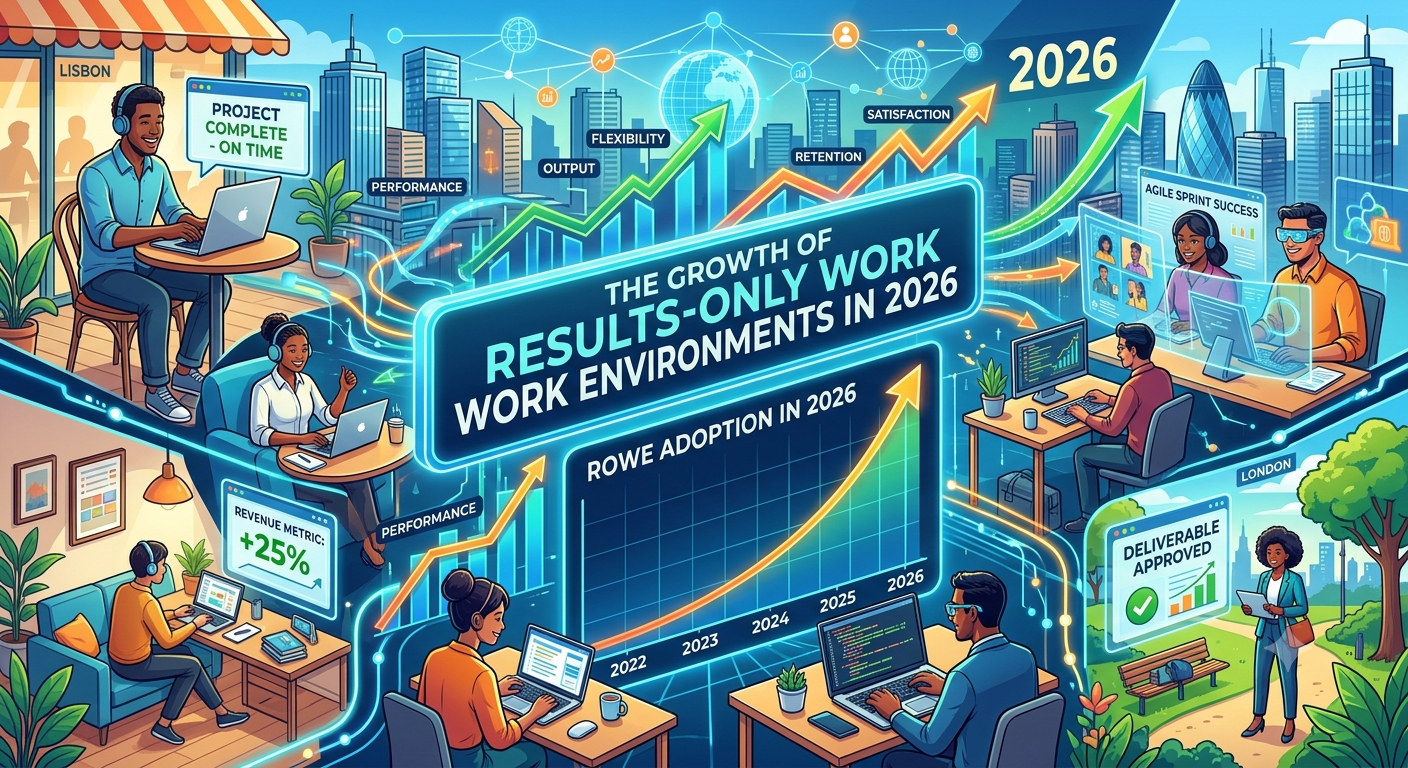
Introduction: Work Environments
The business world is changing as organizations look for ways to increase productivity and employee satisfaction. Companies used to reward employees based on their attendance and working hours. However, firms now focus on achievable goals, work quality, and completed tasks.
The Growth of Results-Only Work Environments in 2026 reflects modern organizations’ interest in implementing new methods of evaluating employees’ performance. The new model gives employees more freedom and flexibility in managing working hours while maintaining responsibility for completed tasks. This paper will discuss the implications of this emerging trend in the workplace.
The Growth of Results-Only Work Environments?
1. Understanding Results-Only Work Environments
A results-only work environment is a working environment that sets employee performance, completed work, and achievement of objectives instead of the amount of working hours. Modern organizations are considering different flexible arrangements to ensure employee performance and satisfaction. In 2026, it will be possible to set goals and measure performance to increase the efficiency of the working process.
2. Understanding Results-Only Work Environments
A results-only work environment is an innovative approach to managing employees based on the quality and quantity of work they produce during a specific time frame instead of the hours they work. A firm sets specific goals that an employee has to achieve while leaving the choice of the method to them. For instance, a content writer will be evaluated based on the quality, accuracy, and deadlines of the completed articles, not the number of hours spent at the computer. In a similar way, a sales professional will be able to demonstrate their success based on the clients’ satisfaction and reached goals.
However, despite more flexibility and freedom, employees are expected to fulfill all objectives set by the organization within a specific deadline. Therefore, besides setting specific and realistic goals, managers have to maintain open communication with their employees.
3. Why Companies Are Adopting This Model
Businesses are shifting towards measuring employee performance based on the quantity and quality of achieved goals rather than hours of work. The changes reflect the broader professional trends as more employees request more flexibility in choosing working hours, especially when the quality and quantity of work are maintained. By setting attainable objectives, companies can get reliable results without having to control every aspect of employees’ tasks.
Moreover, goals-oriented work environments help to promote business growth as well as employee productivity, motivation, and engagement. The ability to work more freely within attainable standards also helps to attract quality professionals who value flexibility. Finally, by focusing on employees’ achievements rather than their working hours, firms have better chances of building a highly performing and motivated team.
4. The Role of Technology in This Setting
Technology plays a crucial role in helping organizations to implement this new approach to managing and measuring employees’ performance. The software allows firms to post assignments, communicate with staff, and supervise the progress of each employee. At the same time, goal-oriented dashboards can display information about all employees’ achieved objectives, which helps to quickly identify underperforming areas.
With a reliable system in place, managers do not have to rely on daily reports from employees to assess their progress. At the same time, artificial intelligence can help to identify employees’ priorities and help to complete the most critical tasks first. Overall, the use of technology in this setting is beneficial. However, if not implemented carefully, the new procedures will fail to deliver intended results.
5. Benefits of Results-Only Work Environments
The most significant advantage of introducing a results-only environment is that employees have more freedom and flexibility to control their working hours. The ability to choose the working hours gives employees the opportunity to organize all activities around important personal goals while being responsible about their work. At the same time, the focus on achieving specific objectives helps to improve the productivity of employees.
By removing many routine aspects of the job, such as reporting, meetings, and other activities, a results-only environment allows a more significant focus on critical parts of a business. In addition, the new approach can also lead to lower operational costs as fewer employees have to come to the office. Besides, it helps to build objective criteria for measuring the performance of each employee.
6. A Healthy Working Climate
A healthy working environment is essential for all employees to be able to fulfill their responsibilities. They need reliable tools, clear instructions, and competent leadership to achieve all goals. In addition, a favorable working environment is one where there is a high level of collaboration, communication, and inclusiveness.
Employees have to be honest and transparent with their colleagues while sharing and discussing ideas. It is vitally important to ensure that all remote and office employees receive equal opportunities for professional growth and advancement. In addition, a healthy work environment should be based on fair expectations and standards set by the manager. Moreover, an efficient system should recognize and appreciate employees’ contributions and make reasonable demands on them.
Finally, a healthy working environment should promote employee commitment to the business through open and transparent communication. If workers are not invested in promoting the company’s interests, it will be challenging to achieve stable growth.
7. Limitations of the Results-Only Model
A results-only model requires extensive analysis and evaluation of employees’ performance. While the new working environment removes many restrictions on employees, they have to meet the set standards. The main limitation of a results-only model is that it is challenging to measure the quantity and quality of work in some professions.
For instance, it may be difficult to measure how much a researcher has contributed to an ongoing project. In addition, some employees may have difficulties working outside traditional office hours. Therefore, when combined with flex-time, the new model may lead to longer working hours. At the same time, new guidelines may affect how often and how well employees communicate with each other. To address these challenges, it is essential to set attainable standards and goals while making sure that employees receive the required support.
8. Implementation Strategies
Before introducing a results-only model, company managers have to set specific objectives for each position so that employees know what they have to achieve within the set time frame. The manager has to establish constant communication with their subordinates to ensure that they understand all instructions and have the necessary resources. Moreover, the managers should be realistic about the performance of their employees, taking into account the quality of work, quantity, customer satisfaction, and employee engagement.
Companies can also consider introducing the new model gradually while collecting employees’ feedback. In addition, analyzing the results of the implemented goals and the level of employee productivity will help to understand if the model is beneficial. Finally, training will help employees to develop the necessary skills, such as time management, that will contribute to their productivity in a results-only setting.
Conclusion: Work Environments
The Growth of Results-Only Work Environments in 2026 represents a significant shift in how organizations evaluate employees. Instead of rewarding those who work more hours, businesses try to find ways to get more done without having to increase employees’ working hours. While the changes will present some challenges, they create many opportunities.
By setting attainable goals while ensuring open communication, companies can create a working environment that promotes employee satisfaction while helping to achieve organizational objectives. In addition, the new model helps to promote fairness, productivity, and flexibility that are critical for long-term growth.
Ready to take the next step in your career? Use the Best Job Tools to explore flexible job opportunities, track your applications, and find roles that match your skills and career goals.



Leave a Reply