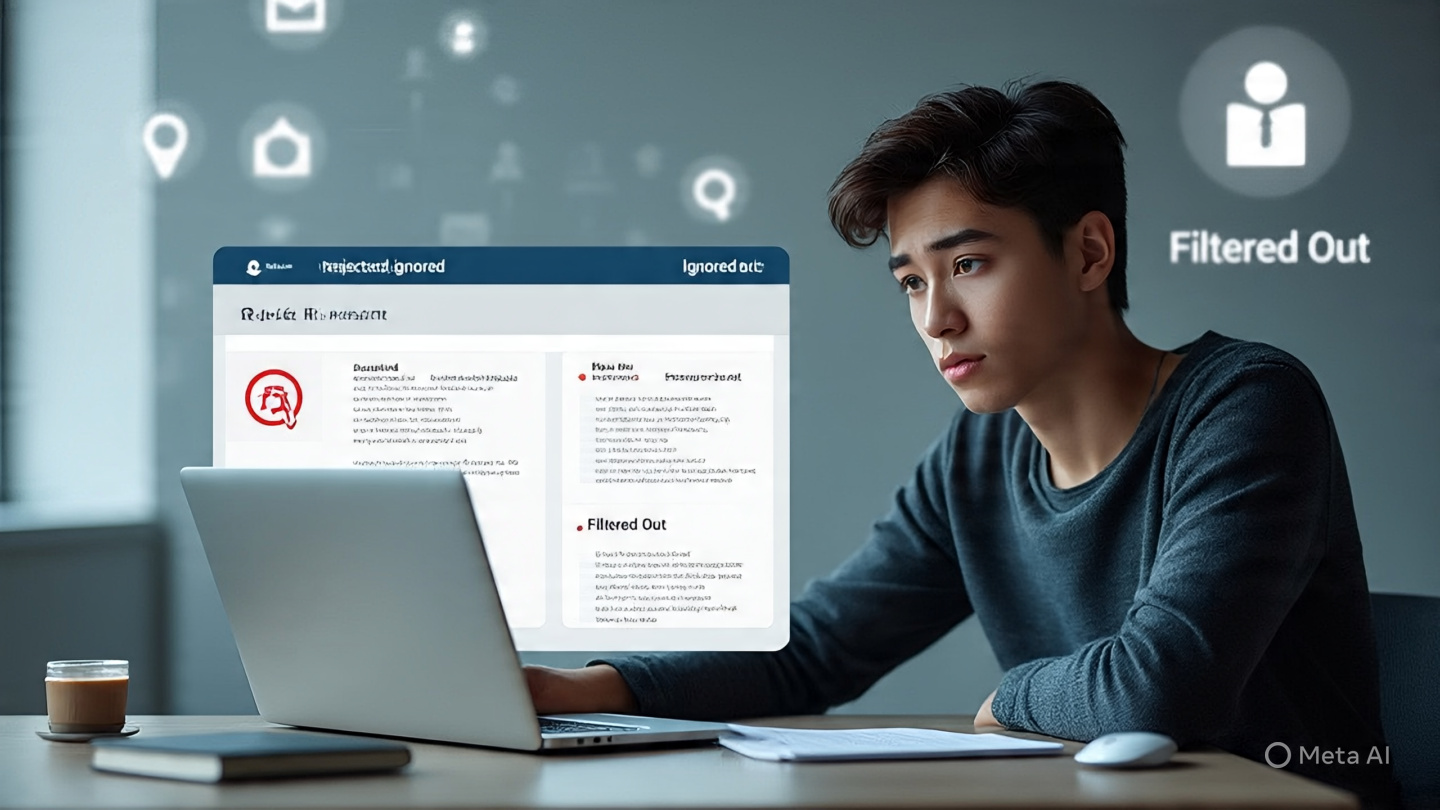
Introduction: AI Job Search Mistakes
The job market has gone through a big change with the introduction of AI. Now, most companies use AI in almost everything—whether it is resume screening or shortlisting candidates. This makes the work faster and more efficient. But the main problem is that many people don’t know how to use AI properly to improve their resume screening and get shortlisted. And they do AI job search mistakes.
A lot of people make mistakes while using AI in their job search, because of which their profiles get ignored by recruiters. That’s why it is very important to understand these mistakes, so you can improve yourself and avoid repeating them.
In this article, we are going to explore AI job search mistakes that get your profile ignored.
AI Job Search Mistakes That Get Your Profile Ignored
1. Copy-Pasting AI Content Without Personalization
AI is now included in almost everything and has become very advanced. It can help us do many tasks easily. But there is a big difference between taking help from AI and copying from AI—and many people don’t understand this.
Using AI for help is a smart move, but copying content exactly is a mistake. If you want to create a resume or a cover letter, you can take help from AI. But before submitting, you must edit it and make some changes so that it sounds human and reflects your real voice, experience, and value.
Many people ignore this step, which is why recruiters can easily tell that the content is copied and pasted, and they reject the application.
2. Ignoring Keywords from Job Descriptions
Another common mistake is ignoring keywords from the job description.
Before sending your resume, it is very important to read the job description carefully. Companies receive many resumes, and it is impossible to read each one in detail. That’s why they use an Applicant Tracking System (ATS), where AI shortlists candidates who have used the right keywords from the job description. If your resume does not include those keywords, it may get rejected before it even reaches the recruiter.
That’s why you should not make this mistake. You can use AI to extract important keywords from the job description and include them naturally in your resume.
3. Over-Optimizing for AI, Not Humans
As we discussed earlier, adding keywords from the job description in your resume is very important. Because of this, many people try to add too many keywords just to pass the ATS—but this is also a mistake.
Using keywords in your resume is important, but it should be done within a limit.
If your resume is full of keywords, it can feel unnatural and become difficult to read. That’s why you should avoid keyword stuffing. Instead, include keywords naturally so your resume stays clear, simple, and easy to read.

4. Using the Same Resume for Every Job
Another big mistake is sending the same resume to every job.
Every job has different requirements. If you create one resume and send it for every role, your chances of getting rejected are high. This is because the keywords may not match, and important skills required for that specific job may be missing.
AI tools look for relevance. If your profile does not align with the job, it gets filtered out. That’s why you should customize your resume for each role using AI—but keep it honest, relevant, and tailored to the job.
5. Not Showing Measurable Results
A candidate should create a resume that builds trust in the recruiter’s mind. And trust is built when you show proof of your work. That’s why adding measurable results in your resume is very important.
However, many people only mention responsibilities and forget to include measurable results.
For example, saying “managed social media” is just a basic statement. But saying “increased engagement by 40%” is a strong, measurable result. It clearly shows your impact and gives proof of your work.
This helps the recruiter trust your abilities and also makes your resume more impressive.
6. Blindly Trusting AI Suggestions
Fully depending on AI suggestions is a big mistake. Sometimes AI can generate outdated or incorrect content. If you rely on it completely and use everything it suggests without checking, your application may include irrelevant or misleading information.
To avoid this mistake, always review, edit, and fact-check any AI-generated content before using it.
Conclusion: AI Job Search Mistakes
AI can either boost your job search — or quietly block your opportunities.
The difference isn’t in using AI, but in how you use it.
If you rely on it blindly, your profile becomes generic, keyword-heavy, and easy to ignore. But when you combine AI with your own thinking, experiences, and clarity, your application stands out.
Remember:
AI helps you get noticed, authenticity helps you get selected
So instead of replacing your effort with AI, use it to enhance your strengths, not hide them.
Because in a world where everyone has access to AI, your real advantage is still you.
“Avoid common AI job search mistakes and explore opportunities on Best Job Tool where your profile gets the visibility it deserves.”




Leave a Reply