Introduction: Structure Every Interview Answer
Have you ever seen a candidate who has many qualifications and skills but still gets rejected? Not because they lack skills, but because they present their answers in a very generic or boring way. Because of this, recruiters become confused, and the candidate fails to stand out from other candidates.
That is why it is very important to structure every interview answer using simple frameworks to make your answers impressive and memorable.
In this article, we are going to explore some practical and effective ways to structure every interview answer using simple frameworks.
How to Structure Every Interview Answer Using Simple Frameworks?
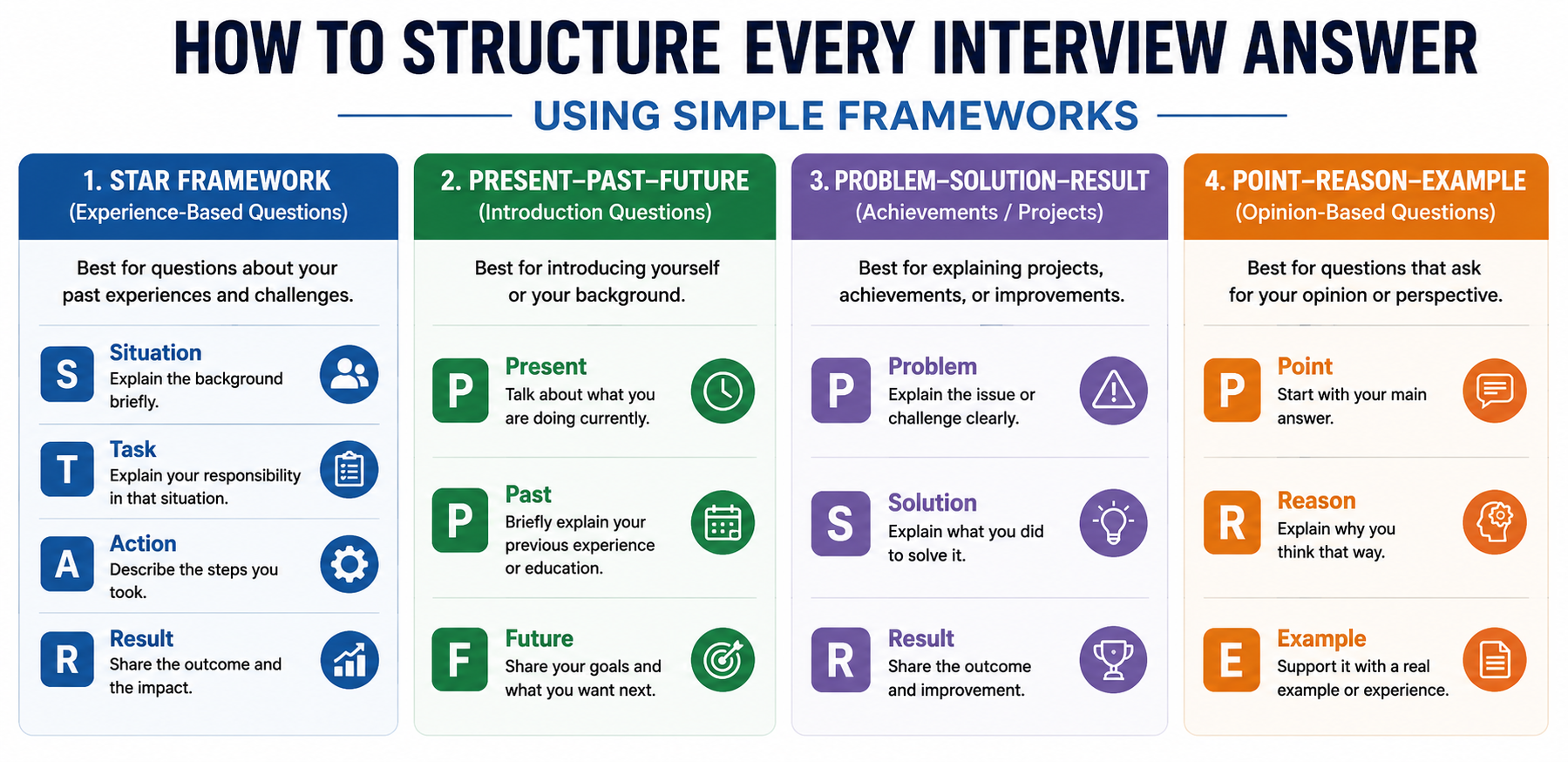
1. Use the STAR Framework for Experience-Based Questions
One of the most effective ways to make your answers structured is by using the STAR method.
Many times, when candidates explain their experience to recruiters, their answers do not have a clear structure. Because of this, recruiters get confused and cannot clearly understand what the problem was, what solution the candidate gave, and what impact they created. A recruiter may get confused even if the answer is actually good. That is why you should use the STAR method to make your answers structured and professional.
STAR stands for Situation, Task, Action, and Result.
Whenever a recruiter asks you a question, first explain the situation. Then talk about the task you were given to complete. After that, explain the actions you took to complete the task. Finally, share the result or outcome you achieved. This method helps recruiters understand everything easily and also creates a strong impression on them.
2. Use the Present-Past-Future Framework for Introduction Questions
Another effective way is to use the Present-Past-Future framework for introduction questions.
When recruiters ask introduction questions at the beginning to know more about you, many people share incomplete information. Because of this, recruiters do not feel completely satisfied with the answer. That is why you should use this structure.
In this method, first talk about what you are currently doing. Then briefly explain your previous experience or education. In the end, explain what you want to do next in your career.
This simple structure makes your introduction look clear and professional, and recruiters get all the information they want to know.
3. Use the Problem-Solution-Result Framework
Another effective way to make your answers structured is to focus on both the problem and the solution.
If you only explain the problem or only talk about the solution, your answer can feel incomplete. Because of this, recruiters may get confused and may not clearly remember your answer. Confusion makes it easier for recruiters to forget what you said.
But when you explain both the problem and the solution, your answer becomes clear and well-structured. Recruiters can understand your answer step by step, and they can also see how you solve problems. This shows your thinking ability and problem-solving skills.

4. Use the Point-Reason-Example Framework for Opinion Questions
Using the Point, Reason, and Example framework for opinion questions is also one of the best ways to structure your answers.
In interviews, there are many questions that candidates need to answer properly. Some of these questions are asked to understand your opinion. For example, “Why do you want this job?” or “Why should we hire you?”
Even though these are opinion-based questions, your answers should still have a clear structure. First, start with your main point or answer. Then explain the reason behind it. In the end, support your answer with a real example because it makes your answer stronger and more believable.
5. Keep Your Answers Short and Focused
Presenting your answers in a structured way during an interview is one of the best ways to make your answers memorable and impressive for recruiters.
But structure does not mean making your answers too detailed or very lengthy. If your answers become too long, recruiters may feel bored and disconnected instead of staying engaged.
That is why it is very important to keep your answers short and clear. To do this, avoid unnecessary details and explain only the most important parts of the situation. This helps recruiters understand your answers in a clear and impressive way.
6. Practice Frameworks Before Interviews
Practicing frameworks before an interview is also very important. But this does not mean you need to memorize complete answers. Instead, practice remembering the structure.
For example, for introduction questions, remember to use the Present-Past-Future technique. For experience-based questions, use the STAR method. For achievement-related questions, the Problem-Solution-Result technique works best. And for opinion-based questions, use the Point-Reason-Example structure.
Conclusion: Structure Every Interview Answer
Structured answers can make a big difference in interviews because they help you speak clearly, stay focused, and avoid confusion. Simple frameworks like STAR, Present-Past-Future, Problem-Solution-Result, and Point-Reason-Example make your answers more organized and professional without making them sound memorized.
The best part is that you do not need advanced communication skills to use these frameworks. With regular practice, you can answer questions more confidently, reduce nervousness, and explain your experiences in a way that recruiters can easily understand. Small improvements in structure can make your interview answers much stronger and more memorable.
“Improve your interview communication and explore better opportunities on Best Job Tool where clear and structured answers help candidates stand out.”




Leave a Reply