Introduction: Quantified Achievements
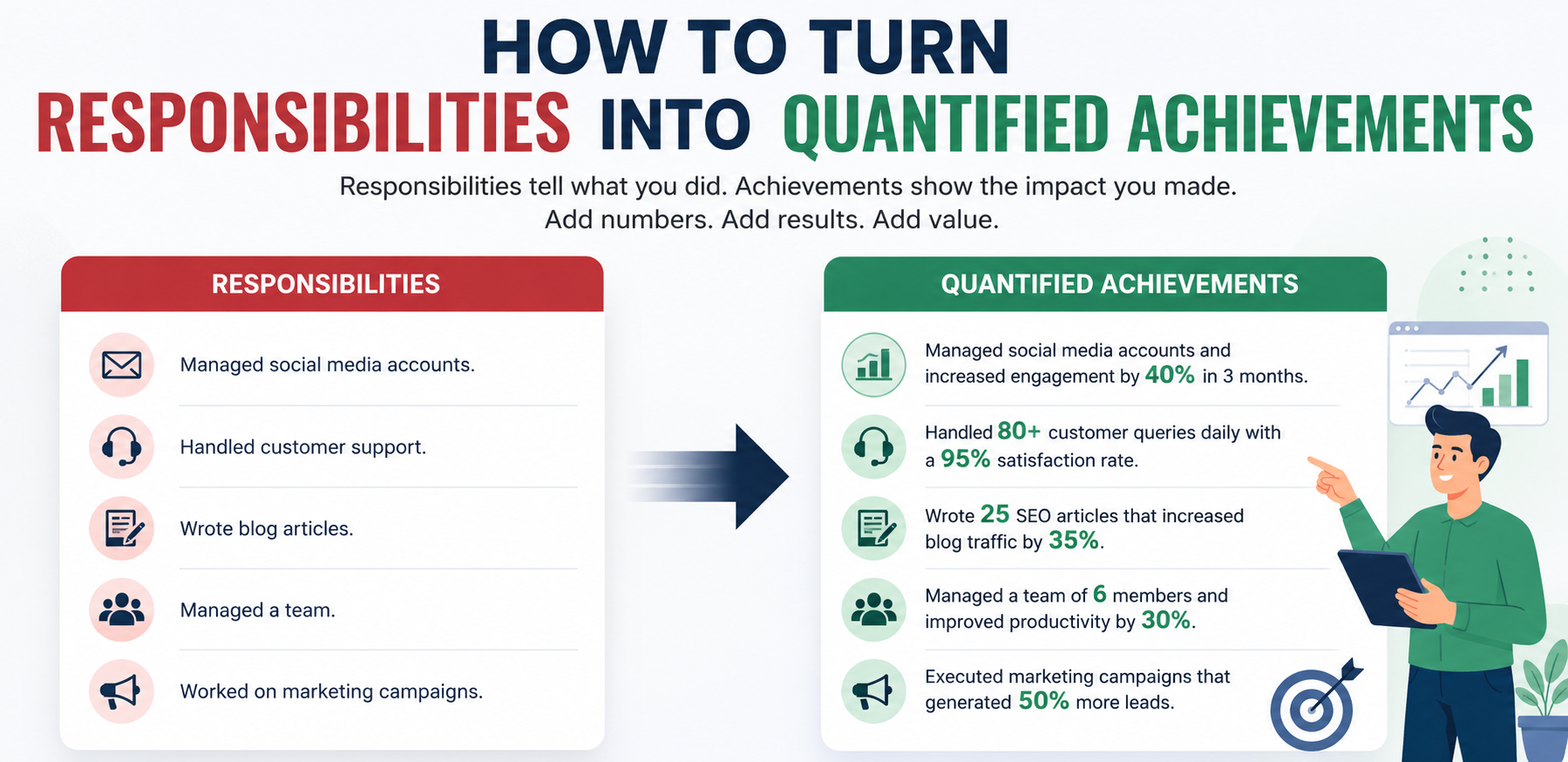
Many people write resumes, LinkedIn profiles, and portfolio descriptions by only listing responsibilities. They write things like:
- Responsible for managing social media
- Handled customer support
- Worked on marketing campaigns
- Managed a team
- Wrote blog articles
The problem is that responsibilities only explain what you were supposed to do. They do not show how well you did the work.
Recruiters and clients want to see achievements because achievements prove your impact. When you add numbers, results, and outcomes to your work experience, your profile becomes stronger and more professional.
For example:
Instead of writing:
“Managed social media accounts.”
You can write:
“Managed social media accounts and increased engagement by 40% in three months.”
This sounds more valuable because it shows measurable results.
In this article, you will learn how to convert simple responsibilities into quantified achievements using basic methods and easy examples.
Why Quantified Achievements Matter?
Quantified achievements help employers understand your value quickly. Numbers make your work easier to trust because they provide proof.
When recruiters scan resumes, they often look for:
- Growth percentages
- Revenue increases
- Time saved
- Productivity improvements
- Number of clients handled
- Team size managed
- Projects completed
- Engagement rates
- Traffic increases
These details help your experience stand out from other candidates.
For example:
“Wrote articles for company blog.”
This is normal and common.
But:
“Wrote 25 SEO articles that increased blog traffic by 35%.”
Now the recruiter can clearly see your contribution.
How to Turn Responsibilities Into Quantified Achievements?
1. Start by Listing Your Responsibilities
The first step is very simple.
Write down all your work responsibilities first.
For example, if you are a content writer:
- Wrote blog posts
- Researched topics
- Edited content
- Managed deadlines
- Posted articles online
Now ask yourself:
- How many?
- How often?
- How fast?
- What improved?
- What result happened?
- What changed because of your work?
These questions help you discover achievements hidden inside your responsibilities.
2. Add Numbers Wherever Possible
Numbers make your statements stronger.
You can add:
- Percentages
- Timeframes
- Revenue numbers
- Client numbers
- Project counts
- Team sizes
- Traffic growth
- Productivity increases
For example:
Instead of:
“Handled customer support.”
Write:
“Handled 80+ customer queries daily with a 90% satisfaction rate.”
Now the statement feels more professional.
3. Use the Formula: Action + Task + Result
One of the easiest ways to create quantified achievements is by using this formula:\
Action + Task + Result
Example:
“Created 15 social media posts per week that increased engagement by 35%.”
Breakdown:
- Action = Created
- Task = 15 social media posts per week
- Result = Increased engagement by 35%
This structure keeps your achievement clear and powerful.
Examples for Different Jobs
Content Writer
Wrote articles for websites.
Quantified Achievement:
Wrote 40+ SEO-friendly articles that increased organic traffic by 30% in six months.
Social Media Manager
Managed Instagram page.
Quantified Achievement:
Managed Instagram page and grew followers from 2,000 to 10,000 within eight months.
Customer Support Executive
Answered customer questions.
Quantified Achievement:
Resolved 70+ customer queries daily while maintaining a 95% satisfaction score.
Graphic Designer
Created marketing designs.
Quantified Achievement:
Designed 100+ promotional graphics that improved campaign engagement by 45%.
Teacher
Taught students.
Quantified Achievement:
Taught 60 students and improved average test scores by 20% during the academic year.
Freelancer
Worked with clients.
Quantified Achievement:
Completed 35 freelance projects for international clients with a 4.9-star average rating.
4. Use Strong Action Verbs
Strong action verbs make your achievements look more confident.
Instead of weak words like:
- Did
- Worked on
- Helped with
Use stronger verbs like:
- Improved
- Increased
- Generated
- Created
- Reduced
- Managed
- Led
- Developed
- Optimized
- Delivered
- Organized
- Achieved
For example:
Instead of:
“Worked on social media campaigns.”
Write:
“Developed social media campaigns that increased audience reach by 50%.”
5. Quantify Time Saved
Saving time is also a valuable achievement.
Employers like people who improve efficiency.
Example:
“Automated reporting process and reduced weekly reporting time from 5 hours to 2 hours.”
This achievement shows productivity improvement.
6. Quantify Money or Revenue Impact
If your work affected sales or revenue, include it.
Example:
“Helped generate ₹2 lakh in monthly sales through targeted email campaigns.”
Even small financial contributions are important.
7. Quantify Growth
Growth-based achievements are powerful.
You can measure:
- Follower growth
- Website traffic growth
- Sales growth
- Audience growth
- Engagement growth
- Customer growth
Example:
“Increased newsletter subscribers by 25% within four months.”
8. Quantify Productivity
Productivity achievements show you can handle work efficiently.
Examples:
- Completed 10 projects monthly
- Managed 50 calls daily
- Published 4 articles weekly
- Edited 100 videos yearly
For example:
“Published 5 blog posts weekly while maintaining consistent quality and deadlines.”
9. Use Percentages Carefully
Percentages look impressive, but they should be realistic.
Avoid fake or exaggerated numbers.
Instead of writing:
“Increased sales by 5000%.”
Write honest numbers that you can explain during interviews.
Authentic achievements build trust.
Conclusion: Quantified Achievements
Turning responsibilities into quantified achievements is one of the easiest ways to improve your resume and professional profile.
Responsibilities only explain what you did.
Achievements explain the value you created.
You do not need a high-level job title to show measurable impact. Even small improvements, consistent work, and daily tasks can become strong achievements when supported with numbers and results.
Start by reviewing your previous work and asking simple questions:
- How much work did I complete?
- What improved because of my work?
- How many people did I help?
- How fast did I complete tasks?
- What measurable result happened?
The more clearly you show your impact, the more professional and trustworthy your profile becomes.
Small numbers are still better than no numbers because they help employers understand your contribution more clearly.
Over time, quantified achievements can help you stand out in resumes, LinkedIn profiles, freelance proposals, and interviews.




Leave a Reply