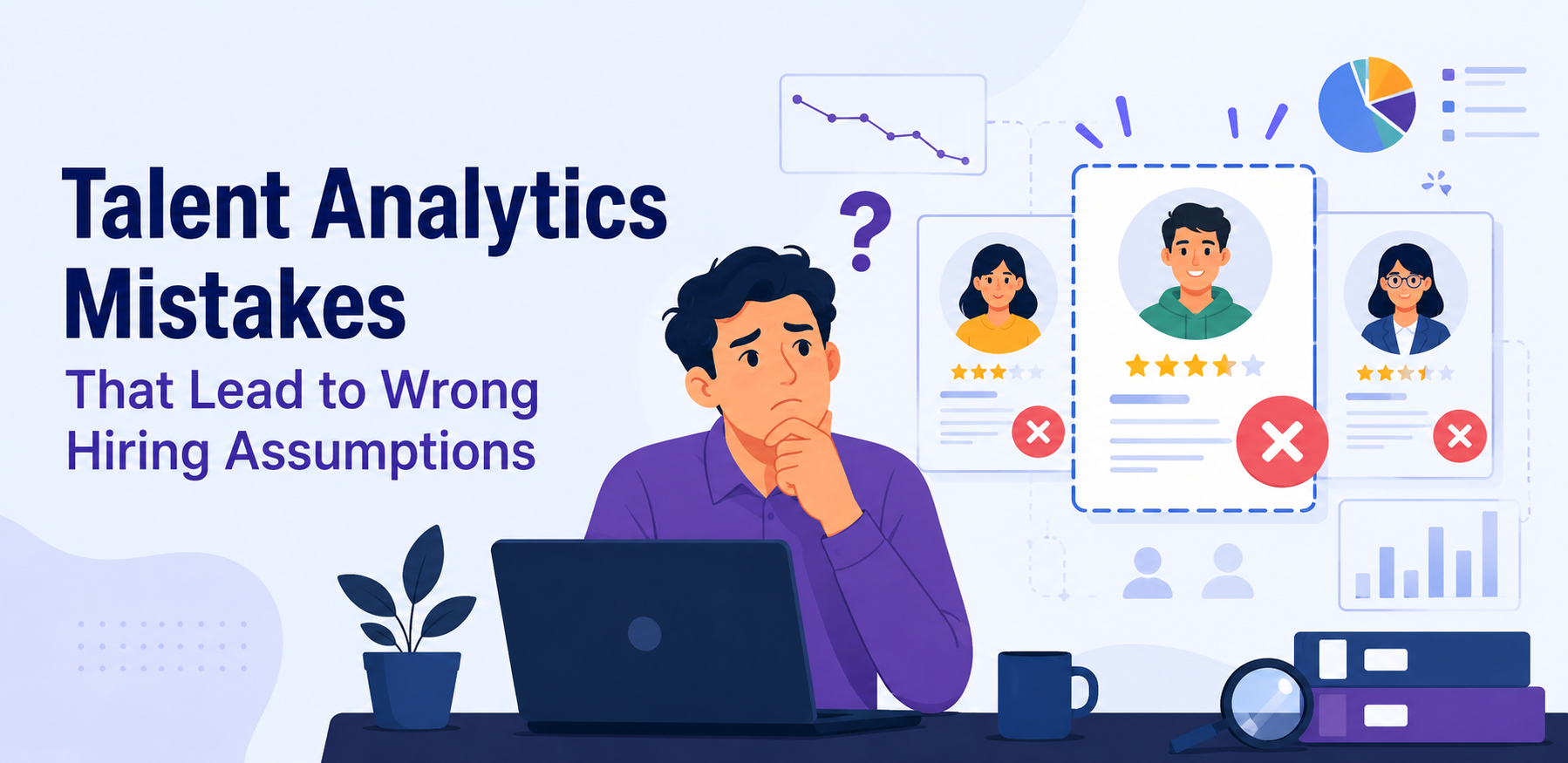
Introduction: Talent Analytics Mistakes
A recruiter’s responsibility is to select the best candidate for the company so the company can grow with the help of the candidate’s effective skills. That is why recruiters take every possible step to evaluate candidates. One of these steps is talent analytics, which means using data to make hiring decisions. But sometimes, because of incorrect or confusing data, recruiters make talent analytics mistakes that lead to wrong hiring assumptions and the loss of good candidates.
It is very important for recruiters to understand these talent analytics mistakes so they can avoid wrong hiring assumptions during recruitment.
In this article, we are going to understand some real talent analytics mistakes that recruiters make and how these mistakes can lead to wrong hiring assumptions.
Talent Analytics Mistakes That Lead to Wrong Hiring Assumptions
1. Depending Only on Resume Keywords
The first talent analytics mistake is depending only on resume keywords.
Today, competition has become very high, and companies receive thousands of applications for one role. Because of this, it becomes impossible to read every resume personally in detail. That is why companies now use an Applicant Tracking System (ATS) to filter resumes.
An ATS analyzes important keywords in resumes, and only the resumes that contain those keywords are selected and forwarded to recruiters. Because of this, sometimes even the best candidates get disqualified just because some keywords are missing.
That is why, if hiring decisions are made only on the basis of keywords, many talented people can be missed by the company.
2. Ignoring Context Behind Data
Another mistake many recruiters make is ignoring the context behind the data. This means trusting only numbers and ignoring the real reasons behind them. Because of this, companies often reject talented candidates.
It is important for recruiters to give importance to context as much as they give importance to numbers, so that no incorrect assumptions are made from the data.
3. Using Small or Incomplete Data Samples
Companies sometimes ignore talented candidates when recruiters make hiring decisions based on small or incomplete data.
When recruiters have limited data, they compare every candidate according to that data. Because of this, many talented candidates do not fit into those data points, and recruiters reject them. But this is not the correct way of hiring because it can make hiring decisions biased and cause companies to miss talented candidates.

4. Confusing Correlation With Performance
One of the biggest mistakes in talent analytics is confusing correlation with performance. This means companies make incorrect predictions and hire candidates based on those assumptions. Because of this, many talented candidates do not fit those predictions and face rejection.
For example, some companies think that candidates with higher grades will always perform better at work. But in reality, this is not always true because skills matter the most in a job. In such cases, a talented candidate may have good communication, teamwork, and learning abilities, but lower grades. Because of this, the company may reject the candidate even though the candidate is the best fit for the role.
5. Relying Too Much on Automated Scores
For many roles, candidates have to give assessment tests or go through AI screening, where they receive scores based on their performance. If a candidate’s score is lower than the expected score, they are often rejected. But this is completely wrong because when a company depends fully on assessment scores, many talented candidates can be missed.
These systems can mostly measure technical knowledge, but they cannot properly measure creativity, emotional intelligence, or potential, which are also very important factors in the hiring process.
That is why focusing on scores is important, but depending completely on them is a mistake.
Conclusion: Talent Analytics Mistakes
Talent analytics can make recruitment smarter, but incorrect use of data can create wrong hiring assumptions and poor decisions. Depending too much on automated tools, incomplete information, or biased patterns may cause companies to overlook talented candidates.
That is why recruiters should treat analytics as a support tool instead of the only decision-making factor. Combining accurate data with human understanding, communication, and fair evaluation helps companies make better hiring decisions and build stronger teams.
“Build smarter hiring strategies and improve recruitment accuracy with data-driven decisions on Best Job Tool.”




Leave a Reply