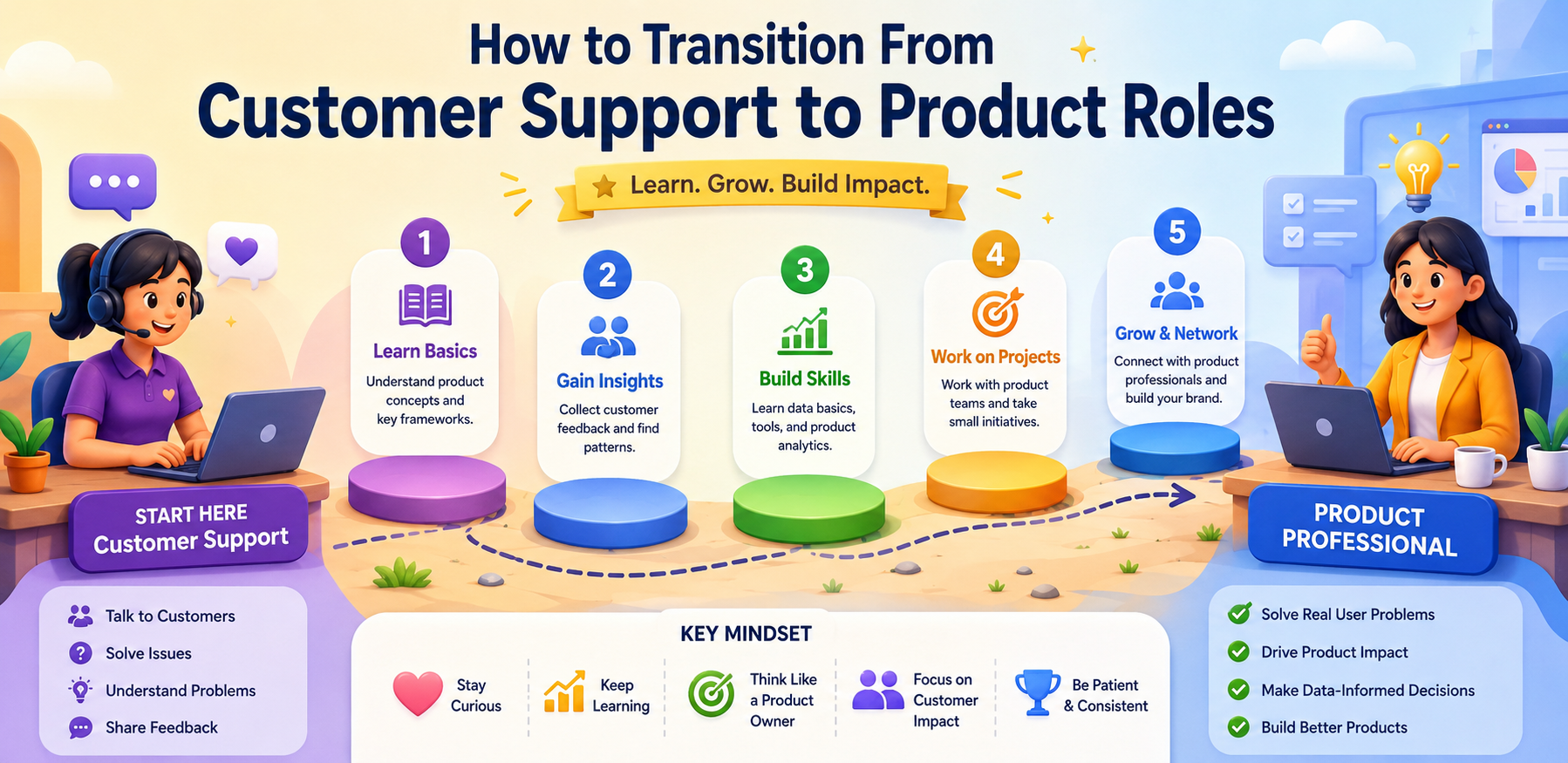
Introduction: Transition From Customer Support to Product Roles
Many people start their career in customer support because it helps them learn communication, problem-solving, and customer behavior. But after some time, many support professionals want to move into product roles because they want to work on product improvement, customer experience, and business growth.
The good news is that customer support experience can actually become a strong advantage for product roles. Customer support teams understand customer pain points better than anyone else because they talk to users every day. They know what customers like, what problems they face, and what features they need.
Transitioning from customer support to product roles may feel difficult in the beginning, especially when you see job descriptions asking for product experience. But with the right skills, mindset, and strategy, this career change is possible.
In this article, we will understand how to make transition from customer support to product roles step by step.
Understand What Product Roles Actually Mean
Before switching careers, it is important to understand what product roles involve.
A product professional works on improving a product so that customers can get better value from it. Product teams focus on understanding user needs, solving problems, planning features, and improving customer experience.
Some common product roles are:
- Product Manager
- Associate Product Manager
- Product Analyst
- Product Operations Specialist
- Product Support Specialist
- UX Research Assistant
Different companies may have different responsibilities for these roles, but the main goal is usually the same: building products that solve customer problems.
When customer support professionals understand these responsibilities clearly, they can prepare themselves better for thetransition.
How to Transition From Customer Support to Product Roles?
1. Recognize the Skills You Already Have
Many customer support professionals think they are starting from zero when moving into product roles. But this is not true.
Customer support already teaches many important skills that product teams need.
Some transferable skills include:
Customer Understanding
Support professionals talk directly with users every day. They understand customer frustrations, expectations, and common issues.
This customer knowledge is extremely valuable in product management because good products are built around user needs.
Communication Skills
Product teams communicate with developers, designers, marketers, and customers. Strong communication helps product professionals explain ideas clearly.
Customer support experience improves communication naturally.
Problem-Solving Ability
Support teams solve customer issues daily. They learn how to stay calm, analyze problems, and find solutions quickly.
This mindset is useful in product roles where solving user problems is the main focus.
Patience and Empathy
Product professionals need empathy to understand customer emotions and experiences.
Support professionals already develop empathy while handling different customer situations.
Feedback Collection
Support teams receive direct customer feedback every day. This helps them understand patterns and recurring problems.
Product teams use this kind of information to improve products and features.
Instead of ignoring your support experience, learn how to present it as a strength.
2. Learn Product Basics
Even though support experience is valuable, learning product management basics is still important.
You do not need to become an expert immediately. Start with simple concepts first.
Learn topics like:
- Product lifecycle
- User research
- Feature prioritization
- Customer journey
- Product metrics
- Market research
- Agile methodology
- Product roadmaps
- User stories
You can learn these skills through:
- Free YouTube videos
- Online courses
- Blogs
- Product management communities
- Podcasts
- LinkedIn posts from product leaders
Learning consistently is more important than learning everything at once.
Spend even 30 to 45 minutes daily learning product concepts.
3. Start Working Closely With Product Teams
One of the best ways to transition into product roles is by building relationships with product teams inside your company.
Many support professionals miss this opportunity.
Try to:
- Share customer feedback with product managers
- Participate in product discussions
- Help identify customer pain points
- Volunteer for product-related projects
- Ask product teams how features are planned
- Join meetings when possible
This helps in two ways:
First, you start learning how product teams work.
Second, product managers begin noticing your interest and skills.
Internal transitions often become easier when teams already know your work quality.
4. Become the Voice of the Customer
Customer support professionals have one unique advantage: they directly understand customer problems.
You can use this strength to stand out.
Instead of only solving tickets, start identifying patterns such as:
- Frequently reported bugs
- Common feature requests
- Confusing onboarding experiences
- Customer frustrations
- Missing product features
Create reports or summaries that help product teams understand customer behavior better.
For example:
- Which issue appears most frequently?
- Which feature do customers request often?
- Which process creates frustration?
- What causes users to stop using the product?
This kind of insight makes you valuable to product teams.
5. Learn Basic Data and Analytics Skills
Product roles often involve decision-making based on data.
You do not need advanced technical knowledge in the beginning, but understanding basic analytics is very helpful.
Learn simple things like:
- Reading dashboards
- Understanding customer metrics
- Tracking user behavior
- Basic Excel or Google Sheets
- Understanding KPIs
- Customer retention metrics
If possible, also learn beginner tools like:
- Google Analytics
- Mixpanel
- Jira
- Trello
- Notion
These tools are commonly used in product environments.
Basic analytical skills can make your transition smoother.
6. Improve Your Product Thinking
Product thinking means understanding problems from a business and customer perspective.
Instead of thinking only about solving one support ticket, product professionals think about solving problems permanently for many users.
For example:
A support mindset may say:
“Let me help this customer solve the issue.”
A product mindset may say:
“Why are many customers facing this issue, and how can the product reduce this problem permanently?”
Start practicing this type of thinking.
Whenever customers report problems, ask yourself:
- Why is this happening?
- Can the process be simplified?
- Is the feature confusing?
- Can onboarding improve?
- Is there missing guidance?
This habit helps you think like a product professional.
Conclusion: Transition From Customer Support to Product Roles
Moving from customer support to product roles is completely possible. In fact, many successful product professionals started their careers in support because customer-facing experience teaches empathy, communication, and problem-solving.
The most important thing is to recognize the value of your existing experience while learning new product skills gradually.
Start by understanding product basics, working closely with product teams, improving analytical thinking, and building product knowledge consistently.
You do not need to become perfect before applying for product opportunities. Growth happens step by step.
With patience, continuous learning, and confidence in your customer understanding, customer support professionals can successfully build strong careers in product management and related product roles.




Leave a Reply