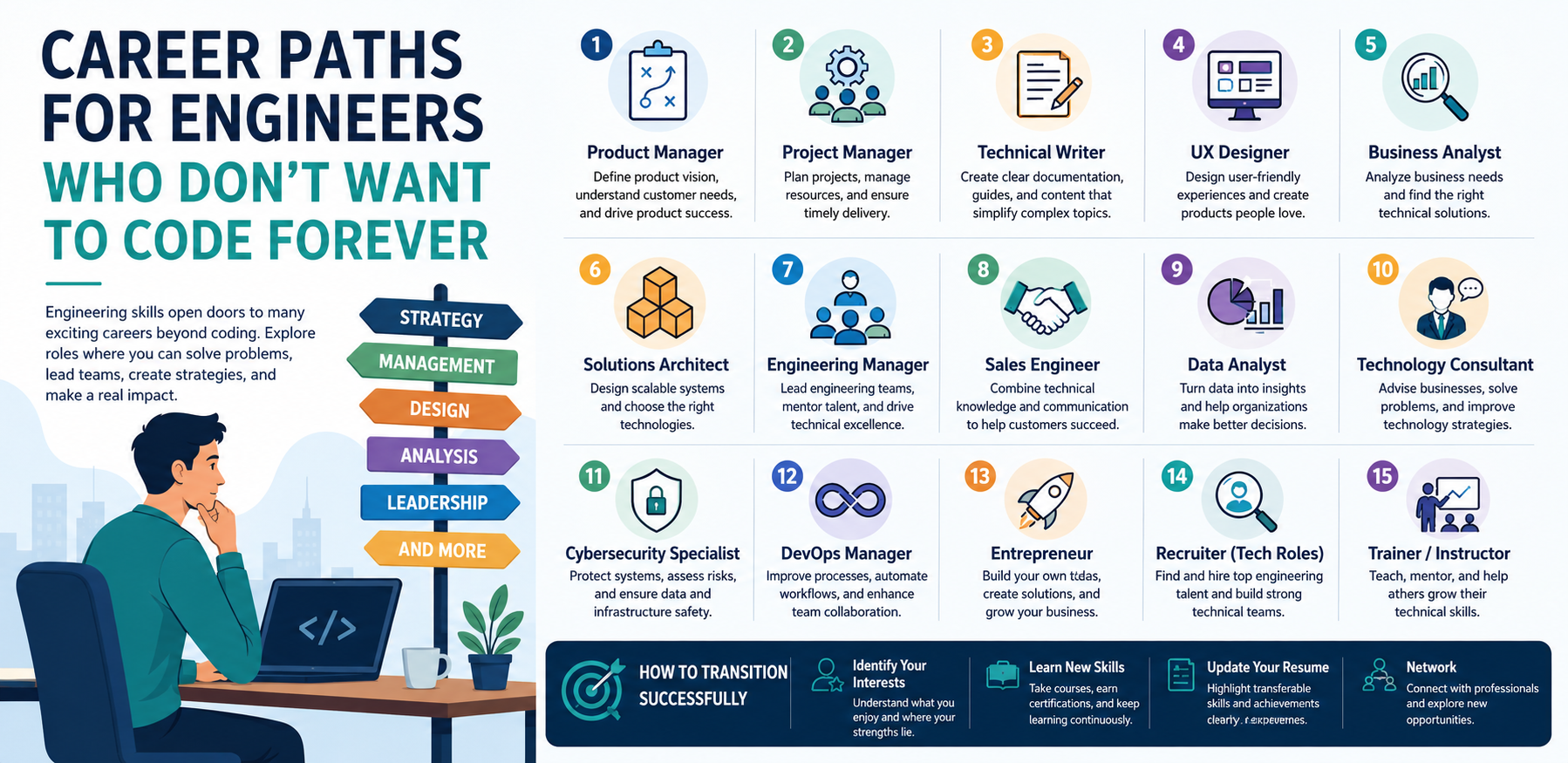
Introduction: Career Paths for Engineers
Many engineers start their careers with coding. They spend hours writing code, fixing bugs, testing applications, and learning new programming languages. Coding is an important skill, and it helps engineers build a strong foundation in technology.
However, not every engineer wants to write code for their entire career. After a few years, some professionals realize that they enjoy planning, managing, communicating, designing, or solving business problems more than coding. Others may simply want a change in their career direction.
The good news is that engineering skills can open the door to many career opportunities beyond software development. Engineers have strong problem-solving abilities, analytical thinking, and technical knowledge that are valuable in many roles.
If you are an engineer who does not want to code forever, here are some career paths for engineers you can explore.
Career Paths for Engineers Who Don’t Want to Code Forever
1. Product Manager
Product management is one of the most popular career options for engineers who want to move away from coding.
A Product Manager is responsible for defining what a product should do and how it should solve customer problems. They work closely with developers, designers, marketing teams, and business stakeholders.
Instead of writing code, Product Managers focus on:
- Understanding customer needs
- Creating product strategies
- Prioritizing features
- Managing product roadmaps
- Coordinating between teams
Engineers often make excellent Product Managers because they understand technical concepts and can communicate effectively with development teams.
Skills Needed
- Communication skills
- Leadership skills
- Problem-solving abilities
- Business understanding
- Market research
2. Project Manager
It is another great option for engineers.
Project Managers ensure that projects are completed on time, within budget, and according to requirements. They organize tasks, manage resources, and coordinate team activities.
Their responsibilities include:
- Creating project plans
- Tracking progress
- Managing risks
- Conducting meetings
- Communicating with stakeholders
Engineering experience helps Project Managers understand technical challenges and make realistic decisions.
Skills Needed
- Time management
- Team coordination
- Leadership
- Risk management
- Communication
3. Technical Writer
Some engineers enjoy explaining technical concepts more than writing code. Technical writing can be a perfect career path for them.
Technical Writers create:
- User guides
- Product manuals
- Documentation
- Knowledge base articles
- Training materials
Technology companies need clear documentation so users and developers can understand their products.
Engineers already understand technical systems, which makes it easier for them to explain complex topics in simple language.
Skills Needed
- Writing skills
- Research abilities
- Attention to detail
- Communication
- Technical understanding
4. UX Designer
User Experience (UX) Designers focus on making products easy and enjoyable to use.
Instead of building software, they design how users interact with it. They study user behavior and create solutions that improve customer experiences.
Their work includes:
- User research
- Wireframing
- Prototyping
- Usability testing
- Interface improvement
Engineers often have a logical approach to problem-solving, which can help them create effective user experiences.
Skills Needed
- Creativity
- User research
- Design thinking
- Problem-solving
- Communication
5. Business Analyst
Business Analysts act as a bridge between business teams and technical teams.
They identify business problems and find technology-based solutions.
Their responsibilities include:
- Gathering requirements
- Analyzing business processes
- Creating reports
- Recommending improvements
- Supporting project implementation
Engineers are often successful in this role because they understand both technical systems and analytical thinking.
Skills Needed
- Data analysis
- Communication
- Documentation
- Critical thinking
- Business knowledge
6. Solutions Architect
Solutions Architects design technology solutions for organizations.
While they may still use technical knowledge, they typically spend more time planning systems than writing code.
Their responsibilities include:
- Designing system architecture
- Evaluating technologies
- Advising clients
- Solving technical challenges
- Supporting implementation teams
This role is ideal for experienced engineers who enjoy strategy and system design.
Skills Needed
- Technical expertise
- Communication
- Strategic thinking
- Problem-solving
- Leadership
Conclusion: Career Paths for Engineers
Coding is an excellent skill, but it does not have to define your entire career. Engineering experience provides a strong foundation that can lead to many exciting opportunities beyond software development.
Whether you choose product management, project management, consulting, technical writing, data analysis, entrepreneurship, or leadership roles, your engineering background will continue to be valuable.
The key is to understand your interests, develop new skills, gain relevant experience, and remain open to learning. Career growth is not about leaving engineering behind. It is about using your engineering knowledge in ways that align with your goals, strengths, and long-term interests.
A successful career does not depend on coding forever. It depends on finding work that keeps you engaged, motivated, and continuously growing.





Leave a Reply