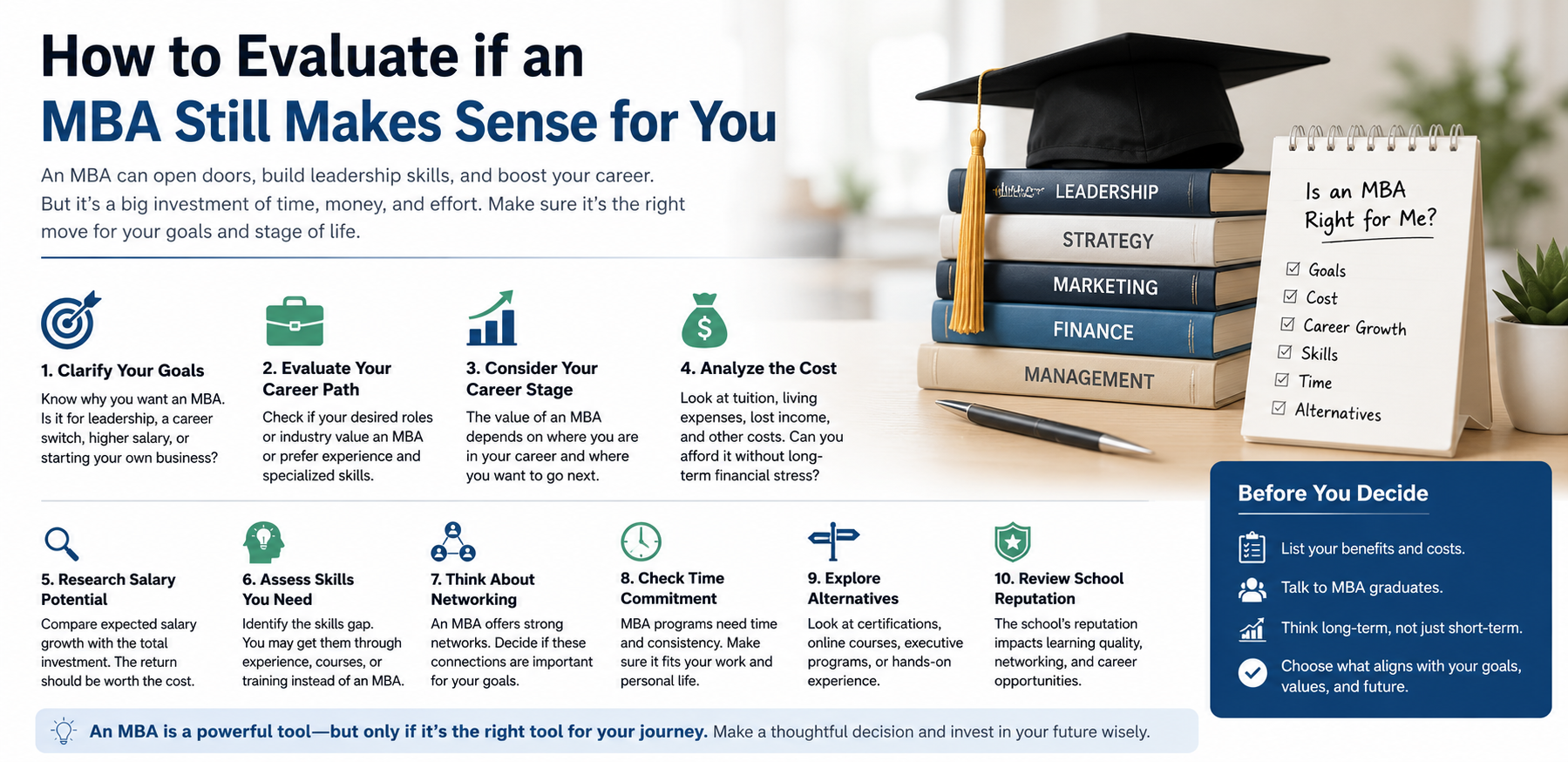
Introduction: MBA Still Makes Sense for You
For many years, an MBA (Master of Business Administration) has been considered one of the most valuable degrees for career growth. It has helped professionals move into management positions, increase their salaries, build strong networks, and learn important business skills.
However, the job market is changing. Today, people can learn business skills through online courses, certifications, workshops, and real-world experience. Because of this, many professionals wonder whether spending time and money on an MBA is still worth it.
The answer is different for every person. An MBA can be a great investment for some people, while for others it may not provide enough value.
Before making a decision, it is important to evaluate your goals, finances, career plans, and learning needs. This article will help you determine whether an MBA still makes sense for you.
How to Evaluate if an MBA Still Makes Sense for You?
1. Understand Why You Want an MBA
The first thing to ask yourself is why you want to pursue an MBA.
Many people decide to get an MBA because their friends are doing it or because they believe it will automatically lead to success. However, an MBA should have a clear purpose.
Ask yourself questions such as:
- Do I want to move into a leadership role?
- Do I want to switch industries?
- Do I want to start my own business?
- Do I want to increase my salary?
- Do I need business knowledge for career growth?
Your reason for pursuing an MBA should be specific. If you do not have a clear goal, it may be difficult to get the full value from the degree.
The clearer your objective, the easier it becomes to decide whether an MBA is the right choice.
2. Evaluate Your Career Goals
Career goals play a major role in this decision.
Some careers strongly value MBA qualifications. For example:
- Business management
- Consulting
- Finance
- Marketing leadership
- Corporate strategy
- Operations management
In these fields, an MBA can improve your chances of getting promoted or hired.
However, some industries focus more on skills and experience than degrees.
Examples include:
- Content writing
- Graphic design
- Software development
- Digital marketing
- Social media management
- Freelancing
In these careers, practical skills and portfolios often matter more than an MBA.
Look at the positions you want to achieve in the future and check whether most successful professionals in those roles have an MBA.
This can help you understand whether the degree is truly necessary.
3. Consider Your Current Career Stage
Your career stage can influence the value of an MBA.
For fresh graduates, an MBA may provide business knowledge and improve job opportunities.
For professionals with a few years of experience, an MBA can help them move into management roles.
For experienced professionals, the degree may help them qualify for senior leadership positions.
However, if you already have strong industry experience, leadership responsibilities, and a successful career path, the benefits may be smaller.
Think about where you are today and where you want to be in the next five to ten years.
The gap between your current position and your future goal can help determine whether an MBA is needed.
4. Analyze the Cost of the MBA
One of the biggest factors is cost.
MBA programs can be expensive. Besides tuition fees, there are additional expenses such as:
- Books
- Accommodation
- Travel
- Living expenses
- Examination fees
You should also consider the income you may lose if you leave your job to study full-time.
Before enrolling, calculate the total investment.
Then compare that cost with the expected benefits.
Ask yourself:
- How much will the degree cost?
- Can I afford it comfortably?
- Will I need a loan?
- How long will it take to recover the investment?
A realistic financial evaluation can prevent future stress.
5. Research Potential Salary Growth
Many people pursue an MBA because they expect higher salaries.
While salary growth is possible, it is not guaranteed.
Your future income depends on factors such as:
- Industry
- Work experience
- Location
- Skills
- Business school reputation
- Market conditions
Research salary trends in your target industry.
Talk to professionals who have completed an MBA.
Check job listings and salary reports.
If the expected salary increase is small compared to the cost of the degree, the investment may not make financial sense.
On the other hand, if the MBA can significantly increase your earning potential, it may be a worthwhile decision.
6. Determine Whether You Need New Skills
An MBA teaches many valuable business skills.
These often include:
- Leadership
- Finance
- Marketing
- Operations
- Strategic planning
- Communication
- Team management
Ask yourself whether you genuinely need these skills.
If your current role already provides opportunities to learn them, you may not need a formal MBA.
Today, many professionals develop business knowledge through:
- Online courses
- Certifications
- Workshops
- Company training programs
- Practical work experience
If these options can help you achieve your goals at a lower cost, they may be worth considering.
Conclusion: MBA Still Makes Sense for You
An MBA can still be a valuable investment, but it is not the right choice for everyone. The degree makes the most sense when it supports specific career goals, provides skills you genuinely need, offers valuable networking opportunities, and delivers a reasonable return on investment.
Before making a decision, carefully evaluate your career aspirations, financial situation, industry trends, learning preferences, and alternative options. Do not pursue simply because it is popular or because others expect you to do so.





Leave a Reply