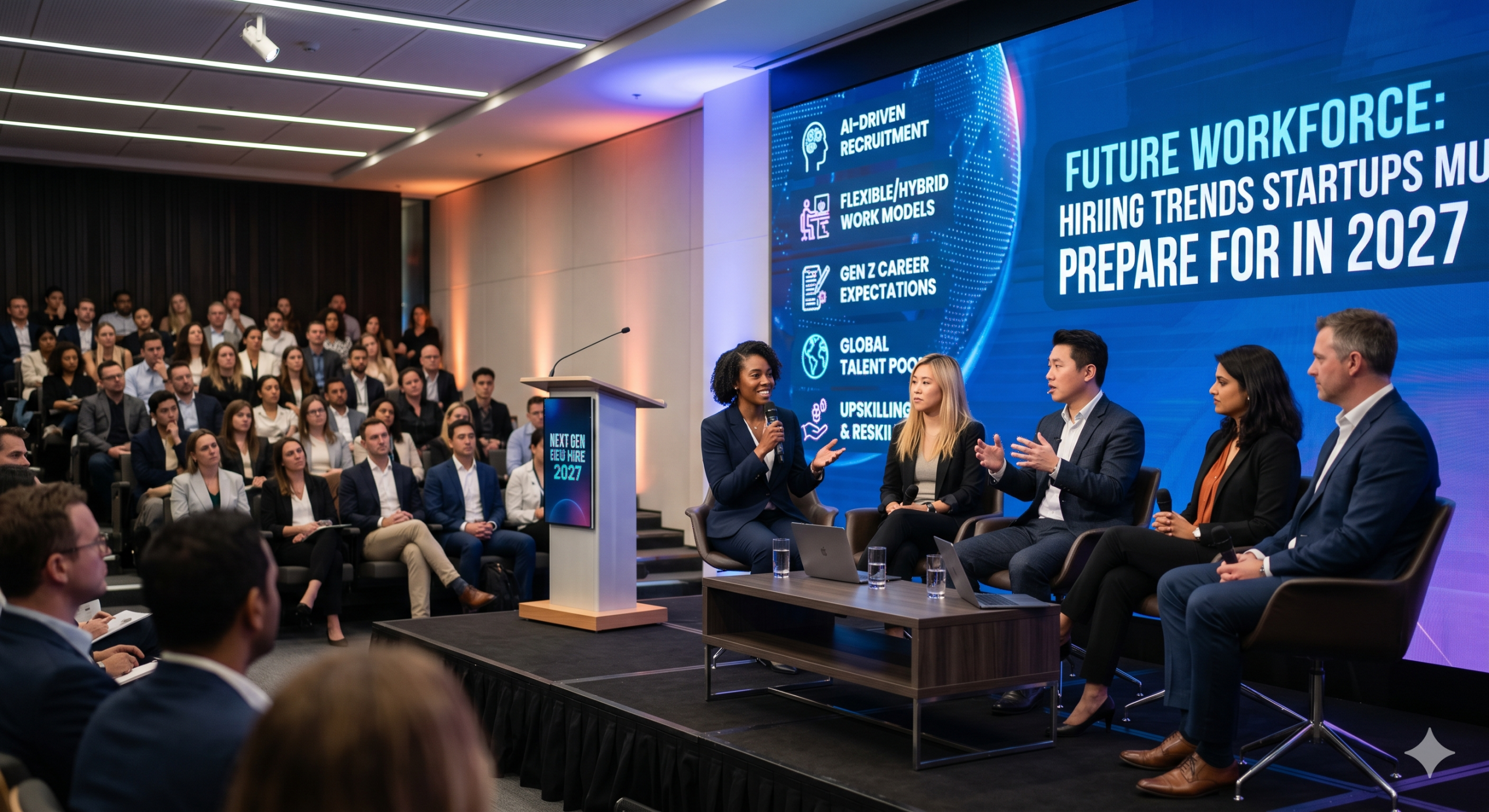
Startup hiring is no longer about scaling headcount as quickly as possible. Over the last few years, founders and hiring leaders have moved from aggressive expansion to precision hiring—building smaller, more capable teams that can deliver measurable business outcomes. By 2027, that shift will become even more pronounced. Startups will face a hiring environment shaped by AI adoption, tighter capital discipline, skills-first talent evaluation, distributed teams, and rising pressure to prove productivity per employee.
For startup leaders, this means hiring strategy can no longer sit in the background. Recruitment in 2027 will be a core business lever tied directly to runway, product velocity, customer growth, and operational resilience. Founders that prepare early will be in a stronger position to compete for high-value talent, fill critical roles faster, and avoid the costly mistakes of overhiring, under-scoping roles, or recruiting without a long-term workforce plan.
This article outlines the hiring trends startups should prepare for in 2027 and explains how founders, HR teams, and talent leaders can respond with practical, structured actions. The goal is not to chase every trend. It is to understand which shifts are becoming structural and how to build a startup hiring model that is lean, scalable, and aligned with the realities of modern work.
1. Precision Hiring Will Replace Broad Expansion
One of the most important hiring shifts startups should expect in 2027 is the continued move from volume hiring to precision hiring. In earlier growth cycles, many startups hired aggressively to build momentum, capture market share, and expand teams ahead of demand. That model is becoming less sustainable. Investors are increasingly focused on efficiency, profitability, and productivity per hire, which means founders will be expected to justify every new role.
Instead of asking, “How quickly can we build this team?” startups will increasingly ask:
- Which roles directly influence revenue, retention, product delivery, or operational leverage?
- What work can be automated, outsourced, or restructured instead of hiring full-time for it?
- What level of seniority is actually needed to solve the problem?
- How can one strategic hire remove multiple bottlenecks across the business?
In practice, precision hiring means fewer but more intentional hires. Startups will prioritize “high-impact roles” rather than building large teams too early. These roles often sit in product, AI, engineering, growth, customer success, and revenue operations—functions where one strong hire can meaningfully accelerate business outcomes. Recent hiring outlooks already show a shift toward more selective, niche-focused startup hiring, especially in AI, product engineering, and revenue-critical functions.
How startups should prepare
- Build a role approval process tied to business outcomes, not just manager requests
- Create a “must-hire vs nice-to-have” framework for every quarter
- Define expected ROI for each new position before opening the role
- Review whether automation, contractor support, or internal reallocation can solve the problem first
The startups that hire well in 2027 will not necessarily be the ones with the largest teams. They will be the ones with the clearest talent-to-outcome alignment.
2. AI Fluency Will Become a Baseline Hiring Expectation
By 2027, AI skills will not be limited to technical roles. Startups should expect AI fluency to become a baseline expectation across functions including operations, marketing, customer support, recruiting, finance, and administration. This does not mean every employee must become an AI engineer. It means employees will increasingly be expected to work effectively with AI tools, automate routine tasks, improve workflows, and use AI to increase speed and output quality.
Hiring data already shows that demand for AI-related skills is rising sharply across both technical and non-technical roles. Upwork’s 2026 in-demand skills report found that AI-related skills grew strongly year over year, but demand for broader human expertise remained stable, suggesting that businesses are embedding AI into existing workflows rather than replacing whole job categories. Experimental hiring research has also found that AI skills can significantly improve interview chances across occupations, including office support roles.
For startups, the implication is clear: AI hiring strategy is not only about recruiting machine learning specialists. It is also about building teams that can work in AI-enhanced environments.
What AI fluency may look like in startup roles
- A recruiter using AI to draft outreach, summarize interviews, and improve sourcing
- A customer support lead using AI to organize tickets, draft responses, and identify patterns
- An operations associate automating recurring reporting and documentation tasks
- A marketer using AI for content briefs, campaign testing, and research workflows
- A founder or manager using AI to reduce administrative load and speed up decision support
How startups should prepare
- Update job descriptions to distinguish between “AI-native role requirements” and “AI productivity expectations”
- Add practical AI workflow questions to interviews
- Train current employees on safe, useful AI adoption before hiring externally
- Prioritize candidates who can show how they used AI to improve execution, not just talk about tools
In 2027, startups that treat AI as an isolated technical hiring issue will fall behind. AI readiness will be a workforce capability issue.
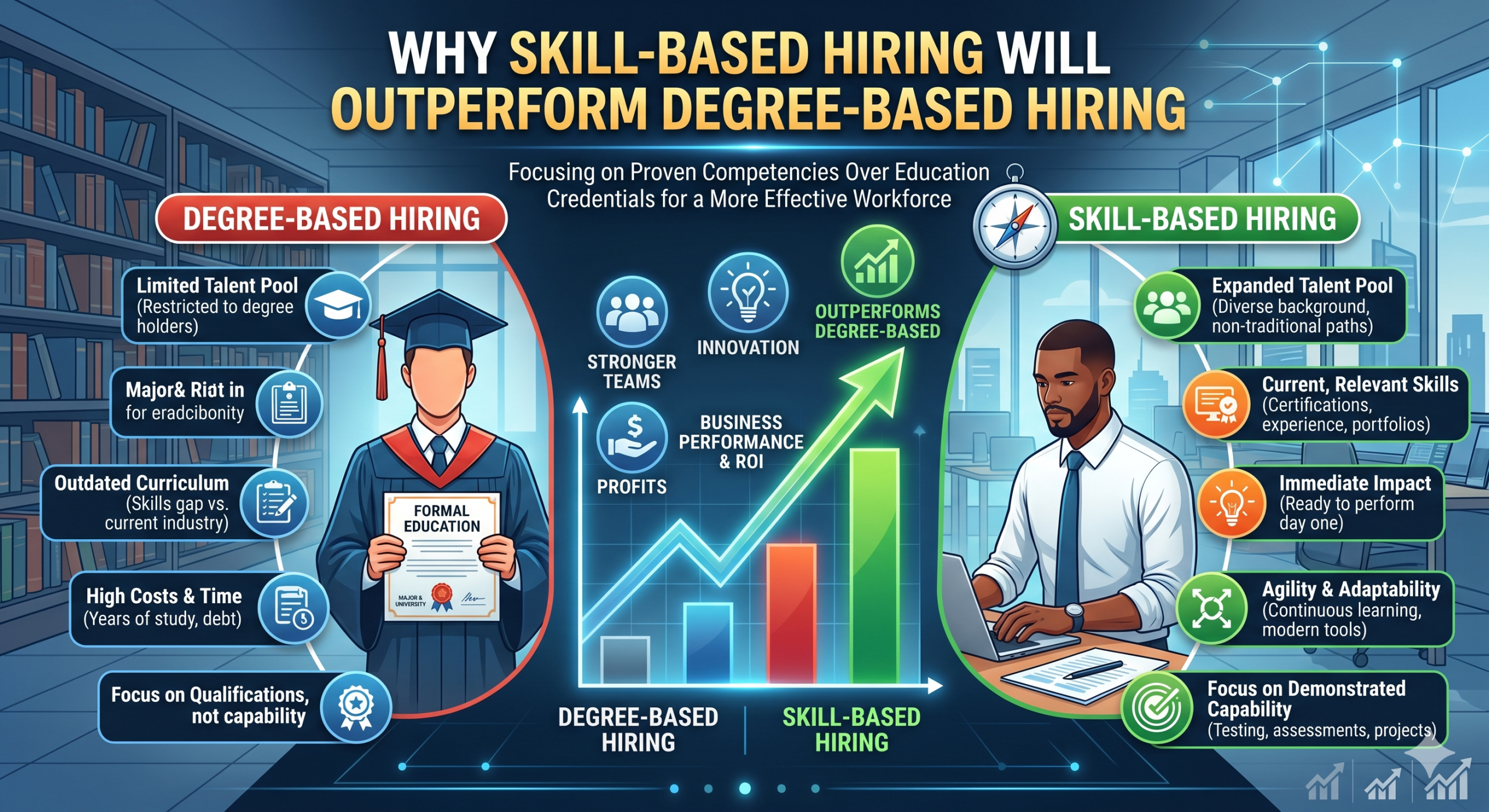
3. Skills-Based Hiring Will Matter More Than Degrees or Linear Backgrounds
Startups should also prepare for a deeper shift toward skills-based hiring. As roles evolve faster than traditional education pathways can keep up, employers are placing greater weight on demonstrated capability, portfolio evidence, problem-solving ability, and practical experience rather than degrees alone. This trend is especially visible in AI-related, digital, and startup environments where execution speed matters more than credentials.
Research and market signals increasingly support this direction. Studies tracking labor market demand have shown a growing premium for AI and emerging skills, while degree requirements in some categories have softened relative to practical capability. Startup hiring reports also point to more selective, skill-focused hiring, with stronger demand for commercial intelligence, technical depth, and managerial effectiveness rather than generalist resumes.
For startups, skills-based hiring is not only a fairness or employer branding issue. It is a speed and quality issue. When teams hire for demonstrated capability instead of over-filtering on pedigree, they widen the talent pool and reduce the risk of missing high-potential candidates from nontraditional backgrounds.
What this means in practice
Startups should begin evaluating candidates based on:
- Work samples and practical assignments
- Evidence of building, shipping, selling, analyzing, or improving something relevant
- Tool proficiency tied to role outcomes
- Problem-solving and communication ability
- Learning agility and adaptability in ambiguous environments
How startups should prepare
- Audit current job descriptions for unnecessary degree, pedigree, or years-of-experience filters
- Replace generic requirements with clear capability statements
- Introduce structured work tests or scenario-based assessments
- Train hiring managers to evaluate proof of execution, not just resume familiarity
In 2027, the best startup hiring teams will widen access while increasing quality by getting clearer on the exact skills each role needs.
4. Distributed and Remote-First Talent Models Will Stay Strategic
Even as some companies push for more in-office time, startups should not assume that remote work will disappear as a hiring advantage. In 2027, distributed work will remain a strategic lever—especially for startups competing with larger employers for specialized talent. The question will not be whether remote work exists. It will be whether startups can use remote, hybrid, and global hiring models intentionally rather than reactively.
For many startups, distributed hiring solves three major challenges:
- Access to specialized talent that may not exist locally
- Lower hiring friction for hard-to-fill roles
- Better cost flexibility compared to hiring only in expensive hubs
This is particularly relevant for product, engineering, customer support, operations, and growth roles that can be performed effectively across geographies. At the same time, remote work is no longer just a policy issue. It is an operating model issue. Hiring distributed teams without clear systems, documentation, communication standards, and performance management processes creates more problems than it solves.
What startups should prepare for
- More candidates will expect flexibility, even if not fully remote
- Cross-border hiring and contractor models will become more common
- Remote roles will attract more applications, which increases screening complexity
- Distributed teams will require stronger onboarding, documentation, and async communication practices
Action steps for startup leaders
- Decide which roles are remote-first, hybrid, location-bound, or contractor-friendly
- Standardize remote onboarding, communication expectations, and performance rhythms
- Use location strategy deliberately: hire locally when presence matters, globally when capability matters more
- Build compensation frameworks that are fair, transparent, and scalable across markets
For startups with limited brand recognition, flexibility can still be a meaningful competitive advantage in 2027—provided it is supported by strong execution.
5. Fractional, Contract, and Specialist Hiring Will Grow
One of the most practical hiring trends startups should prepare for in 2027 is the expansion of flexible talent models. Not every business problem needs a full-time employee. As capital efficiency becomes more important, many startups will rely more heavily on fractional leaders, project-based specialists, contractors, and niche consultants to fill gaps without expanding permanent headcount too early.
This model is especially useful when startups need:
- Senior expertise for a short but critical period
- Specialized knowledge in areas such as pricing, RevOps, compliance, analytics, or employer branding
- Fast execution on defined deliverables
- Interim leadership while full-time hiring is still being scoped
Fractional hiring is not a replacement for core team building. It is a way to keep the business moving while preserving flexibility. In many cases, it can also reduce hiring risk. Instead of making a rushed permanent hire for a poorly defined role, startups can test scope through a contract or project-based engagement first.
Roles where flexible hiring can work well
- Finance leadership and FP&A support
- Growth marketing and performance marketing
- Recruitment operations and employer branding
- Product design and UX research
- Legal, compliance, and HR policy support
- Data analysis and RevOps setup
How startups should prepare
- Define which roles must be in-house and which can be flexible
- Create a vendor/fractional talent budget separate from permanent hiring plans
- Build clear project scopes and success metrics before bringing in external specialists
- Treat contractor onboarding and communication with the same seriousness as employee onboarding
In 2027, the strongest startup talent strategies will blend permanent hires with flexible expertise rather than defaulting to one model.
6. Candidate Experience and Employer Credibility Will Matter More
Startups often underestimate how much candidate experience affects hiring outcomes. In competitive talent markets, strong candidates do not only evaluate compensation and title. They also evaluate speed, clarity, communication quality, role definition, leadership credibility, and the professionalism of the hiring process itself.
As AI-generated applications increase and job markets become noisier, candidate trust will become more valuable. If a startup’s process feels vague, disorganized, overly slow, or overly automated, high-quality candidates are more likely to disengage. This is particularly true for senior talent, niche specialists, and candidates with multiple options.
Common startup hiring mistakes that damage candidate experience
- Unclear job descriptions with unrealistic scope
- Long interview loops without decision clarity
- Delayed feedback or inconsistent communication
- Poorly structured assessments that do not match the role
- Leadership interviews that fail to explain business direction or expectations
What good candidate experience looks like in 2027
- Clear, outcome-based job descriptions
- Transparent process timelines and decision criteria
- Thoughtful use of AI without removing human communication
- Respect for candidate time, especially during assessments
- Fast follow-up and decisive closure, even for rejected candidates
How startups should prepare
- Audit the candidate journey from application to offer
- Reduce unnecessary interview rounds
- Create interview scorecards to improve consistency
- Train hiring managers to sell the role honestly and effectively
- Measure drop-off rates, offer acceptance rates, and time-to-hire as core recruiting metrics
A startup may not always win on brand or salary, but it can still win on clarity, speed, and credibility.
7. Retention Strategy Will Become Part of Hiring Strategy
By 2027, startups will need to stop treating hiring and retention as separate conversations. The cost of replacing talent—especially in specialized, high-ownership roles—is too high for early-stage companies to ignore. Every hiring decision should be made with retention in mind: role design, manager quality, onboarding, compensation logic, growth pathways, and workload sustainability all influence whether a hire succeeds or leaves within a year.
This matters because the startup environment itself creates retention risk. Ambiguity, shifting priorities, lean teams, and resource constraints can energize the right people but exhaust the wrong ones. If startups hire quickly without aligning role scope, expectations, and growth opportunities, they end up with avoidable churn.
Hiring questions startups should ask before opening a role
- Is the scope realistic for one person?
- What will success look like in 30, 90, and 180 days?
- Who will manage this person, and how strong is that manager?
- What growth path exists if the employee performs well?
- Is compensation aligned with market realities and workload expectations?
Retention practices that should start at hiring stage
- Honest role previews rather than overselling the opportunity
- Clear onboarding plans tied to early wins
- Documented growth expectations and performance metrics
- Thoughtful manager matching
- Regular compensation and responsibility reviews for high-impact employees
Retention is not just a culture issue. It is a hiring quality issue. In 2027, startups that think about employee durability from day one will spend less time backfilling and more time building.
Conclusion
Startup hiring in 2027 will be shaped by a simple but demanding reality: every hire must create real business value. Founders will operate in a market where AI changes role design, skills matter more than traditional credentials, remote and flexible talent models remain important, and candidate expectations continue to rise. At the same time, capital discipline will push startups to hire with greater precision and hold every headcount decision to a higher standard.
The startups that prepare early will have a clear advantage. They will know which roles deserve permanent investment, which skills matter most, where AI can raise team productivity, and how to design hiring systems that are fast without being careless. They will also understand that recruitment is no longer just an HR function. It is a growth, operations, and financial planning function all at once.
For teams building their 2027 hiring strategy, the practical priority is not to adopt every new trend. It is to build a hiring model that is disciplined, skills-focused, flexible, and credible enough to attract the people who can move the company forward. Using a best job tool with global reach can also help startups access stronger candidate pipelines, especially for remote and specialist roles where local hiring options may be limited. In a market defined by selective growth, the right talent systems will matter as much as the right product roadmap.


Leave a Reply