Introduction: Promotions and Raises
Do you know how remote-first companies think about promotions and raises?
Traditional office companies and remote-first companies work very differently. Because of this, their approach to promotions and salary raises is also different.
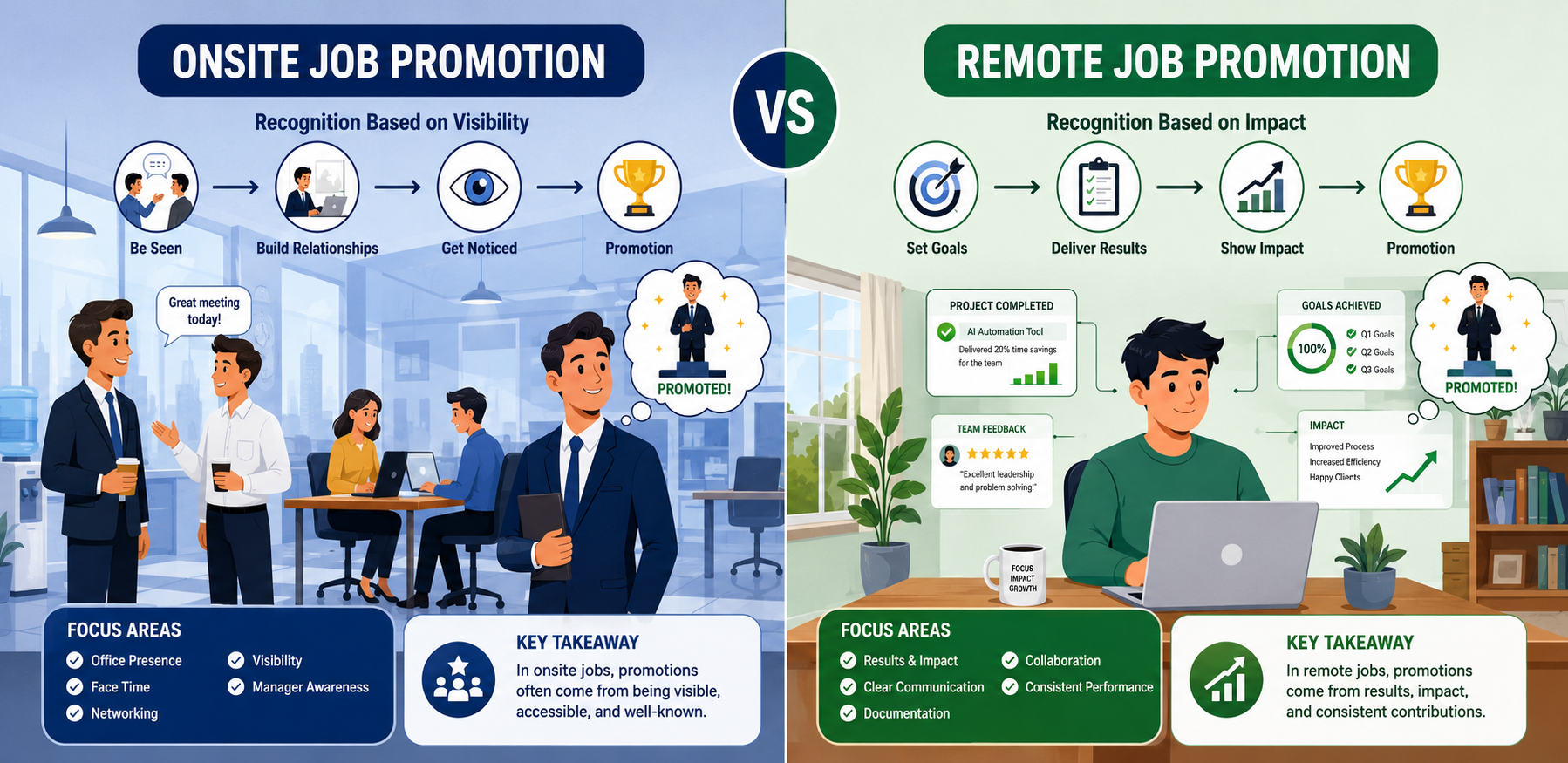
In a traditional workplace, employees work together in the same office. They interact with each other every day, attend meetings in person, and spend time with their managers. As a result, managers can easily observe employees’ work, behavior, and participation. Sometimes, employees who are more visible in the office, attend more meetings, and interact frequently with managers may have a better chance of getting promoted.
However, in a remote-first company, employees do not work in the same location. They are often spread across different cities or countries. Because of this, people may not know each other personally and may not interact as often as they would in an office environment. Therefore, promotions and salary raises are usually based more on the quality of work, results, performance, and impact an employee creates rather than on physical presence or visibility.
In this article, we will look at how remote-first companies think about promotions and raises.
How Remote-First Companies Think About Promotions and Raises?
1. Promotions Are Based on Impact
In remote companies, promotions are often based on impact. This means it does not matter whether an employee has completed a small amount of work or a large amount of work. What matters most is the value and results their work creates for the company.
For example, imagine a remote company has two employees. One employee has been working for the company for two years, while the other has been there for only six months. However, the newer employee has completed tasks that solved important problems, improved processes, and helped the team grow.
In this situation, the newer employee may receive a promotion instead of the employee who has been with the company for two years. This is because, even though they have spent less time at the company, the impact of their work has been greater.
2. Clear Documentation Plays a Major Role
In an on-site job, all employees work in the same place. Managers, team leaders, and employees work together every day. Because of this, managers can easily observe employees and notice who is more active, engaged, and involved in the workplace.
However, in a remote company, employees work from different locations, and managers may also be located somewhere else. As a result, managers cannot directly observe every employee’s work on a daily basis. This is why documentation becomes very important when it comes to promotions.
Managers evaluate employees by reviewing documents, reports, and performance records. They look at factors such as how well employees performed, whether they completed their tasks on time, and what kind of feedback they received from teammates and clients. Employees with strong performance and positive results are more likely to receive promotions.
3. Promotions Usually Follow Defined Career Levels
Imagine if a company evaluated every employee at the same level when deciding promotions. In that case, employees who have been with the company for a longer time would usually perform better because they already understand the work, systems, and processes. New employees, on the other hand, need time to learn and understand things before they can perform at their best.
As a result, older employees would keep receiving most of the promotions, which could create an unfair system and limit opportunities for newer employees.
To avoid this, remote companies often use different career levels when evaluating employees for promotions. Junior and senior employees are assessed based on different expectations.
For a junior employee, promotion may depend on how quickly they learn, how well they complete their tasks, and whether they follow company guidelines and processes. If they consistently perform well in these areas, they may be eligible for a promotion.
For a senior employee, the expectations are usually higher. They are often expected to take initiative, solve problems independently, guide other team members, and influence important team decisions. When a senior employee demonstrates these qualities, they may become eligible for a promotion.

4. Communication Skills Influence Career Growth
Another important factor for promotion is communication. Communication plays a very important role in any workplace, especially in a remote company. While working remotely, employees often need to interact with clients, managers, and colleagues. If communication is not clear, it can lead to misunderstandings and confusion.
Because of this, remote companies often consider employees with strong communication skills for promotions. This includes employees who write clear and professional emails, communicate effectively during video meetings, manage documents properly, provide regular updates on their work, and explain their ideas in a clear and easy-to-understand way.
Employees who can communicate well help teams work more smoothly and efficiently, which makes them strong candidates for promotion.
5. Performance Matters More Than Presence
In an on-site job, employees who are more visible in the office are often considered for promotions because managers can notice them more easily. Spending more time in the office may create the impression that an employee is working harder or contributing more.
However, things work differently in a remote company. Employees do not regularly visit an office and instead work from their own locations. Because of this, managers cannot evaluate employees based on their physical presence.
As a result, promotions are usually based on performance. Managers look at factors such as whether an employee completes important projects on time, achieves their goals, participates actively in team meetings, and consistently delivers high-quality work.
Employees who demonstrate strong performance and produce reliable results are more likely to be considered for promotion.
Conclusion: Promotions and Raises
IRemote-first companies do not usually base promotions and raises on office visibility or the amount of time an employee has spent with the company. Instead, they focus on performance, impact, communication, and results.
Employees who consistently deliver high-quality work, achieve their goals, communicate effectively, and contribute to the success of the team are more likely to earn promotions and salary increases. Understanding these factors can help professionals build successful careers in remote-first organizations.
“In remote-first companies, promotions are earned through impact, ownership, and results—not office visibility. Learn how to grow your career with Best Job Tool.”



Leave a Reply