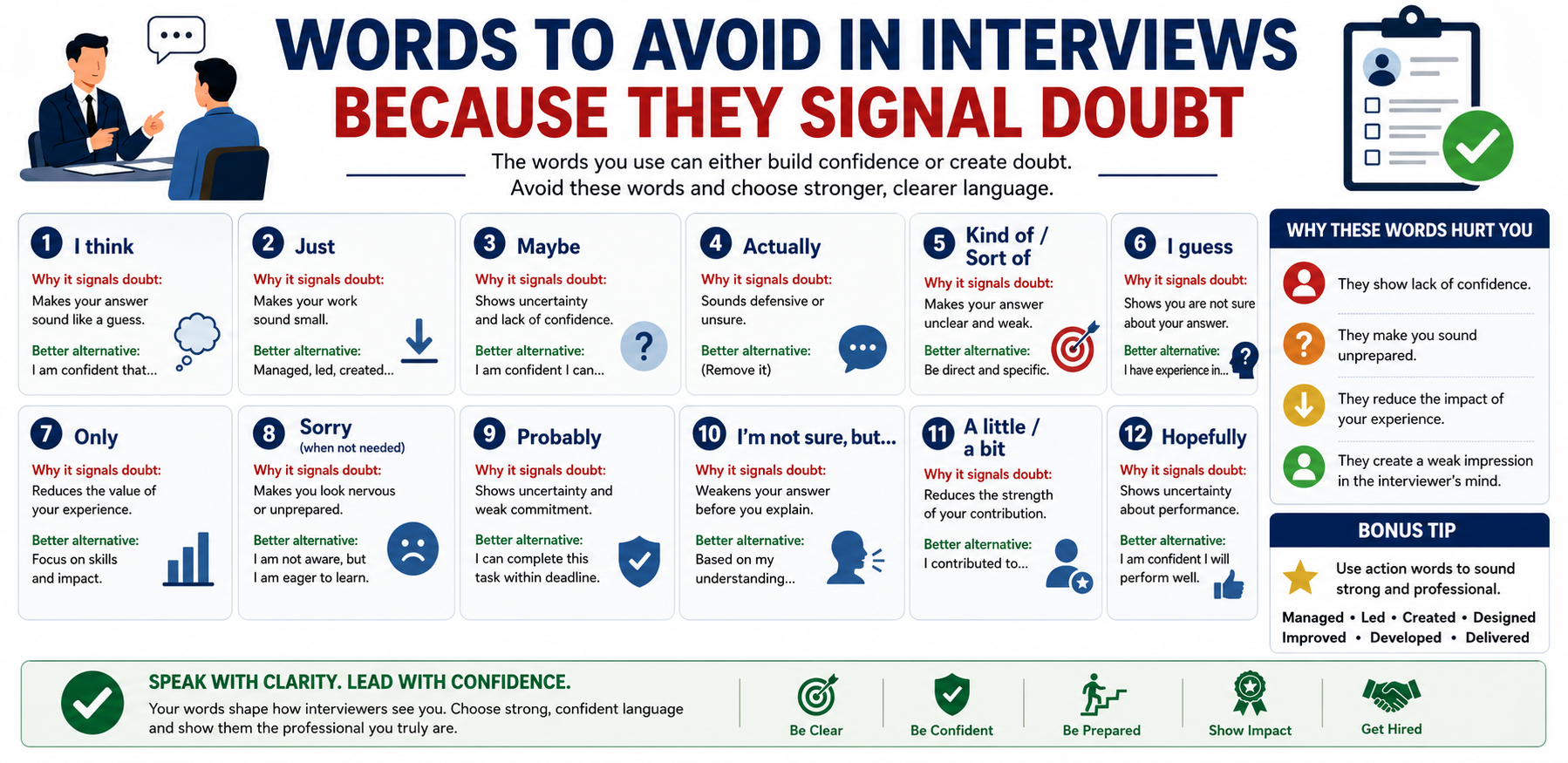
Introduction: Words to Avoid in Interviews
Job interviews are not just about what you say—they are also about how confident you sound while saying it. Even if your skills are strong, certain words can quietly reduce your impact. These words often signal uncertainty, lack of confidence, or hesitation, even when you don’t mean them that way.
In this article, we will explore the words you should avoid in interviews, why they create a negative impression, and what you can say instead. The goal is simple: help you sound clear, confident, and professional.
Why is it Important Words to Avoid in Interviews?
Interviewers are not only listening to your answers. They are also judging:
- Your confidence level
- Your clarity of thinking
- Your decision-making ability
- Your communication skills
Small words like “maybe,” “just,” or “I think” can change how your answer feels. They may make you sound unsure—even if your experience is strong.
For example:
Wrong: “I think I can manage team projects.”
Right: “I can manage team projects effectively.”
The second sentence sounds more confident and reliable.
Words to Avoid in Interviews Because They Signal Doubt
1. “I think”
Why it signals doubt:
“I think” weakens your statement. It makes your answer sound like a guess instead of a fact.
Example:
WRONG: “I think I am good at project management.”
RIGHT: “I am good at project management.”
Better alternatives:
- “I am confident that…”
- “From my experience…”
- “I have successfully…”
2. “Just”
Why it signals doubt:
“Just” makes your work sound small or less important.
Example:
WRONG: “I just handled social media pages.”
RIGHT: “I managed social media pages.”
Better alternatives:
- Remove the word completely
- Focus on action words like “managed,” “led,” “created”
3. “Maybe”
Why it signals doubt:
“Maybe” shows uncertainty and lack of confidence in your abilities.
Example:
WRONG: “Maybe I can handle this role.”
RIGHT: “I am confident I can handle this role.”
Better alternatives:
- “I believe…”
- “I am confident…”
- “I am ready to…”
4. “Actually”
Why it signals doubt:
Many candidates use “actually” when correcting themselves, but in interviews it can sound defensive or unsure.
Example:
WRONG: “Actually, I worked on two projects.”
RIGHT: “I worked on two projects.”
Better alternatives:
- Remove it completely
- Speak directly and clearly
5. “Kind of / Sort of”
Why it signals doubt:
These phrases make your answer unclear and weak.
Example:
WRONG: “I kind of managed a team.”
RIGHT: “I managed a team.”
Better alternatives:
- Be direct
- Use clear action verbs
6. “I guess”
Why it signals doubt:
“I guess” shows that you are not sure about your own answer.
Example:
WRONG: “I guess I handled customer complaints.”
RIGHT: “I handled customer complaints.”
Better alternatives:
- “I worked on…”
- “I handled…”
- “I was responsible for…”
7. “Only”
Why it signals doubt:
“Only” reduces the value of your experience.
Example:
WRONG: “I only worked for six months.”
RIGHT: “I worked for six months and gained strong experience in…”
Better alternatives:
- Focus on learning and impact
- Highlight achievements instead of duration
8. “Sorry” (when not needed)
Why it signals doubt:
Saying “sorry” too often can make you look nervous or unprepared.
Example:
WRONG: “Sorry, I don’t know that answer.”
RIGHT: “I am not aware of that, but I am eager to learn.”
Better alternatives:
- “That’s a good question. I would like to learn more about it.”
- “I have not worked on that yet, but I am open to learning.”
9. “Probably”
Why it signals doubt:
“Probably” shows uncertainty and weak commitment.
Example:
WRONG: “I probably can complete this task.”
RIGHT: “I can complete this task within the deadline.”
Better alternatives:
- Be confident about your ability
- If unsure, say what you will do to confirm
10. “I’m not sure, but…”
Why it signals doubt:
This phrase immediately weakens your answer before you even explain it.
Example:
WRONG: “I’m not sure, but I think the answer is…”
RIGHT: “Based on my understanding…”
Better alternatives:
- “From what I know…”
- “As per my experience…”
- “My understanding is…”
11. “A little / a bit”
signals doubt:
These words reduce the strength of your contribution.
Example:
WRONG: “I helped a little in the project.”
RIGHT: “I contributed to the project.
Better alternatives:
- Use stronger verbs like “led,” “managed,” “supported,” “delivered”
12. “Hopefully”
Why it signals doubt:
“Hopefully” shows uncertainty about your performance.
Example:
WRONG: “Hopefully I will do well in this role.”
RIGHT: “I am confident I will perform well in this role.”
Better alternatives:
- “I am confident…”
- “I am prepared to…”
How These Words Affect Interviewers?
When you use uncertain words repeatedly, interviewers may think:
- You lack confidence
- You are not fully prepared
- You are unsure about your abilities
- You may struggle under pressure
Even if this is not true, perception matters a lot in interviews.
How to Replace Weak Words with Strong Language?
Here are simple transformation rules:
Weak → Strong
- “I think” → “I am confident that”
- “I guess” → “I have experience in”
- “Maybe” → “I am ready to”
- “Just” → Remove it
- “Sort of” → Be specific
Final Thoughts: Words to Avoid in Interviews
Interviews are not about sounding perfect—they are about sounding clear, confident, and prepared. Small words can create a big difference in how your answers are perceived.
If you remove uncertain words like “maybe,” “I think,” and “just,” your communication instantly becomes more powerful.
Remember this simple rule:
Speak less with doubt, and more with clarity.
With practice, your language will naturally become stronger, and your confidence will shine through in every interview.
You can exp;lore more such blogs with the Best Job Tool.






Leave a Reply