Introduction
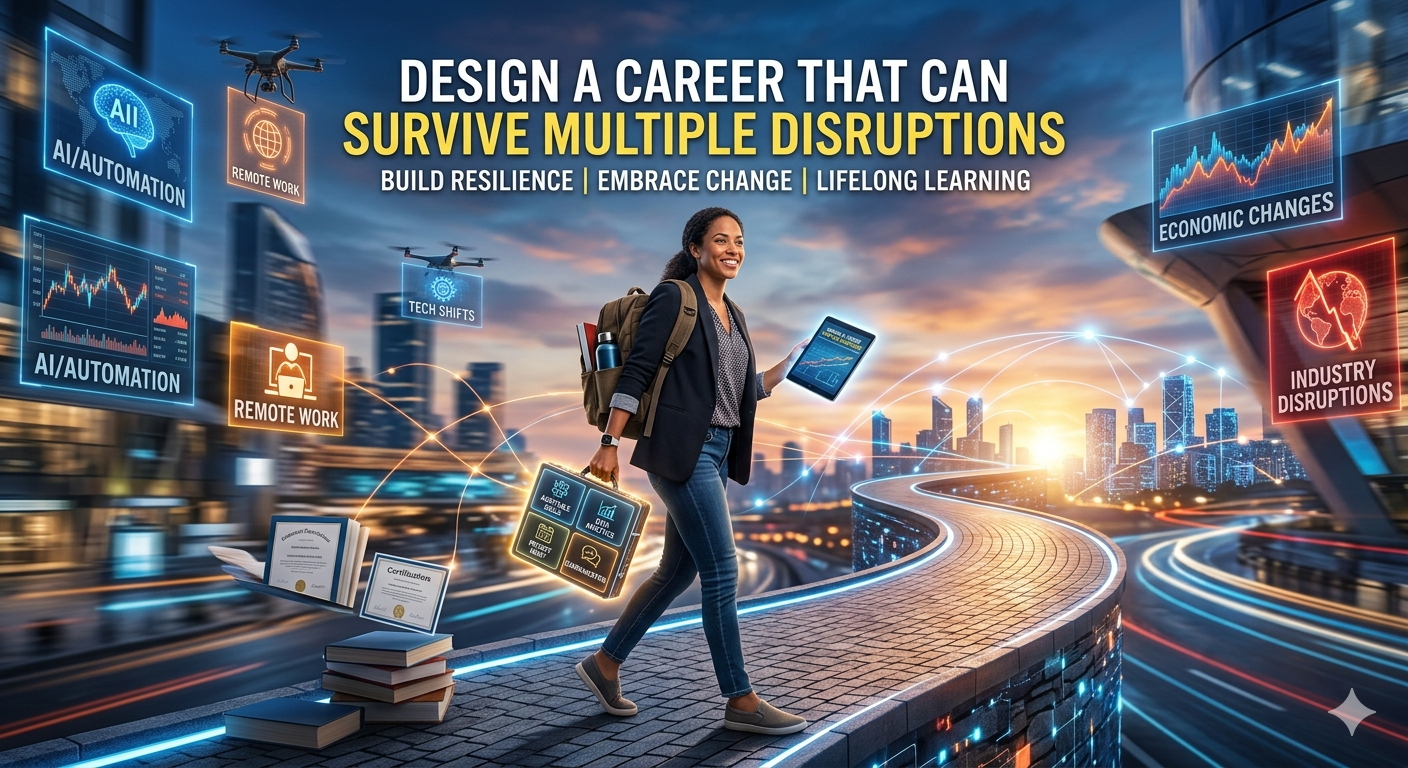
Careers today are no longer predictable. Economic shifts, technological advancements, automation, and changing industries are constantly reshaping the job market. As a result, professionals can no longer rely on stability alone. This is exactly why understanding how to design a career that can survive multiple disruptions has become essential.
A resilient career is not built around a single job or skill. Instead, it is built around adaptability, continuous learning, and strategic positioning. Professionals who prepare for change are more likely to remain relevant and successful during uncertain times.
In a rapidly evolving world, career durability has become just as important as career growth.
Understanding what career disruption really means
Career disruption refers to major changes that affect industries, jobs, or professional demand. These disruptions may come from automation, artificial intelligence, economic downturns, or shifts in consumer behavior.
In some cases, entire job categories disappear while new ones emerge. Professionals who fail to adapt often struggle during these transitions.
Additionally, disruptions can happen unexpectedly. This makes preparation critical.
Therefore, building a disruption-resistant career requires long-term thinking rather than short-term comfort.
Why traditional career paths are becoming risky
Traditional careers were often based on specialization within one organization or industry. However, this model is becoming less reliable.
Companies restructure frequently, industries evolve quickly, and skills become outdated faster than before. As a result, relying on one fixed path creates vulnerability.
Additionally, technological advancements are changing job requirements continuously. Professionals who resist change may lose relevance.
Therefore, modern careers require flexibility and adaptability.
How to design a career that can survive multiple disruptions
The first step is building adaptable skills. Focus on abilities that remain valuable across industries, such as communication, problem-solving, leadership, and strategic thinking.
Next, avoid depending entirely on one role or industry. Diversification increases resilience.
Additionally, stay informed about industry trends and emerging technologies. Awareness helps you prepare early for change.
Moreover, develop a growth mindset. Professionals who continuously learn adapt faster during disruptions.
Thus, career resilience comes from preparation and flexibility.
Building transferable and future-proof skills
Transferable skills are essential for long-term stability. These skills remain useful even when industries change.
Critical thinking, collaboration, adaptability, and emotional intelligence are examples of future-proof capabilities.
Additionally, digital literacy has become increasingly important across all professions.
Professionals should also focus on learning how to learn. This ability improves long-term adaptability.
Therefore, strong foundational skills create career durability.
Diversifying experience and income sources
Relying on a single source of income can create risk. Professionals should explore ways to diversify their experience and opportunities.
This may include freelancing, consulting, side projects, or cross-functional work.
Additionally, working across different industries increases exposure and adaptability.
Moreover, multiple income streams provide financial stability during uncertain periods.
Thus, diversification strengthens career resilience.
Staying relevant through continuous learning
Continuous learning is no longer optional. Industries evolve too quickly for static skill sets.
Professionals should regularly update their knowledge through courses, certifications, workshops, and practical experience.
Additionally, learning should focus on both technical and strategic skills.
Moreover, staying curious and open to change improves long-term growth.
Therefore, lifelong learning supports career survival.
The importance of adaptability and mindset
Mindset plays a major role in navigating disruptions. Professionals who fear change often struggle to adjust.
Adaptability allows individuals to respond quickly to new situations. Instead of resisting change, they learn from it.
Additionally, resilience helps professionals recover from setbacks and maintain momentum.
Moreover, confidence grows when individuals know they can adapt.
Thus, mindset is a key component of career stability.
Building strong professional networks
Networks become extremely valuable during disruptions. Opportunities often come through relationships and referrals.
Professionals should actively maintain industry connections and engage with communities.
Additionally, networking provides access to insights and emerging trends.
Moreover, strong relationships create support during career transitions.
Therefore, networking strengthens both opportunity and resilience.
Using technology strategically in your career
Technology is one of the biggest drivers of disruption. However, it can also become a competitive advantage.
Professionals should understand how technology affects their industry and role.
Additionally, learning digital tools improves efficiency and relevance.
Moreover, embracing technology early creates opportunities instead of threats.
Thus, technology should be seen as a tool for growth rather than fear.
Preparing financially for career disruptions
Financial preparation is an important part of career resilience. Unexpected disruptions can create temporary instability.
Building savings and managing expenses wisely provides security during transitions.
Additionally, multiple income streams reduce financial pressure.
Moreover, financial flexibility allows professionals to make strategic career decisions instead of reactive ones.
Therefore, financial planning supports long-term stability.
Conclusion
Understanding how to design a career that can survive multiple disruptions is essential in today’s unpredictable professional environment. Stability no longer comes from one role or company. It comes from adaptability, continuous learning, and strategic planning.
Professionals who build transferable skills, diversify their experience, and stay prepared for change are more likely to succeed during uncertain times.
In a world shaped by rapid transformation, resilience is the most valuable career advantage. To explore future-ready opportunities that align with your skills and goals, use the best job tool and stay ahead in an evolving job market.
Find Your Dream Job Today – Explore Endless Career Opportunities and Secure Your Next Role with Best Job Tool.
Leave a Reply