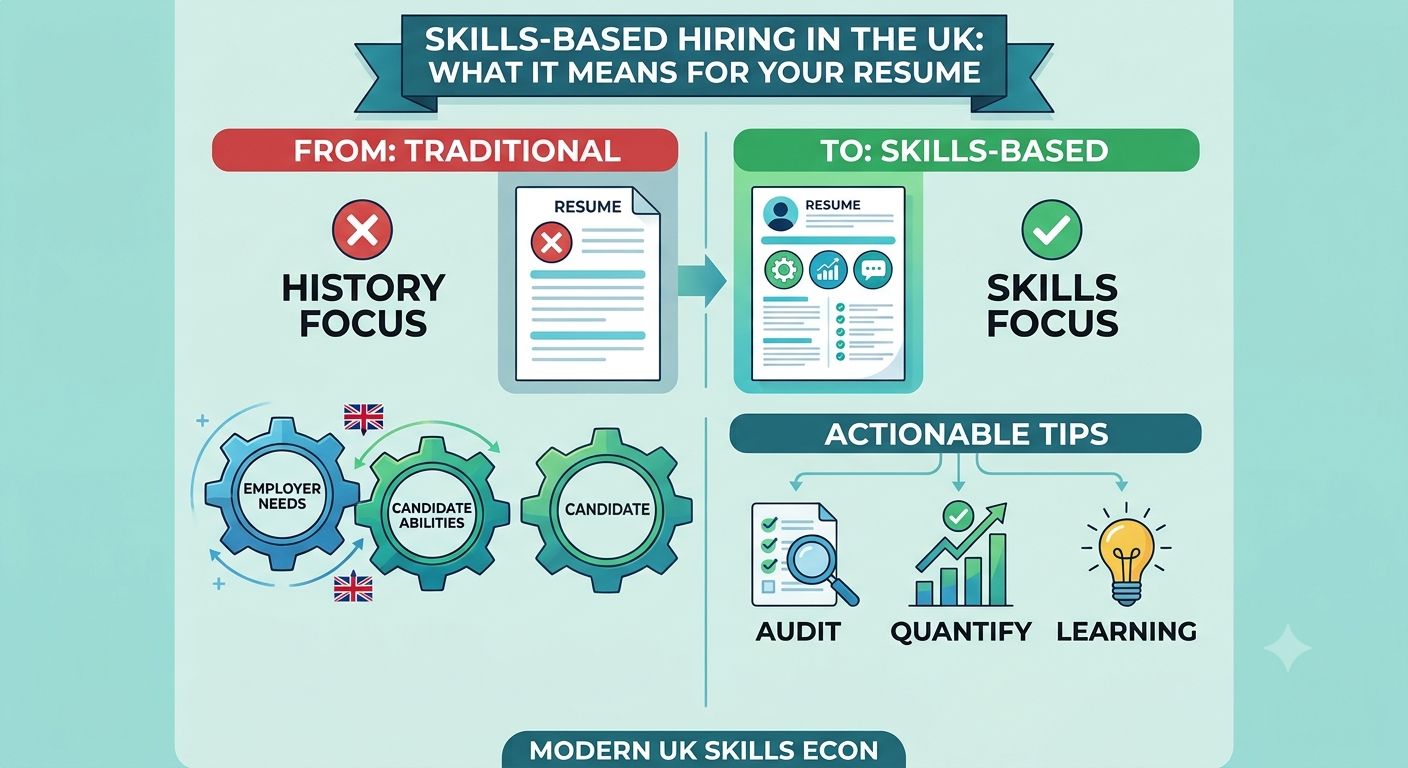
Introduction: Skills-Based Hiring in the UK
The recruitment market is changing – employers are starting to value skills over traditional qualifications. UK employers are embracing skills-based hiring practices to attract candidates on the basis of abilities, experience and related skills.
Skills-based hiring helps freshers, career changers, and skilled workers showcase the skills they have acquired during their work, courses or self-learning to increase their chances of being hired.
Skills-Based Hiring in the UK: What It Means for Your Resume?
1. What Is Skills-Based Hiring?
Skills based hiring looks at candidates’ skills and talents. For digital marketing roles, employers assess whether candidates have the required skills.
A skills-based hiring approach helps employers reach more candidates and discover new talent. Moreover, such approaches encourage non-traditional ways of obtaining knowledge and can be motivating for first-time out-of-work candidates.
Skills-based hiring also had a particular impact on certain industries, such as technology, healthcare, finance, retail, and marketing. Some jobs require specific skills proven through degrees, licenses, or professional qualifications.
2. Why Are UK Employers Turning to Skills-Based Hiring?
Employers today require people who are able to work in changing and unpredictable conditions, using the latest technologies and methods. Traditional measures fail to confirm that a candidate has the knowledge and abilities to perform a specific job.
Skills-based recruitment helps employers find candidates with the skills required for a specific job. Moreover, skills-based hiring can be motivating for those who learned the required professional competencies in unusual circumstances.
A more broad-based approach to recruitment also helps to acquire talents from a more extended pool of candidates. Skills-based hiring is growing in the UK across technology, healthcare, and marketing, though some professions still require specific qualifications.
3. How Does Skills-Based Hiring Affect Your Resume?
Job seekers should tailor their CVs to each vacancy, highlighting relevant skills, achievements, and experience. Candidates should highlight relevant skills and measurable achievements in their CVs to match employers’ needs. A resume writer should ensure that their professional experience and qualifications match the requirements of the job vacancy.
4. Highlight Relevant Skills at the Top of Your Resume
While scanning resumes, recruiters rarely go through the content of a CV in detail. Instead, they pay special attention to the top of a resume, specifically the professional summary and the skills section. Therefore, it is essential to create a convincing and relevant professional summary and the skills section.
The key skills from the job description should be included in the skills section of your resume. It is better to avoid writing a long list of skills, and instead, choose the relevant and required ones. The skills section can include the following subcategories:
- Technical skills (SEO, data analysis, programming, Microsoft Excel, graphic design);
- Communication skills (writing, presenting, negotiating);
- Problem-solving skills (research, analysis);
- Digital skills (knowledge of CMS, project managers, marketing automation tools);
- Organizational skills (planning, time management, teamwork).
Make sure your CV skills match the job requirements and are backed by evidence from your work experience, education, or portfolio.
5. Use Keywords From the Job Description
Many employers use application tracking systems (ATS) to sort through the applicants’ resumes. These ATSs have specific algorithms to pick keywords related to the required qualifications, expertise, and experience for the given job vacancy.
It is recommended to scan the job description and include the keywords related to the required skills, expertise, and experience in your CV, specifically in your professional summary and the skills section.
For instance, if the content writer vacancy specifies such keywords as SEO, keyword research, editing, and content strategy, make sure that you include these words in relevant sections of your resume. Skills-based hiring requires adjusting the resume to the specific needs of the job vacancy. However, it is important not to overstuff your resume with keywords and to avoid indicating skills that you do not possess. This is because many employers will conduct interviews to assess if you truly have the professional capabilities as specified in your resume.
6. Demonstrate Your Skills With Achievements and Projects
While indicating your skills on your resume is essential, the achievements and projects section is even more important. By looking through this section, an employer can assess whether the claims about your professional skills and abilities are true. If you are a career person, you can include the projects you completed in the relevant industries or the extra skills you obtained through your work. If you are a fresher or a career changer, make sure that you include the academic projects, internships, volunteering, freelance projects, and other relevant work experiences.
For instance, if you are a content writing fresher, you can include samples of articles you have written, blog posts, SEO projects, etc., in your portfolio. Such evidence is required for skills-based hiring in the UK, as it replaces the traditional qualifications, meaning that employers need to ensure that job candidates truly possess the abilities they claim to have on their resumes.
7. Include Certifications and Relevant Training
Although skills-based hiring focuses primarily on the professional skills a candidate has, certifications and training courses can also be of great importance. It is a good idea to take relevant online courses to increase your skills in the necessary domains. For instance, content writers can take online courses in SEO, while data analysts can take online courses in Excel.
When updating your resume for skills-based hiring in the UK, make sure to include the relevant qualifications with the names of the training institutions and the dates when the courses were completed. It is essential to update your resume with evidence of relevant training and certifications, as employers look for individuals with the required skills set. However, instead of focusing on the quantity, make sure that the training you indicate on your resume is relevant to the job vacancy for which you are applying.
8. Prepare for Skills Assessments and Interviews
Although a resume is a crucial step in the job application process, some employers might want to see firsthand if an applicant has the professional skills as specified on their resume. Depending on the requirements of a particular job vacancy, employers might give writing assignments, logical tasks, data analysis tasks, presentations, and other assessments to estimate the professional knowledge and skills of the applicants.
It is recommended to look over the job requirements and practice the skills assessments relevant to the position. Moreover, it is a good idea to prepare stories demonstrating how you used these professional skills in previous work experiences.
Understanding skills-based hiring is essential for preparing for an interview. An interview is where the applicant can demonstrate their professional knowledge and skills set in detail.
Conclusion: Skills-Based Hiring in the UK
The emphasis on skills-based recruitment offers job seekers with new opportunities to present themselves as the best fit for a given post. Skills-Based Hiring in the UK encourages applicants to focus on the relevant proficiencies, accomplishments, certifications, and experience.
To optimise your resume during the job search, it is essential to research the target positions, prioritising skills, highlighting achievements, and providing a portfolio or examples of the work. It is also necessary to ensure that the information provided matches the requirements and to customise the documents for each vacancy. With the critical information prioritised, it becomes easier to optimise the document for each application and increase the likelihood of getting shortlisted.
Ready to find your next opportunity? Use the Best Job Tool to explore suitable vacancies, highlight your skills, and connect with employers across the UK. Start your job search today!

Leave a Reply