Introduction
In today’s competitive job market, employers value adaptability almost as much as experience. Industries change quickly, technology evolves constantly, and remote work environments Career Stories require professionals who can learn independently without continuous supervision. Because of this, companies increasingly look for candidates who can demonstrate fast learning, problem-solving ability, and adaptability through real career examples.
However, many professionals struggle to explain these qualities effectively during interviews, networking conversations, LinkedIn discussions, or resume writing. They often say things like:
- “I’m a fast learner.”
- “I adapt quickly.”
- “I can handle challenges.”
The problem is that these statements are too generic. Recruiters hear them from almost every applicant. What actually creates impact are career stories that prove you learn fast through measurable actions, decisions, and outcomes.
Strong career storytelling helps professionals demonstrate growth, adaptability, and productivity in a practical way. Instead of simply claiming to be a quick learner, you show employers how you handled unfamiliar situations, learned new skills rapidly, and delivered results under pressure.
For remote professionals, freelancers, and candidates applying to global opportunities, storytelling has become one of the most valuable communication skills in modern hiring.
Why Fast Learning Matters More Than Ever
The workplace has changed significantly over the past few years. Companies no longer hire only for existing knowledge. They hire for adaptability.
Modern businesses want professionals who can:
- Learn new tools quickly
- Adjust to changing workflows
- Handle remote collaboration
- Solve unexpected problems
- Work independently
- Manage productivity without constant supervision
This is especially important in remote work environments where employees often need to figure things out independently across different time zones and communication systems.
A candidate who learns quickly can usually:
- Contribute faster
- Reduce training time
- Adapt to industry changes
- Handle evolving responsibilities
- Improve operational efficiency
Because of this, employers often evaluate learning ability through behavioral interview questions and professional storytelling.
Why Most Professionals Tell Weak Career Stories
Many candidates focus too much on responsibilities instead of growth.
For example:
- “I managed client communication.”
- “I worked on marketing campaigns.”
- “I handled administrative tasks.”
These statements explain activities but not adaptability or learning speed.
Weak storytelling usually lacks:
- Context
- Challenges
- Skill development
- Measurable outcomes
- Decision-making examples
Employers want to understand:
- What challenge existed
- What you learned
- How quickly you adapted
- What result you achieved
Career stories become powerful when they show transformation instead of simple task completion.
The Best Structure for Career Stories
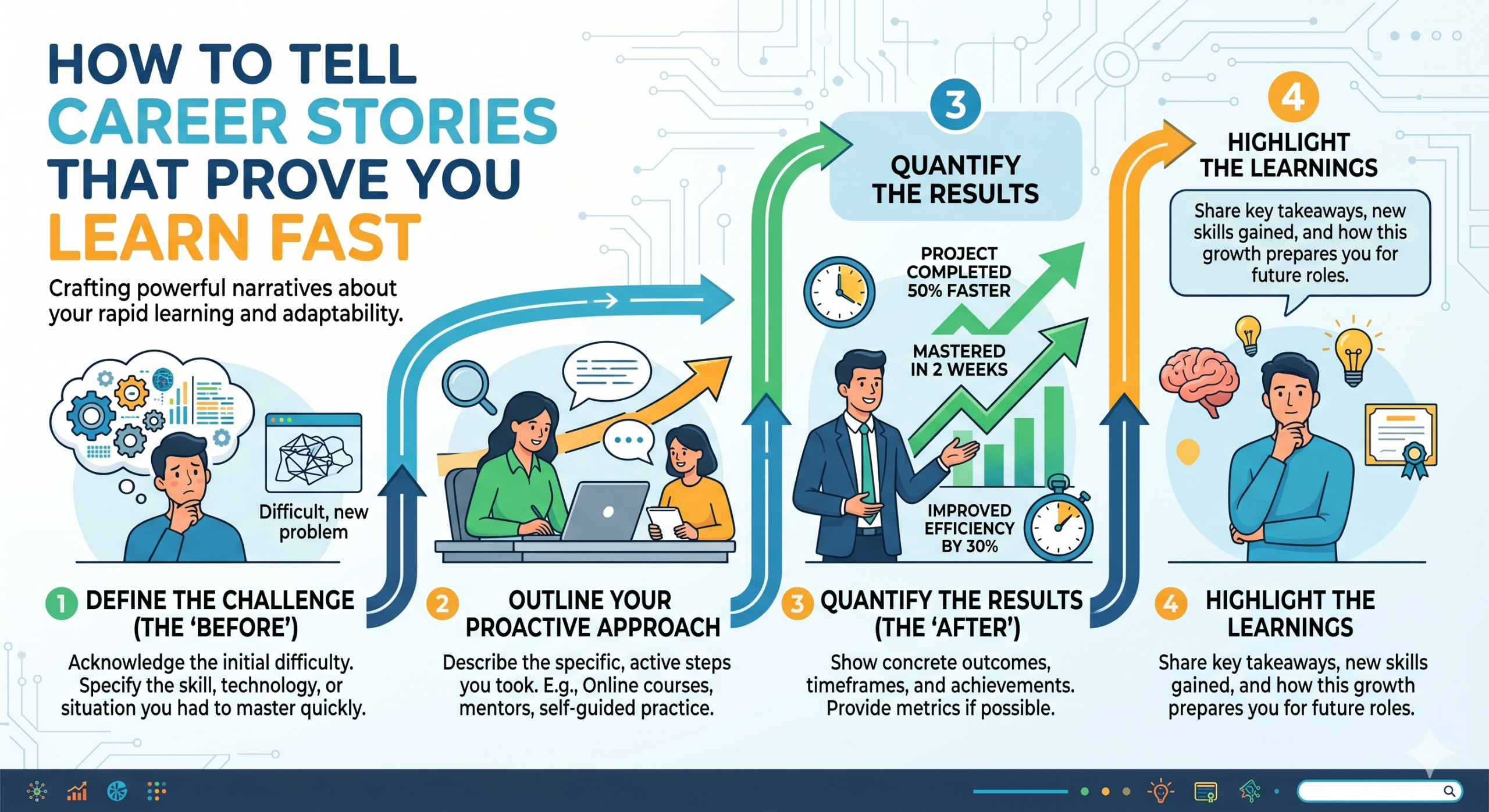
The most effective career stories follow a simple framework:
Situation → Challenge → Action → Result → Learning
This structure creates clarity and makes your examples easier to remember.
Example of Weak Storytelling
“I learned project management software quickly.”
This statement is forgettable.
Improved Career Story
“When our company switched to a new project management platform, most workflows became delayed during the transition period. I spent one weekend learning the system independently through tutorials and testing processes. Within two weeks, I helped organize team workflows more efficiently and reduced task tracking delays by 30%.”
This version proves:
- Initiative
- Adaptability
- Independent learning
- Productivity improvement
- Measurable impact
The goal is to make employers visualize your problem-solving ability through real experiences.
Focus on Learning Under Pressure
The strongest career stories usually involve situations where professionals had to adapt quickly.
Examples include:
- Learning software rapidly
- Handling unexpected projects
- Managing remote collaboration
- Solving workflow problems
- Entering new industries
- Working with limited guidance
Employers trust stories more when they involve pressure or uncertainty because they demonstrate real adaptability.
Strong Examples of Fast-Learning Situations
- Switching industries successfully
- Managing international clients for the first time
- Learning remote collaboration tools quickly
- Handling leadership responsibilities unexpectedly
- Adapting to remote work environments
- Solving technical issues independently
Stories involving growth under pressure create stronger credibility.
Use Metrics Whenever Possible
Numbers make career stories more believable and professional.
Instead of saying:
- “I improved productivity.”
Say:
- “I reduced reporting time by 40% after learning automation workflows independently.”
Metrics create measurable evidence.
Useful Metrics Include
- Time saved
- Revenue growth
- Productivity improvements
- Engagement increases
- Cost reductions
- Error reduction
- Faster delivery times
- Customer satisfaction improvements
Even small numbers strengthen storytelling quality significantly.
For remote professionals, measurable outcomes are especially important because companies often evaluate performance through productivity and efficiency metrics.
How Remote Work Changed Career Storytelling
Remote work has transformed how professionals communicate value. Employers now prioritize:
- Self-management
- Independent learning
- Digital communication
- Productivity systems
- Adaptability
Because of this, career stories should include examples of:
- Learning tools independently
- Managing remote workflows
- Communicating across time zones
- Handling virtual collaboration
- Maintaining productivity remotely
Example
“After transitioning to remote work, I learned asynchronous communication systems and project tracking tools within one week. This helped our team reduce missed deadlines and improve collaboration across three international time zones.”
This type of story demonstrates:
- Learning speed
- Remote adaptability
- Communication skills
- Operational value
Modern hiring managers increasingly value these qualities in distributed work environments.
Avoid Common Career Storytelling Mistakes
Many professionals weaken their stories unintentionally.
Speaking Too Generally
Avoid vague phrases like:
- “I work hard.”
- “I’m motivated.”
- “I’m a team player.”
Use evidence instead.
Making Stories Too Long
Keep examples structured and concise.
Focusing Only on Tasks
Talk about challenges, learning, and outcomes.
Ignoring the Result
Every story should end with a measurable or meaningful outcome.
Memorizing Robotic Answers
Stories should sound natural and conversational.
Strong storytelling feels authentic, confident, and clear.
How to Build Better Career Stories Over Time
Career storytelling improves through preparation and documentation.
Practical Ways to Build Strong Stories
Keep a Career Wins Document
Track:
- Challenges solved
- Skills learned
- Productivity improvements
- Client feedback
- Project outcomes
Save Metrics Regularly
Small improvements become powerful interview examples later.
Practice Explaining Experiences Clearly
Good communication improves confidence.
Focus on Transformation
The best stories show how you grew through experience.
Professionals who document achievements consistently usually perform better during interviews and networking opportunities.
Using Career Stories on LinkedIn and Resumes
Career storytelling is not limited to interviews. It also improves:
- LinkedIn profiles
- Resumes
- Cover letters
- Freelance proposals
- Networking conversations
For example, instead of writing:
- “Managed social media accounts.”
Write:
- “Learned analytics tools independently and improved LinkedIn engagement by 45% through audience-focused content strategies.”
This creates stronger positioning immediately.
Modern recruiters often scan profiles quickly, so concise achievement-focused storytelling becomes a competitive advantage.
Why Learning Ability Creates Long-Term Career Security
Technical skills change constantly, but learning ability remains valuable across industries.
Professionals who adapt quickly usually:
- Handle career transitions better
- Stay competitive longer
- Learn emerging technologies faster
- Adjust to remote work more effectively
- Recover from industry changes more easily
Companies increasingly hire based on potential, adaptability, and growth mindset instead of only static experience.
This is why career stories that prove you learn fast have become essential in modern hiring markets.
Conclusion
In today’s rapidly changing professional world, the ability to learn quickly has become one of the most valuable career advantages. Employers want professionals who can adapt to new systems, handle challenges independently, and continue growing in remote and fast-moving work environments.
However, simply saying you are a fast learner is no longer enough. Strong career storytelling helps transform generic claims into measurable proof through real experiences, challenges, and results.
The most effective career stories focus on:
- Adaptability
- Problem-solving
- Independent learning
- Measurable outcomes
- Growth under pressure
Whether used in interviews, resumes, LinkedIn profiles, or networking conversations, these stories help professionals communicate value more clearly and confidently.
Professionals looking to improve productivity, career positioning, and remote job readiness can also explore platforms like “Best Job Tool” to discover smarter strategies for long-term career growth and professional development.

Leave a Reply