Introduction
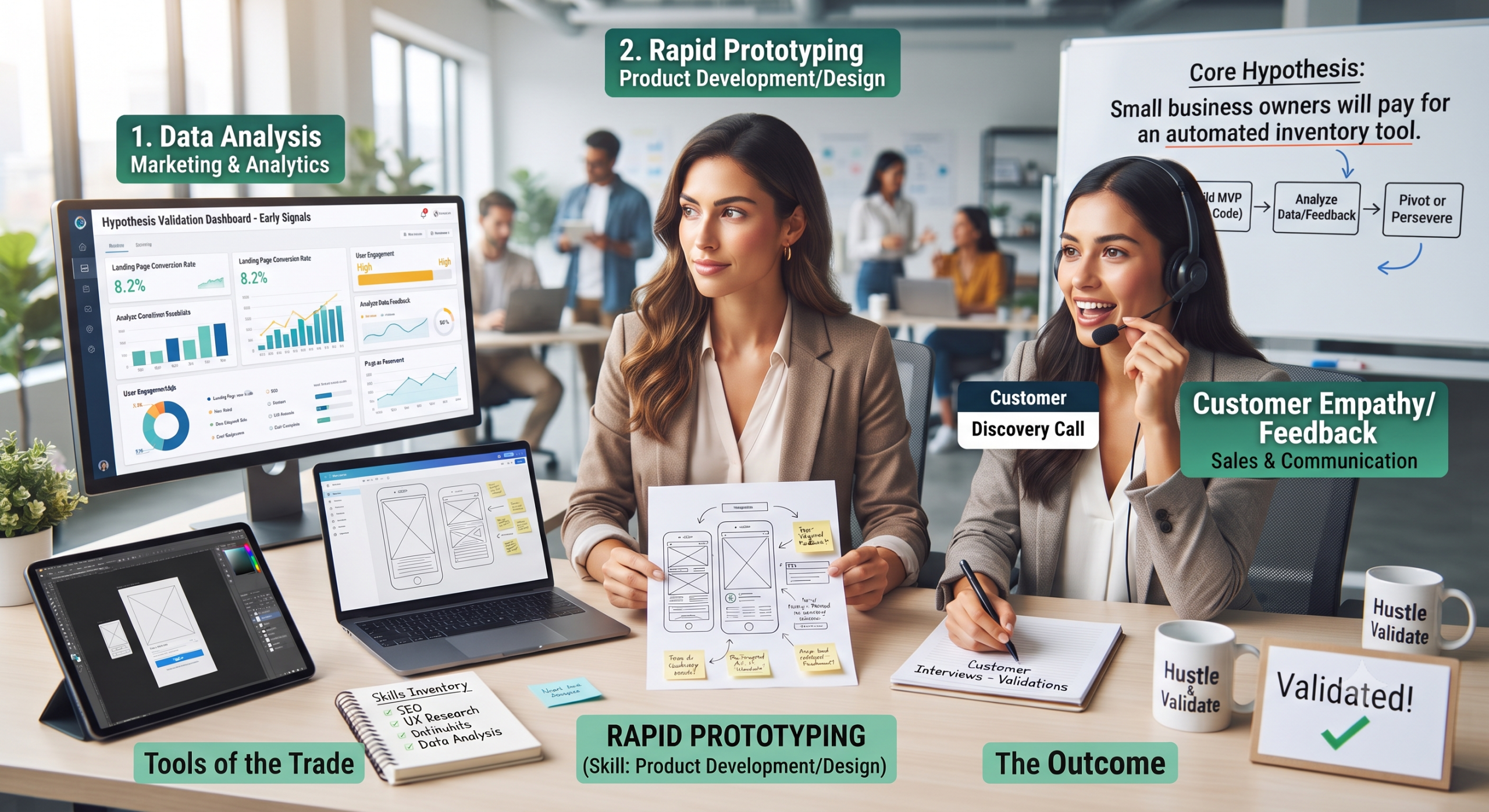
Many successful businesses begin with a simple hypothesis: a belief Validate that a specific product or service can solve a real customer problem. However, one of the biggest mistakes aspiring entrepreneurs make is investing months—or even years—building a business before validating whether customers actually want it.
If you’re currently employed, you already possess valuable skills that can significantly speed up this validation process. Whether your expertise is in marketing, sales, software development, finance, customer service, operations, or project management, your professional experience can help you test business ideas efficiently while minimizing financial risk.
Instead of viewing your job and entrepreneurial ambitions as separate paths, use your workplace knowledge to evaluate demand, gather customer insights, and refine your business concept. This guide explains how to leverage your existing skills to validate a business hypothesis quickly while balancing remote work, travel testing, productivity, and financial planning.
Understand What a Business Hypothesis Is
A business hypothesis is an assumption that needs to be tested before significant investment.
Examples include:
- Customers are willing to pay for my solution.
- My target audience experiences this problem regularly.
- A subscription model is more attractive than one-time purchases.
- Small businesses prefer automated solutions over manual services.
- Remote professionals need a specific productivity tool.
Every assumption should be supported by real customer evidence rather than personal opinions.
Your objective is to collect data that confirms—or disproves—your hypothesis as quickly as possible.
Identify Job Skills That Support Business Validation
Your current role likely provides skills that are directly applicable to entrepreneurship.
Examples include:
Marketing Professionals
Can validate ideas through:
- Customer surveys
- Landing pages
- Digital advertising
- Market research
- SEO analysis
Sales Professionals
Can validate by:
- Speaking with prospects
- Understanding objections
- Testing pricing strategies
- Measuring buying intent
Customer Support Teams
Can identify:
- Common customer frustrations
- Frequently requested features
- Service gaps
- Product improvement opportunities
Finance Professionals
Can assess:
- Profit margins
- Pricing models
- Revenue forecasts
- Business sustainability
Software Developers
Can build:
- Minimum Viable Products (MVPs)
- Prototypes
- Automation tools
- Beta versions
Recognizing these transferable skills allows you to validate ideas faster than starting from scratch.
Talk to Potential Customers Before Building
The fastest way to validate a business idea is through direct customer conversations.
Ask questions such as:
- What challenges do you face?
- How are you solving this problem today?
- What frustrates you about current solutions?
- Would you pay for a better alternative?
- What features matter most?
Avoid asking whether people “like” your idea.
Instead, focus on understanding their existing behavior and willingness to invest in a solution.
Customer interviews often reveal opportunities that market research alone cannot identify.
Build a Simple Minimum Viable Product (MVP)
An MVP is designed to test demand—not impress customers.
Examples include:
- A landing page
- A consulting service
- A digital guide
- A prototype
- A basic mobile app
- A subscription waiting list
The objective is to gather real customer feedback as early as possible.
Avoid spending months developing features before confirming market demand.
Use Remote Work to Expand Customer Validation
Remote work provides access to broader customer markets and more flexible testing opportunities.
You can validate your hypothesis through:
- Online surveys
- Video interviews
- Virtual product demonstrations
- Remote consulting sessions
- Digital communities
- Social media groups
If your business idea is location-independent, perform travel testing by temporarily managing customer interactions from different locations during personal travel. This helps confirm that your processes, communication systems, and customer support remain effective regardless of where you work.
Businesses that operate successfully across multiple environments are generally more scalable.
Apply Productivity Principles to Test Faster
Validating ideas quickly requires disciplined execution.
Instead of trying to perfect every detail, focus on consistent experimentation.
Weekly Validation Plan
Monday
- Customer interviews
Tuesday
- Competitor analysis
Wednesday
- MVP improvements
Thursday
- Marketing experiments
Friday
- Review customer feedback
Weekend
- Analyze results
- Plan next iteration
Productivity Tips
- Prioritize learning over perfection.
- Test one assumption at a time.
- Automate repetitive tasks.
- Track measurable outcomes.
- Set weekly validation goals.
- Document customer insights.
Fast learning creates better businesses than lengthy planning.
Measure Business Validation with Real Metrics
Avoid relying on opinions alone.
Track measurable indicators such as:
- Website traffic
- Email sign-ups
- Conversion rates
- Customer interviews completed
- Product pre-orders
- Repeat customers
- Revenue generated
- Customer acquisition cost
These metrics provide objective evidence about market demand.
Successful entrepreneurs make decisions based on data rather than assumptions.
Prepare Financially Before Scaling
Validation should occur before making major financial commitments.
Develop a simple financial plan covering:
- Startup costs
- Monthly operating expenses
- Marketing budget
- Emergency savings
- Revenue targets
Maintain your full-time income while testing your idea whenever possible.
This approach reduces pressure and allows you to make strategic decisions instead of rushing toward profitability.
If your business begins growing, best job tool, a global job platform, can help you recruit remote professionals and freelancers with specialized skills, allowing you to scale efficiently without large upfront hiring costs.
Know When Your Hypothesis Is Validated
A business hypothesis is considered validated when evidence consistently supports your assumptions.
Positive indicators include:
- Customers willingly pay.
- Demand continues to increase.
- Repeat purchases occur.
- Customer referrals grow.
- Marketing campaigns generate consistent results.
- Revenue becomes predictable.
- Feedback confirms strong product-market fit.
Once these indicators appear consistently, you can begin planning long-term growth with greater confidence.
As your business expands, best job tool can also help you connect with experienced global talent to strengthen your team and accelerate growth.
Conclusion
Validating a business hypothesis quickly is one of the smartest ways to reduce entrepreneurial risk. Instead of relying on assumptions, use the professional skills you’ve developed in your current job to conduct customer research, build simple MVPs, analyze market feedback, and measure real demand. Marketing, sales, finance, customer service, and technical expertise all provide valuable advantages during the validation process.
By combining remote work opportunities, travel testing, productivity strategies, and sound financial planning, you can test business ideas efficiently while maintaining career stability. Once your hypothesis is supported by consistent customer demand and measurable results, you’ll be in a much stronger position to grow your venture confidently. As your business evolves, best job tool, a global job platform, can help you connect with skilled professionals and remote talent to support sustainable expansion.


Leave a Reply