Introduction: Bootcamp, a Degree, and Self-Learning
When it comes to learning a new skill, or advancing one’s career, one of the first questions one might face is that whether to attend a bootcamp, get a degree, or teach oneself. All three have their advantages, yet there are situations where one of these options may be more suitable than the other. It depends on the goal, budget, time, and even learning style.
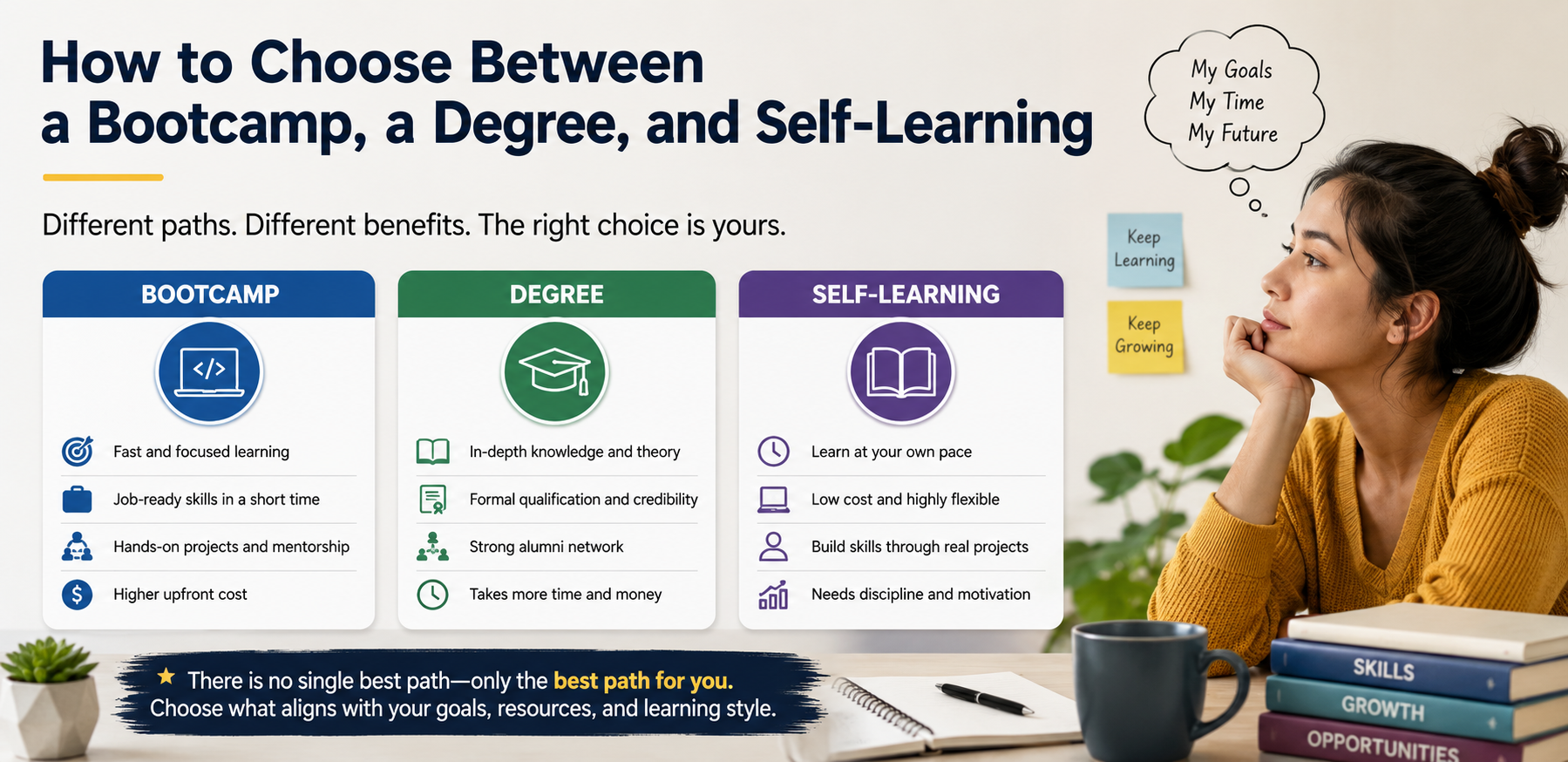
How to choose between a bootcamp, a degree, and self-learning is easier than one might think when considering their benefits.
How to Choose Between a Bootcamp, a Degree, and Self-Learning?
1) Start With Your Goal
Before choosing your options, think about your goals. Do you want to get your first job? Do you want to change your career path? Are you seeking a promotion? Do you want to learn how to do something simply because you want to do it? All of these are valid reasons for getting an education, but they have different implications for your learning path.
For instance, if you need to learn how to become a developer fast, going to a bootcamp is a great idea. If you need to change your field and work in an area that requires higher education, you might need a degree.
On the other hand, if you are not trying to pursue a specific field but rather only want to learn something (e. g., excel, graphic design, writing, or even coding), self-learning might be sufficient. In any case, you should always start with your goals in mind. Do not decide what to do based on what others are doing.
2) When is a Degree Justified?
A degree is typically the longest and most costly alternative. It usually takes two, three, or four years to finish depending on what you learn and your location.
The main advantage of a degree is that it allows you to get formal qualifications. Some employers require a degree before they consider your application. In addition, a degree gives you access to professors, projects, extracurriculars, internships, and connections.
A degree can be a great option if you are just entering the job market and have the time to study. Another scenario when a degree is a good is when one has to pursue a career field such as medicine, law, teaching, or engineering which requires formal education.
On the other hand, a, degree might not always be the best option. For instance, if one has to learn a specific skill, a shorter and faster alternative can be much better.
3) When a Bootcamp Is Better
A bootcamp is generally a shorter and more practice-oriented alternative to a traditional degree program.
They are most popular in fields such as computer coding, data analysis, digital marketing, design, and other spheres of information technology.
One of the most important advantages of a bootcamp is structure. You get a strict curriculum, hours of study, various tasks, and sometimes even teaching and mentoring assistance. This can be a tremendous help to those of you who would struggle with self-learning.
However, bootcamps are also notoriously expensive, and the quality of education varies significantly from one institution to another. Some bootcamps prey on the desperate need of millions of people around the world to gain new skills and promise fantastic opportunities, career growth, and high salaries. Therefore, it is crucial to do your research before making such an expensive decision.
Look into course materials, instructors, reviews, projects, and most importantly, job prospects after graduation. A bootcamp that makes unrealistic promises about your future salary and job opportunities is most likely not as good as you were led to believe.
4) When Self-Learning Is the Right Choice
Self-learning is undoubtedly the most affordable and convenient method.
It may be undertaken by engaging in video tutorials, learning via books, websites, online courses, projects, and many other ways and means. One can pursue self-learning at his or her own time. This method suits the most those who are capable of seeking knowledge on their own.
For instance, one can gain substantial knowledge in writing, Excel, social media marketing, coding, and other areas without investing a fortune in college education. The major limitation of self-learning is lack of structure; thus, it may result in frustration due to absence of a learning path.
Moreover, it may be challenging to stay motivated because of no tangible outcomes. Therefore, it is essential to set clear objectives and engage in regular practice.
5) Think About Your Budget
Money is another crucial point. A degree can be expensive since you have to pay for the education, books, travel, and accommodation. A bootcamp can also be costly. However, self-learning is typically the cheapest option since it requires no spending at all.
Thus, if you have a limited budget, it should not stop you from becoming a developer. First, you can start learning for free and invest in a course later if you feel like you need more information than the free ones provide.
6) Think About Your Learning Style
Another thing to think about is your learning style. If you need someone to keep you accountable and teach you, then a bootcamp or degree is more suitable for you.
If you enjoy independent studying and finding your own resources, then self-learning may be the way to go. You can even combine your learning styles!
Such as learning from free videos and books, then going to a short class to practice what you’ve learned. There are no rules when it comes to your learning style.
Conclusion: Bootcamp, a Degree, and Self-Learning
Choosing between a bootcamp, a degree, and self-learning depends on your career goals, budget, available time, and preferred learning style. A degree can be useful when you need formal qualifications and a strong academic foundation.
A bootcamp may be a better choice when you want focused, practical training and hope to enter a field more quickly. Self-learning offers the most flexibility and can be ideal for people who are comfortable creating their own learning path.




Leave a Reply